

What if the standard often dismissed as a “bureaucratic nightmare” is actually the key to scaling your software delivery without the usual chaos? Most engineering leaders believe that iso 9001 for software development companies is a manufacturing relic that forces Agile teams into a rigid waterfall structure. You likely feel the mounting pressure from enterprise clients who demand certification, yet you fear that excessive documentation will stifle your innovation and slow down your release cycles.
It’s a valid concern, but the reality is that a modern Quality Management System (QMS) acts as a catalyst for reliability rather than a roadblock. This guide reveals how to implement ISO 9001 in a software environment to drive quality, satisfy stakeholders, and maintain your competitive speed. We’ll preview the upcoming ISO 9001:2026 transition, explain how to leverage ISO 90003 guidelines for better code, and provide a roadmap for a lean QMS that wins high-value contracts.
Key Takeaways
- Learn why ISO 9001 is shifting from an optional credential to a mandatory requirement for securing high-value enterprise and government SaaS contracts in 2026.
- Understand the relationship between the core ISO 9001 standard and the ISO 90003 guidelines to build a quality framework tailored specifically to the software development life cycle.
- Discover how to successfully integrate iso 9001 for software development companies into Agile and DevOps workflows by mapping requirements to tools like Jira, Confluence, and GitHub.
- Follow a structured five-stage roadmap that begins with a professional gap analysis to identify where your current processes already meet international standards.
- Identify how a lean Quality Management System reduces technical debt and improves software reliability, allowing your team to scale without sacrificing delivery speed.
Why ISO 9001 is Critical for Software Development in 2026
The global market for digital solutions has reached a saturation point where technical skill alone is no longer a sufficient differentiator. In 2026, iso 9001 for software development companies has transitioned from an optional credential to a mandatory entry requirement for high-value contracts. Enterprise SaaS buyers and government procurement officers now prioritize vendors who can prove their operational resilience through a validated Quality Management System (QMS). Without this certification, your dev shop risks being excluded from the most lucrative tenders before the first technical demo even begins.
Beyond market access, the standard provides a methodical framework for Understanding Software Quality in a complex ecosystem. Modern development relies heavily on interconnected services, third-party APIs, and open-source components. ISO 9001 forces a disciplined approach to managing these external risks, ensuring that your final product isn’t compromised by a vulnerability in a hidden dependency. It builds a foundation for scalability, allowing you to onboard new engineers and expand your tech stack without losing control over your output quality.
The 2026 Quality Landscape: AI and Software Integrity
The integration of Artificial Intelligence into the coding process has fundamentally changed how we view software integrity. While AI-assisted development boosts speed, it also introduces new risks regarding code ownership and logic consistency. The ISO 9001:2026 update reflects these changes by moving the focus from reactive bug-fixing to proactive, risk-based thinking. This update was approved with a 97% approval rate by member bodies in late 2025, signaling a global shift toward more rigorous digital standards. For tech firms, this means your QMS must now account for how AI tools are governed and validated within your SDLC.
Meeting Enterprise and Regulatory Expectations
Certification acts as a powerful tool to streamline your business development efforts. When you pursue ISO 9001, you’re not just checking a box; you’re building a system that satisfies the rigorous security and quality audits of Fortune 500 clients. This reduces the time spent answering lengthy vendor questionnaires and undergoing repetitive manual assessments. By aligning with these recognized international standards, you also simplify the path for global expansion. A certified QMS proves to stakeholders in any jurisdiction that your processes are reliable, documented, and focused on continuous improvement—a commitment to data-driven performance that platforms like Rise bring to the education sector through real-time student analytics.
Building a high-performing leadership team is often the next step after solidifying your operational foundation; for instance, Calibre One explores how strategic leadership drives innovation in sectors like EdTech, which faces similar regulatory and quality pressures.
Understanding ISO 9001 and ISO 90003 for Quality Management
ISO 9001 serves as the foundational framework for any Quality Management System (QMS), but its language can often feel detached from the reality of a sprint or a deployment pipeline. This is where ISO/IEC/IEEE 90003:2018 becomes indispensable. It doesn’t create new requirements; instead, it provides specific guidance on applying the core standard to the unique challenges of computer software. ISO 90003 acts as the essential bridge between generic quality management principles and the technical rigors of software engineering.
For iso 9001 for software development companies, the Software Development Life Cycle (SDLC) is the heartbeat of the QMS. Every stage, from initial requirements gathering to maintenance, must align with the standard’s core principles. A process approach ensures that your team doesn’t just write code, but follows a repeatable, audited sequence that minimizes technical debt and maximizes customer satisfaction. By focusing on leadership and customer-centric outcomes, you transform the SDLC from a purely technical process into a strategic business asset.
Key Clauses for Software Teams
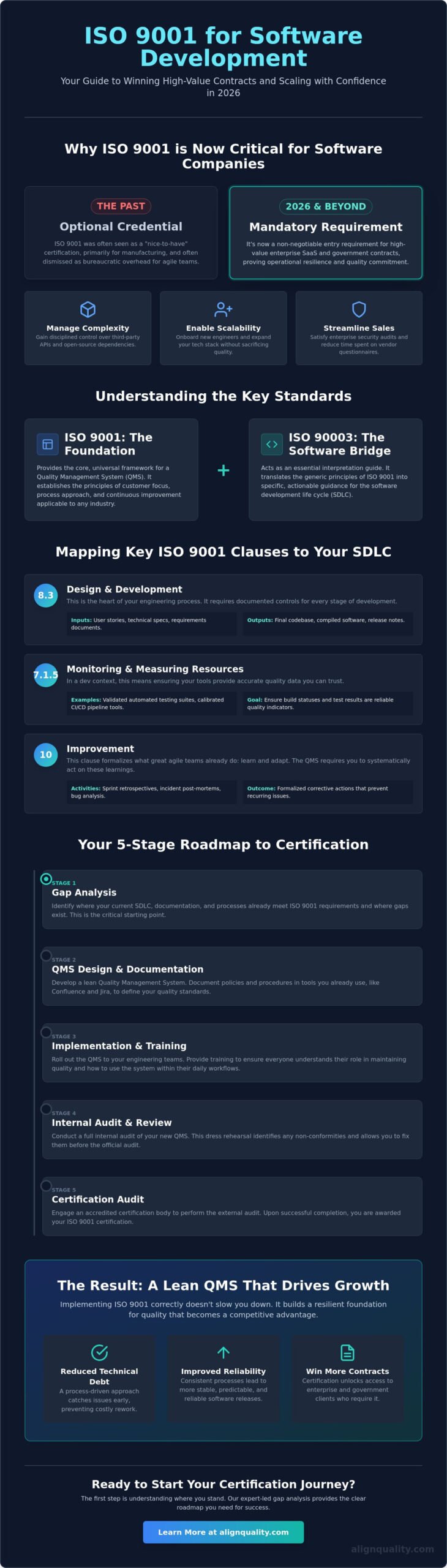
Success in a certification audit depends on how effectively you map technical activities to specific clauses. Clause 8.3, covering design and development, is the most critical for engineers. It requires documented controls for design inputs, such as user stories, and design outputs, like the final codebase. Clause 7.1.5 focuses on monitoring and measuring resources. In a dev context, this translates to the validation of your automated testing suites and CI/CD tools to ensure they provide accurate quality data. Finally, Clause 10 emphasizes improvement. Your team likely already practices this through sprint retrospectives and post-mortems. The standard simply requires you to formalize these as drivers for systemic change.
ISO 9001:2025 vs. 2026: Preparing for the Transition
As the industry moves toward the ISO 9001:2026 publication in September, documentation requirements are becoming more streamlined yet more focused on risk. While the 2015 version remains the current benchmark, the 2026 revision introduces a stronger emphasis on digital integrity and AI governance. Organizations currently certified under the 2015 version have a three-year transition period, ending in September 2029, to align with the new requirements. This period allows companies to integrate new risk-based thinking without disrupting ongoing development cycles.
You can start identifying vulnerabilities in your current process by using our gap analysis checklist to evaluate your software-specific workflows. Understanding these nuances is the first step toward a lean system. If you’re new to the standard, reviewing what is ISO 9001 can provide the necessary context for your leadership team.
Aligning ISO 9001 Requirements with Agile and DevOps Workflows
The persistent myth that ISO 9001 is a “Waterfall-only” framework remains one of the greatest barriers for modern engineering teams. Many developers believe that certification requires a rigid, document-heavy approach that contradicts the core values of the Agile Manifesto. In reality, the standard is process-agnostic. It doesn’t care if you use two-week sprints or six-month phases, provided you can demonstrate control, consistency, and a commitment to improvement. For iso 9001 for software development companies, the goal is to integrate quality requirements into existing workflows rather than layering a parallel system on top of them.
Modern tools like Jira, Confluence, and GitHub provide a wealth of metadata that serves as primary evidence for an auditor. Instead of creating manual status reports, you can use Jira’s history to track the evolution of a requirement from a user story to a completed feature. Pull requests in GitHub or GitLab act as documented evidence of peer reviews and approvals. When these tools are configured correctly, they generate a transparent audit trail without requiring developers to leave their preferred environment. This approach transforms the Quality Management System (QMS) into a living entity that exists within the tools your team already uses every day.
Your CI/CD pipeline is perhaps the most powerful tool for maintaining compliance in a DevOps culture. Automated unit tests, integration tests, and security scans provide objective evidence that quality gates are being met before code reaches production. This automation satisfies the standard’s requirement for monitoring and measurement while accelerating delivery. Similarly, risk-based thinking fits naturally into Sprint Planning. By identifying potential technical debt or security vulnerabilities during backlog grooming, you’re performing the exact risk assessment required by the standard.
Agile Rituals as Quality Management Evidence
Your existing rituals are goldmines for audit evidence. Daily stand-ups demonstrate internal communication and resource monitoring. Sprint retrospectives serve as the formal mechanism for continuous improvement, showing how the team identifies and fixes process gaps. User stories, when paired with clear acceptance criteria, perfectly satisfy Clause 8.3.3 regarding design inputs. By capturing the output of these rituals in a digital format, you fulfill the standard’s requirements without adding unnecessary meetings to the calendar.
Lean Documentation Strategies
Lean documentation focuses on utility over volume. You should avoid creating massive manuals that no one reads. Instead, use automated reports to monitor “externally provided processes,” such as the security and licensing of open-source libraries. A digital QMS should be a searchable, integrated resource. If a developer needs to know the procedure for a critical hotfix, that information should be in Confluence or a Wiki, not a static PDF. This ensures iso 9001 for software development companies remains a practical tool for growth rather than a compliance burden.
A 5-Stage Roadmap to ISO 9001 Certification Success
Achieving iso 9001 for software development companies requires a systematic approach that respects the speed of your existing release cycles. We’ve developed a methodical five-stage framework designed to remove uncertainty and move your organization toward certification with confidence. This progressive path ensures that your Quality Management System (QMS) isn’t just a compliance badge but a functional tool for operational excellence.
- Stage 1: Initial Consultation and Gap Analysis. We perform a deep dive into your current Software Development Life Cycle (SDLC) to identify where your processes already align with the standard and where they fall short.
- Stage 2: QMS Design and Tool Integration. Instead of creating new silos, we tailor your QMS to your existing tech stack, integrating quality requirements directly into Jira, GitHub, or Confluence.
- Stage 3: Implementation and Training. We provide specialized internal auditor training for your lead developers, empowering them to maintain the system from within.
- Stage 4: Internal Audit and Management Review. This is a mandatory “dry run” where we verify your readiness and ensure your leadership team is fully aligned with the quality objectives.
- Stage 5: Final Certification Audit. An accredited third-party registrar conducts the final assessment to grant your official ISO 9001 certification.
The Crucial Role of Gap Analysis
Most software firms are pleasantly surprised to find they already perform many required quality processes. Code reviews, automated testing, and sprint retrospectives are all valid forms of quality control. The gap usually lies in how these activities are captured as evidence. By using our gap analysis checklist, you can save months of effort by identifying these “hidden” processes early. For most mid-sized dev shops, a realistic timeline for reaching certification readiness is between 3 to 6 months, depending on the maturity of your current documentation.
Preparing for the External Audit
The biggest challenge during the final audit is often translating Agile terminology for a traditional ISO auditor. You must be prepared to show how a user story evolves into a feature and how your “Definition of Done” serves as a quality gate. Common non-conformities in software firms often stem from inconsistent version control or a lack of visible management commitment. We ensure your leadership team can clearly articulate the link between the QMS and your strategic business goals, which is a critical requirement for a successful outcome.
To start your progression toward a certified QMS, download our gap analysis checklist and begin evaluating your current software workflows today.
Get Certified with Confidence: Align Quality’s Software Expertise
Generic ISO consultants often fail in the tech sector because they attempt to apply manufacturing-centric logic to a dynamic codebase. They frequently struggle to interpret how a pull request serves as a formal approval or how a sprint retrospective replaces a traditional management review. At Align Quality, we bridge this gap. Our team consists of Certified Lead Auditors who understand code, deployment pipelines, and the specific nuances of iso 9001 for software development companies. We provide a methodical approach that removes the anxiety of the audit process by translating complex requirements into the language of your engineering team.
Our customized frameworks are designed to protect your Agile culture rather than stifle it. We don’t believe in documentation for the sake of compliance. Instead, we focus on creating a lean Quality Management System (QMS) that integrates with your existing tools. This ensures that your developers remain focused on shipping high-quality features while the system automatically captures the evidence required for your certification. By working with specialists who understand the software development life cycle, you ensure a successful outcome without disrupting your release velocity.
Beyond Certification: Operational Excellence
A well-implemented QMS does more than satisfy the requirements of enterprise clients; it provides a structured way to reduce technical debt and improve long-term code maintainability. By formalizing your “Definition of Done” and risk-assessment processes, you create a foundation for sustainable, scalable growth. For software firms looking to align their internal quality with external trust, WhoRatesMe provides an ethical approach to managing online reputation and feedback. Our experts help you align your strategic business plan with daily development operations, ensuring every sprint contributes to your broader organizational goals. We also provide long-term support for annual surveillance audits and offer expert guidance on the upcoming 2026 revision, ensuring your business stays ahead of global regulatory shifts.
For Australian medical technology specialists like One Health Connect, these frameworks are essential for managing the complexities of cloud-based radiology software and integrated health solutions where precision and reliability are non-negotiable.
Next Steps for Your Software Firm
The path to iso 9001 for software development companies begins with a clear understanding of your current state. We recommend scheduling a consultation with our team to map your existing SDLC against the requirements of the standard. This initial step clarifies your path forward and identifies the most efficient route to certification. You can also download our gap analysis checklist to begin an immediate internal assessment of your workflows. Join the growing list of globally recognized, certified software organizations that use quality as a primary competitive advantage in the global market.
Future-Proof Your Software Quality Framework
Implementing iso 9001 for software development companies isn’t just about meeting contract requirements; it’s about building a foundation for sustainable innovation. By integrating quality standards into your existing Agile rituals and DevOps tools, you ensure that your team remains fast and reliable. The upcoming 2026 revision provides a timely opportunity to modernize your processes, especially as AI-generated code and complex SaaS ecosystems become the industry standard. You have until September 2029 to fully transition to the new requirements, but early adoption provides a significant competitive advantage.
Our team of Certified ISO 9001 Lead Auditors understands the specific pressures of the software industry. We use a proven 5-stage certification framework to remove uncertainty from the process, allowing you to focus on building great products. Whether you’re preparing for the 2026 transition or seeking your initial certification, we’re here to guide you through every step of the journey. We’ll help you translate complex clauses into actionable engineering workflows that respect your team’s culture.
Start your journey with our Ultimate ISO 9001 Gap Analysis Checklist to identify your path to operational excellence. Your team is already doing the work. It’s time to get the recognition your quality deserves.
Frequently Asked Questions
Is ISO 9001 really applicable to software development?
Yes, ISO 9001 is highly applicable to the tech sector when implemented alongside the ISO/IEC/IEEE 90003:2018 guidelines. These guidelines provide specific instructions on how to apply quality management principles to computer software. Using iso 9001 for software development companies helps formalize your SDLC, making your development process more predictable and reducing the risk of critical bugs reaching production.
How much does ISO 9001 certification cost for a software company?
The total investment for certification depends on several variables, such as your headcount, the number of office locations, and the complexity of your software products. Typical expenses involve the registrar’s fees for the certification audit and the internal resources needed to build your QMS. Many firms find that the investment pays for itself by opening doors to enterprise-level SaaS contracts that require validated quality systems.
Will ISO 9001 slow down our Agile development process?
ISO 9001 won’t slow down your development if you design your Quality Management System to work with your existing Agile rituals. The standard doesn’t require a Waterfall approach; it simply requires that you have a controlled process. By using your current tools like Jira or GitHub to provide evidence of code reviews and testing, you maintain your velocity while satisfying audit requirements.
What is the difference between ISO 9001 and ISO 27001 for software firms?
ISO 9001 focuses on quality management and the consistency of your development processes to ensure customer satisfaction. In contrast, ISO 27001 is specifically concerned with information security and protecting data assets. While they’re different standards, they’re highly complementary. Many software companies implement both to prove they can deliver high-quality products that are also secure; you can discover CWORT to help manage your regulatory compliance efficiently.
How long does it take to get ISO 9001 certified in the tech industry?
Most software organizations can achieve certification within three to six months. Your specific timeline will depend on the results of your initial gap analysis and how much documentation you already have in place. If your team is already disciplined about sprint retrospectives and automated testing, you’ll likely find the path to certification is much shorter than you expected.
Do we need a full-time Quality Manager to maintain ISO 9001?
You don’t need a full-time Quality Manager to maintain your certification, especially if you’re a small or mid-sized firm. Many organizations distribute these responsibilities among existing team members or use a part-time internal auditor. The key is having a methodical system in place that your team uses daily, which makes the annual surveillance audits a natural part of your operations.