For many business leaders, the path to ISO 9001 certification appears complex and resource-intensive. Questions about return on investment, navigating technical requirements, and preparing for audits can create significant hesitation. But what if becoming iso 9001 certified was less of a hurdle and more of a powerful strategic advantage? Beyond the certificate on the wall lies a proven framework for operational excellence that can transform your business from the inside out, building a foundation of quality and confidence.
This guide demystifies the process. We move beyond the jargon to explore the tangible, real-world benefits that certification delivers to your bottom line. You will discover how a robust Quality Management System not only opens doors to new contracts and tenders but also drives significant internal improvements, reduces waste, and builds undeniable customer trust. Prepare to see ISO 9001 not as a compliance task, but as a strategic investment in your company’s future success.
Beyond the Badge: What ‘ISO 9001 Certified’ Actually Means
Achieving the status of being iso 9001 certified represents far more than a marketing badge; it is the formal validation of your organization’s deep-seated commitment to excellence. This certification, a cornerstone of the internationally recognized ISO 9000 family of standards, is granted by an independent body and signifies the implementation of a robust Quality Management System (QMS). It serves as tangible proof that your business is structured to consistently deliver products and services that meet and exceed customer expectations.
This formal recognition confirms your dedication to a systematic approach that prioritizes quality, efficiency, and continuous improvement, providing confidence to customers, partners, and stakeholders.
The Role of Your Quality Management System (QMS)
Your QMS is the operational blueprint for quality. It comprises the specific policies, processes, and procedures your organization uses to fulfill customer and regulatory requirements. A well-designed and implemented QMS is the non-negotiable foundation for certification, driving consistency and repeatability across all your operations. It ensures that high quality is not an accident but a meticulously planned and consistently achieved outcome, forming the very core of what it means to be iso 9001 certified.
The Importance of Third-Party Audits
Certification is not self-declared. It requires passing a rigorous audit conducted by an external, third-party registrar. This process provides an unbiased and objective assessment of your QMS’s compliance with the ISO 9001 standard. The auditor’s role is to verify that your documented processes are effectively implemented in practice, offering credible, objective proof of your organization’s genuine commitment to quality management and its principles.
Accredited vs. Unaccredited Certification: A Critical Distinction
Not all certificates carry the same weight. An accredited certificate is issued by a certification body that has been independently vetted and approved by an authoritative national or international body. This accreditation ensures competence and impartiality, lending global recognition and credibility to your certification. Conversely, unaccredited certificates may not be accepted for major contracts or tenders. It is critical to verify the accreditation status of your chosen certification body to ensure your investment yields maximum value and authority.
The Core Business Benefits of Achieving ISO 9001 Certification
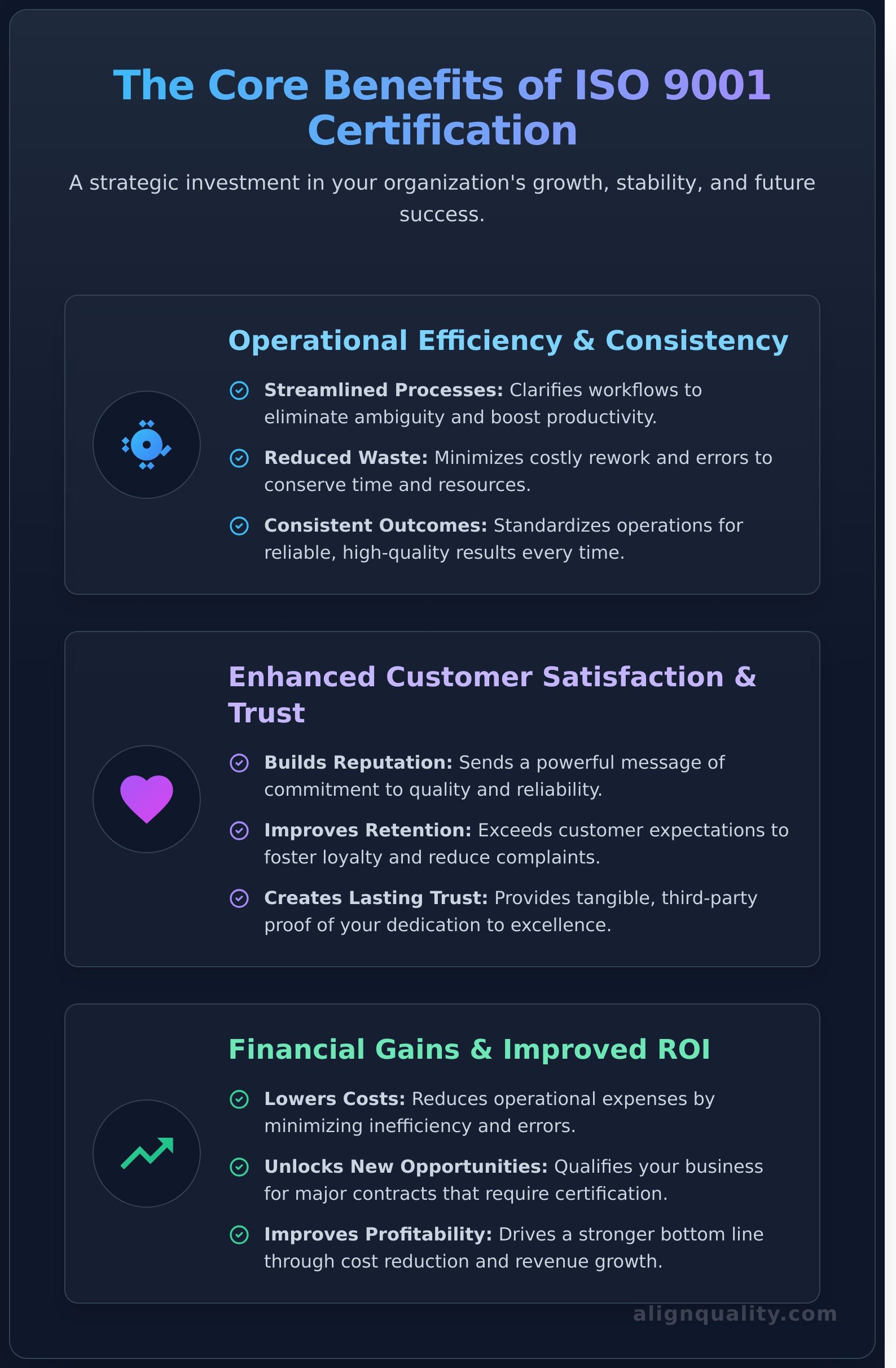
Pursuing ISO 9001 certification is far more than a compliance exercise; it is a strategic investment in your organization’s future growth and stability. By implementing this globally recognized framework, you unlock tangible benefits that resonate across every department-from operations and finance to marketing and customer service. The standard helps your organization move from reactive problem-solving to a culture of proactive, continuous improvement. The principles embedded within the standard provide a powerful roadmap to transform your small business and establish a scalable foundation for success. Here, we explore three key areas of positive impact.
Operational Efficiency and Consistency
A well-implemented Quality Management System (QMS) brings clarity and structure to your daily operations. Becoming iso 9001 certified requires you to document procedures, define clear responsibilities, and establish measurable quality objectives. This systematic approach directly leads to:
- Streamlined Processes: Clearly defined workflows eliminate ambiguity and improve productivity.
- Reduced Waste: By minimizing rework and costly errors, you conserve resources and lower operational costs.
- Consistent Outcomes: Standardized processes ensure that your products or services meet the same high-quality standard every time, regardless of who performs the task.
- Data-Driven Decisions: The framework encourages monitoring and analysis, allowing you to make informed decisions for continuous improvement.
Enhanced Customer Satisfaction and Trust
At its core, ISO 9001 is a customer-focused standard. Its primary goal is to help you consistently meet and exceed customer expectations. Achieving certification sends a powerful message to your market that you are deeply committed to quality. This commitment builds a reputation for reliability and excellence, which helps you reduce customer complaints, improve retention rates, and build lasting trust with your client base.
Financial Gains and Improved ROI
The operational improvements and enhanced customer loyalty driven by ISO 9001 translate directly to a stronger bottom line. Reduced inefficiency, waste, and errors immediately lower your costs. At the same time, your status as an iso 9001 certified company can open doors to new opportunities, as many larger organizations and government bodies require it for their suppliers. This combination of cost reduction and revenue growth improves overall profitability, ensuring the investment in certification pays for itself many times over.
How Certification Drives a Culture of Continuous Improvement
Achieving ISO 9001 certification is not a final destination; it is the beginning of a new operational journey. It fundamentally shifts an organization’s mindset from reactive problem-solving to proactive, continuous improvement. This cultural transformation is one of the most valuable, long-term benefits of becoming an iso 9001 certified company. It empowers every employee to take ownership of quality, transforming them from passive participants into active contributors to your success.
Implementing the Plan-Do-Check-Act (PDCA) Cycle
At the core of the ISO 9001 standard is the Plan-Do-Check-Act (PDCA) cycle, a systematic methodology for iterative improvement. This framework provides a clear, repeatable structure for enhancing processes across your organization.
- Plan: Establish quality objectives and define the processes required to deliver results in accordance with customer requirements and company policies.
- Do: Implement the plan, execute the new processes, and collect data for analysis.
- Check: Monitor and measure processes and products against objectives and report the results.
- Act: Take decisive action to continually improve process performance based on the results.
This disciplined cycle ensures that improvements are managed, measured, and repeatable.
Fostering Risk-Based Thinking
The standard moves your organization away from simply reacting to issues after they occur. Instead, it promotes risk-based thinking-a proactive approach to identifying potential risks and opportunities within your processes before they impact quality. By systematically evaluating what could go wrong, you can implement controls to mitigate those risks. This forward-looking perspective also helps identify opportunities for innovation, making your business more resilient and adaptable to change.
Engaging Your Team in Quality Processes
A culture of quality cannot exist without an engaged team. When your business is iso 9001 certified, roles and responsibilities become clearly defined, which increases accountability at every level. The standard encourages involving employees in process improvement, documentation, and internal audits. This ongoing team involvement is critical for not only achieving but also for maintaining ISO 9001 certification, as it ensures the quality management system remains effective. This empowerment boosts morale and ensures quality becomes a shared, collaborative goal.
Winning More Business: The Impact on Sales and Tenders
Beyond internal process improvements, achieving ISO 9001 certification is a powerful commercial asset. It acts as a universally recognized signal of quality and reliability, giving your business a distinct advantage in a competitive marketplace. For companies looking to grow, being iso 9001 certified doesn’t just refine operations-it unlocks significant new revenue opportunities and solidifies your market position.
Meeting Tender and Government Contract Requirements
In many sectors, ISO 9001 is not just an advantage; it is a prerequisite to compete. Numerous public and private sector tenders mandate certification as a baseline for consideration. This requirement immediately filters out non-certified competitors, placing your business on a shortlist of qualified suppliers.
- Access High-Value Contracts: Qualify for lucrative government and corporate tenders that list ISO 9001 as a mandatory requirement.
- Simplify Supplier Vetting: For buyers, your certification simplifies their qualification process, making it easier and faster to do business with you.
- Demonstrate Capability: It provides concrete proof that your organization can meet the stringent quality and delivery demands of large-scale projects.
Building Credibility with Global Partners
ISO 9001 is the global benchmark for quality management, providing a common language that transcends borders and industries. This international recognition instantly establishes trust with potential partners and customers around the world. It assures them that your business operates according to a proven, systematic framework for quality, reducing their perceived risk and often eliminating the need for costly independent supplier audits.
Using Your Certification as a Marketing Tool
Your certification is a tangible marketing asset that should be actively promoted. It serves as a key differentiator, building a brand reputation founded on proven excellence and customer focus. Make your commitment to quality visible by displaying the certification mark on your website, proposals, and marketing materials. Highlighting this achievement in your communications reinforces your promise of delivering consistent value, helping you attract and retain higher-quality clients.
Ready to turn compliance into a competitive advantage? Start your certification journey with confidence.
Maintaining Your Certification: It’s a Journey, Not a Destination
Achieving your ISO 9001 certification is a significant milestone, but it marks the beginning of your quality journey, not the end. The standard is designed to foster a culture of continuous improvement. Maintaining compliance requires an ongoing commitment to the principles and processes you have implemented. This sustained effort ensures your Quality Management System (QMS) remains effective, adapts to new challenges, and consistently drives your business forward.
Regular audits are a core component of this journey. They are not simply compliance checks; they are structured opportunities to refine operations, identify efficiencies, and reinforce your commitment to excellence. This methodical approach keeps your team focused, accountable, and aligned with your quality objectives, ensuring the benefits of certification are realized year after year.
Understanding Surveillance Audits
Once you are iso 9001 certified, your registrar will conduct periodic surveillance audits, typically on an annual or semi-annual basis. These audits are less intensive than the initial certification audit and serve a critical purpose:
- To verify that your QMS continues to meet the requirements of the ISO 9001 standard.
- To confirm that processes are being followed as documented.
- To identify any non-conformities or opportunities for improvement since the last audit.
Think of them as regular health checks that ensure your QMS remains robust and effective over time.
The Recertification Process
An ISO 9001 certificate is typically valid for three years. Before it expires, your organization must undergo a comprehensive recertification audit. This audit is similar in scope to your initial Stage 2 audit and is designed to re-evaluate your entire QMS. It confirms that your system has not only been maintained but has also evolved with your business. Successfully completing this process reaffirms your long-term dedication to quality and renews your status as an iso 9001 certified company for another three-year cycle.
Navigating the audit cycle with confidence requires expert guidance. At Align Quality, we help businesses streamline their maintenance and recertification processes, ensuring you continue to leverage your QMS for maximum value. Contact us to learn how we can support your quality journey.
Embark on Your ISO 9001 Journey with Confidence
As we’ve explored, becoming iso 9001 certified is far more than a credential to display on your website. It represents a fundamental, strategic commitment to operational excellence and customer satisfaction. This certification is a powerful driver for instilling a culture of continuous improvement and serves as a critical differentiator when competing for tenders and winning new business. By embedding the principles of quality management into the core of your operations, you unlock significant, long-term value and build a more resilient, efficient, and competitive organization.
While the path to certification is rigorous, it is a manageable and highly rewarding process with the right partner. At Align Quality, our expert team is dedicated to streamlining this journey for you. Guided by our Certified ISO 9001 Lead Auditors and our Proven 5-Stage Certification Process, we leverage deep, multi-industry experience to tailor a solution that ensures a successful and confident outcome for your business.
Ready to elevate your business standards and unlock your full potential? Book Your Free Consultation to Start Your Certification Journey today. Your path to enhanced quality and growth begins now.
Frequently Asked Questions About ISO 9001 Certification
What’s the difference between being ISO 9001 compliant and ISO 9001 certified?
ISO 9001 compliance means your organization has implemented a Quality Management System (QMS) that meets the standard’s requirements. This is often a self-declaration. In contrast, being ISO 9001 certified means an independent, accredited certification body has formally audited your QMS and verified that it conforms to the standard. Certification provides external validation and is recognized globally, offering a higher level of assurance to customers and stakeholders than compliance alone.
How long does it typically take to get ISO 9001 certified?
The timeline to become ISO 9001 certified varies based on your company’s size, complexity, and the current state of your quality processes. For a small to medium-sized business, the journey from initial gap analysis to final certification audit typically takes between 3 and 6 months. A well-defined implementation plan and dedicated internal resources are critical to streamlining this process and achieving certification efficiently. This includes stages for documentation, training, internal audits, and management review.
Is ISO 9001 certification mandatory for my industry?
ISO 9001 is a voluntary standard and is not a legal requirement for most industries. However, it often becomes a commercial necessity. Many large corporations and government bodies mandate certification as a prerequisite for their suppliers to ensure quality and consistency in their supply chain. Therefore, while not legally mandatory, certification is frequently essential for market access, competitive bidding, and demonstrating a commitment to quality that clients demand in sectors like manufacturing, technology, and construction.
Can a small business with limited resources get ISO 9001 certified?
Absolutely. The ISO 9001 standard is designed to be scalable and adaptable to organizations of any size, including small businesses. A successful implementation focuses on creating efficient, practical processes that fit your specific operations, not on generating excessive bureaucracy. By leveraging expert guidance and focusing on a streamlined approach, a small business can effectively manage the certification journey, minimize disruption, and achieve the significant commercial benefits that come with being ISO 9001 certified.
Who actually issues the ISO 9001 certificate?
The International Organization for Standardization (ISO) develops and publishes the standards but does not conduct audits or issue certificates. The ISO 9001 certificate is issued by an independent, third-party organization known as a Certification Body or Registrar. It is crucial to select a Certification Body that is accredited by a recognized national accreditation body (such as UKAS in the UK or ANAB in the US) to ensure your certificate is credible and globally accepted.
How much does ISO 9001 certification cost?
The cost of ISO 9001 certification is not a single fee but a combination of factors. Key expenses include the fees for the external audit charged by the Certification Body, which depend on your company size and complexity. Other costs may include fees for a consultant to guide the implementation process, potential software subscriptions, and the internal cost of your employees’ time dedicated to the project. A detailed quote from a certification body is the best way to determine the precise investment required.