To many business leaders, the term “ISO 9001” suggests a world of complex audits, bureaucratic paperwork, and confusing jargon. You may wonder if it is simply a certificate to hang on the wall or a genuine tool for business improvement. The fundamental question, what is ISO 9001, often gets lost in this perception of complexity. In reality, the standard is not about adding rigid rules; it is about creating clarity, consistency, and a reliable framework for excellence. It is a strategic tool designed to optimize your operations and deliver exceptional value to your customers, regardless of your industry.
This plain-English guide is designed to demystify the standard completely. We will translate the technical requirements into practical business benefits, showing you how ISO 9001 provides a powerful blueprint for operational success. You will discover its core principles, understand its tangible impact on efficiency and growth, and gain the clarity needed to determine if certification is the logical next step on your business journey. Consider this your definitive resource for understanding the value of quality management with confidence.
Deconstructing ISO 9001: More Than Just a Certificate
At its core, ISO 9001 is the world’s most recognized standard for quality management systems. But to truly understand what is ISO 9001, it is best to see it not as a rigid set of product rules, but as a powerful framework for your business processes. Think of it as a proven recipe for running a quality-focused organization. It provides the essential ingredients and methodical steps to ensure you operate consistently, efficiently, and with a clear focus on your primary goal: to reliably meet the needs of your customers and stakeholders.
This standard is designed to be versatile, applying to any organization, regardless of its size or industry. It provides a strategic foundation for improving performance, managing business risk, and driving sustainable growth.
What is a Quality Management System (QMS)?
A Quality Management System (QMS) is the formalized system that documents the collection of all your internal policies, processes, procedures, and records. This system defines how your organization directs and controls its activities to achieve its quality objectives. ISO 9001 provides the internationally recognized blueprint for building an effective QMS, ensuring no critical component is overlooked on your compliance journey.
The Standard vs. Certification: A Critical Distinction
It is crucial for leaders to differentiate between the standard and the certification. The ISO 9001 standard is the document itself-the ‘rulebook’ that outlines the requirements for your QMS. Certification, on the other hand, is the process of having an independent, accredited body audit your QMS to verify that it conforms to the standard. Achieving certification provides tangible, third-party proof of your commitment to quality.
Who Creates and Manages the Standard?
ISO 9001 is developed and published by the International Organization for Standardization (ISO), a non-governmental body comprised of national standards bodies from over 160 countries. The standard is not created in isolation; it is the result of a global consensus of experts. As part of the wider ISO 9000 family of standards, it is periodically reviewed to remain relevant in a changing business world, with the current version being ISO 9001:2015.
The Core Philosophy: Unpacking the 7 Quality Management Principles
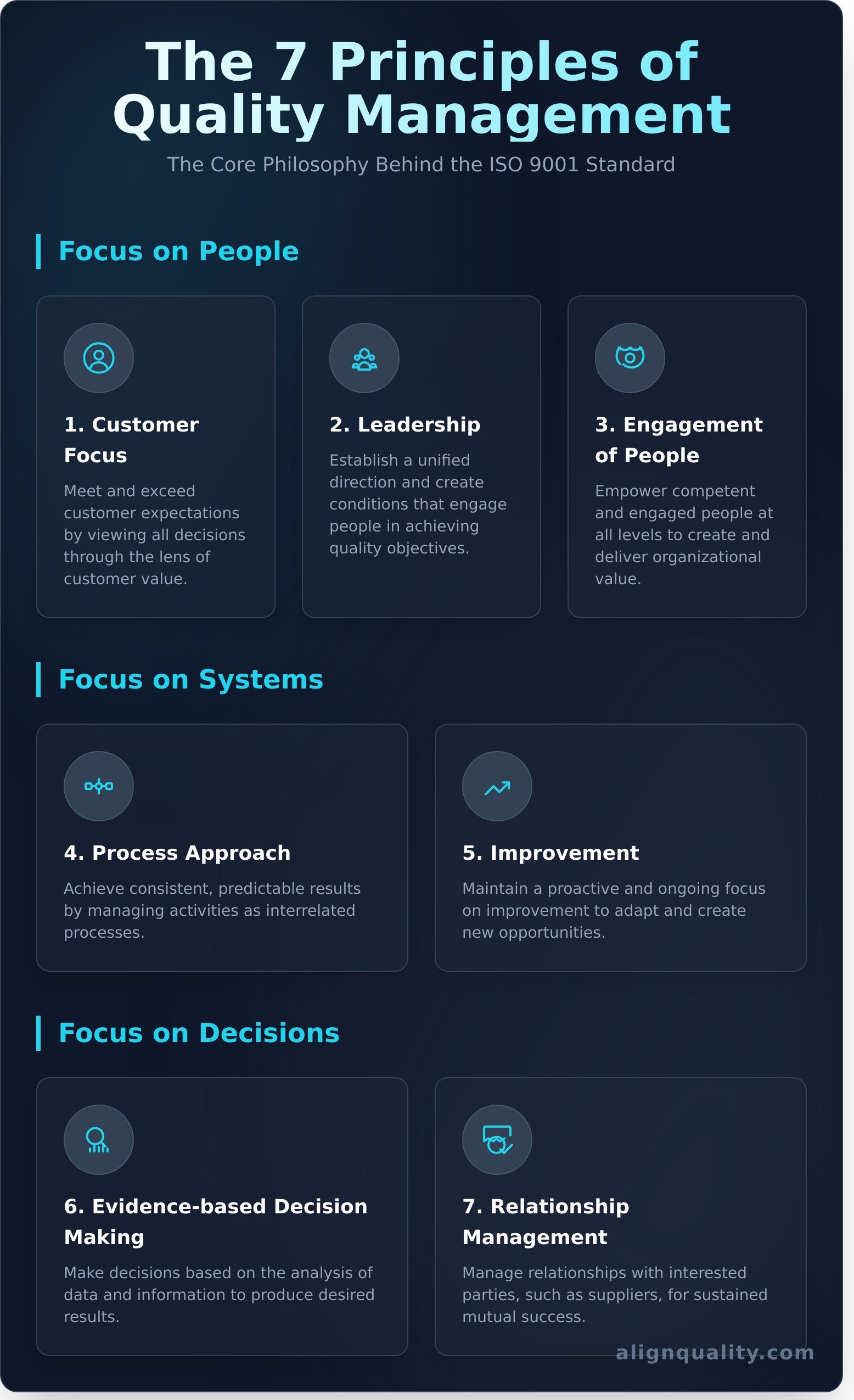
To truly understand what is ISO 9001, you must look beyond the clauses and requirements to its foundational philosophy. At its heart, the standard is built upon a set of core beliefs known as the 7 Quality Management Principles. These are not rigid rules to be audited but guiding values that foster a culture of excellence. As detailed by global quality experts, these principles are the foundation of effective ISO 9001 Quality Management Systems and are essential for achieving long-term customer satisfaction and organizational success.
These seven principles are:
- Customer Focus
- Leadership
- Engagement of People
- Process Approach
- Improvement
- Evidence-based Decision Making
- Relationship Management
Focus on People: Customers, Leadership, and Engagement
The first three principles establish that quality is driven by and for people. A successful quality management system places human factors at the center of its strategy.
- Principle 1: Customer Focus – The primary objective of quality management is to meet customer requirements and strive to exceed their expectations. All decisions should be viewed through the lens of customer value and satisfaction.
- Principle 2: Leadership – Leaders at all levels must establish a unified direction and create conditions in which people are engaged in achieving the organization’s quality objectives.
- Principle 3: Engagement of People – Competent, empowered, and engaged people throughout the organization are essential for creating and delivering value. Their involvement enables their abilities to be used for the organization’s benefit.
Focus on Systems: Process Approach and Improvement
These principles address the operational framework. They ensure that activities are structured, managed, and refined in a systematic way to produce predictable and reliable outcomes.
- Principle 4: Process Approach – Consistent results are achieved more effectively when activities are understood and managed as interrelated processes. This systematic view is central to what ISO 9001 helps organizations implement.
- Principle 5: Improvement – Successful organizations have an ongoing, proactive focus on improvement. This involves reacting to internal and external changes and creating new opportunities.
Focus on Decisions: Evidence and Relationships
The final two principles ensure that the quality management system is guided by logic and a holistic view of the business ecosystem.
- Principle 6: Evidence-based Decision Making – Decisions based on the analysis and evaluation of data and information are more likely to produce desired results. This principle moves organizations away from intuition-only management.
- Principle 7: Relationship Management – For sustained success, an organization must manage its relationships with interested parties, such as suppliers and partners. A strong supply chain is critical to delivering quality.
What ISO 9001 Actually Requires: A Look Inside the Clauses
At its core, the ISO 9001 standard is a logical framework designed for systematic improvement, not unnecessary bureaucracy. Understanding what is ISO 9001 requires a look inside its structure: ten clauses built on the proven Plan-Do-Check-Act (PDCA) cycle. While the first three clauses are introductory, the requirements for your Quality Management System (QMS) begin in Clause 4. This methodical approach ensures quality is a central part of your strategic operations, driving consistency and customer satisfaction.
Plan: Setting the Stage for Quality (Clauses 4-6)
The initial phase focuses on establishing a solid foundation for your QMS. This is where you align quality objectives with your overall business strategy.
- Clause 4 (Context of the Organization): You must first understand your business landscape, including the needs and expectations of interested parties (like customers and regulators) and the scope of your QMS.
- Clause 5 (Leadership): This clause requires top management to demonstrate unwavering commitment, establish a clear quality policy, and define roles and responsibilities.
- Clause 6 (Planning): Here, you identify and plan actions to address business risks and opportunities, setting measurable quality objectives to drive improvement.
Do: Executing the Plan (Clauses 7-8)
With a robust plan in place, the next step is implementation. These clauses ensure you have the capability and control to deliver on your promises.
- Clause 7 (Support): This covers the essential resources needed to run the QMS effectively, including competent personnel, suitable infrastructure, a proper work environment, and organizational knowledge.
- Clause 8 (Operation): This is the heart of your daily activities. It requires you to plan, implement, and control the processes needed to create your products or services. Successfully managing these operational controls is a key milestone on the path to achieving ISO 9001 certification and delivering consistent value.
Check & Act: Measuring and Improving (Clauses 9-10)
The final clauses close the loop on the PDCA cycle, transforming your QMS from a static system into a dynamic tool for continual growth.
- Clause 9 (Performance Evaluation): You must monitor, measure, analyze, and evaluate the performance of your QMS. This includes conducting internal audits and management reviews to ensure it remains effective.
- Clause 10 (Improvement): When issues or nonconformities arise, this clause requires you to take corrective action and, more importantly, to continually improve the suitability and effectiveness of the QMS.
While the structure is logical, navigating the requirements can feel complex. Feeling overwhelmed? Our 5-stage process simplifies your journey.
The Real-World Benefits: How ISO 9001 Drives Business Growth
Achieving ISO 9001 certification is far more than an exercise in compliance; it is a strategic investment in your company’s future. Understanding what is ISO 9001 is the first step, but appreciating how its framework translates into measurable results is where the real value lies. The benefits are not isolated wins but compounding advantages that strengthen your business from the inside out, creating a resilient and competitive organization.
Internal Advantages: Boosting Efficiency and Reducing Waste
A well-implemented Quality Management System (QMS) brings discipline and clarity to your internal operations. By standardizing processes and establishing clear metrics for success, you create a more efficient and predictable operational environment. Key internal gains include:
- Improved Process Consistency: Standardized workflows lead to fewer errors, less rework, and a consistent level of quality in your products or services, directly reducing operational costs.
- Data-Driven Decisions: The standard requires you to monitor, measure, and analyze performance. This data provides objective insights for optimizing resource allocation and driving strategic improvements.
- Enhanced Employee Engagement: With clearly defined roles, responsibilities, and processes, employees understand how their work contributes to quality objectives, which can significantly boost morale and productivity.
External Advantages: Winning Contracts and Building Trust
In a competitive marketplace, ISO 9001 certification is a powerful differentiator that signals credibility and a commitment to quality. This recognition opens doors and strengthens relationships. This enhanced credibility has tangible effects; for example, research by the British Assessment Bureau found that 75% of certified businesses acquired new customers as a direct result of their certification.
- Meet Tender Requirements: Many public and private sector contracts mandate ISO 9001 certification as a prerequisite, making it essential for accessing new business opportunities.
- Strengthen Your Reputation: Certification acts as a third-party endorsement of your company’s commitment to quality, building immediate trust with potential clients, partners, and stakeholders.
- Increase Customer Satisfaction: By consistently meeting and exceeding customer expectations, you foster loyalty and create a base of repeat business that is vital for long-term growth.
Strategic Advantages: Creating a Culture of Improvement
Perhaps the most profound benefit is the cultural shift that ISO 9001 inspires. The standard embeds a forward-looking mindset focused on continual improvement, ensuring your business remains agile and resilient. This commitment to evolving and optimizing is at the core of what is ISO 9001. It provides a robust framework for managing business risks, capitalizing on opportunities, and scaling your operations effectively and with confidence.
To learn how your business can embark on this journey, explore our proven certification process.
Is ISO 9001 Right for Your Organization?
A common misconception is that ISO 9001 is exclusively for large, multinational manufacturing companies. However, a key part of understanding what is ISO 9001 is recognizing its universal applicability. The standard was intentionally designed as a flexible framework for any organization-regardless of its size, sector, or the service it provides. The core question is not about what you do, but how committed you are to doing it with excellence.
Applicability Across Industries
The power of ISO 9001 lies in its principles, not its prescriptions. Whether you are a technology company refining a software development lifecycle, a healthcare provider standardizing patient care, or a construction firm ensuring project safety, the focus remains the same: consistently meeting customer and regulatory requirements. The standard provides the framework, and you tailor the Quality Management System (QMS) to fit your unique operational context.
From Startups to Global Corporations
Organizational size is not a barrier to certification; it simply changes the strategic focus. For small businesses, implementing a QMS builds a robust foundation for scalable growth and enhances credibility in a competitive market. For large corporations, ISO 9001 is an essential tool for ensuring process consistency, managing risk across multiple sites, and maintaining a uniform standard of quality that protects the brand’s global reputation.
Signs You’re Ready for the ISO 9001 Journey
Embarking on the path to certification is a significant commitment. How do you know if the timing is right? Certain operational challenges often indicate that an organization is ready to benefit from the structure ISO 9001 provides. Consider if your team is facing any of the following:
- Missed Opportunities: You are frequently losing out on bids or tenders that list ISO 9001 certification as a prerequisite.
- Inconsistent Outcomes: Your business struggles with recurring quality issues, leading to customer complaints, rework, and wasted resources.
- Uncontrolled Growth: Rapid expansion has made processes difficult to manage, and you need a formal system to maintain control and quality.
If these points resonate with your current situation, it is a strong indicator that you are ready. An expert assessment can provide a clear roadmap for your certification journey, helping you move forward with a defined strategy.
Ready to take the next step with confidence? Book a free consultation to assess your readiness.
Transform Your Business with the Power of ISO 9001
We’ve explored how ISO 9001 is far more than a certificate-it’s a strategic framework for embedding quality into the core of your operations. By embracing its principles of customer focus, process-based thinking, and continual improvement, you create a resilient organization poised for growth. Ultimately, the answer to what is iso 9001 is a proven blueprint for enhancing customer satisfaction, streamlining processes, and achieving sustainable success.
Embarking on the certification journey can seem complex, but you don’t have to navigate it alone. At Align Quality, our team of Certified ISO 9001 Lead Auditors leverages a proven 5-Stage Certification Process to guide businesses across multiple industries toward compliance. We provide the expert partnership you need to streamline the process and achieve your quality objectives with clarity and precision.
Ready to achieve ISO 9001 certification with confidence? Book your free consultation today. Take the definitive step toward operational excellence and unlock your organization’s full potential.
Frequently Asked Questions About ISO 9001
What is the difference between ISO 9000 and ISO 9001?
The ISO 9000 series provides the fundamentals and vocabulary for quality management systems. In contrast, ISO 9001 is the specific, certifiable standard within that family that contains the actual requirements an organization must implement. While ISO 9000 offers guidance and definitions, only ISO 9001 can be audited and certified. Therefore, when businesses seek certification, they are working to meet the criteria defined exclusively within the ISO 9001 standard.
Is ISO 9001 certification mandatory by law?
ISO 9001 certification is not a legal or statutory requirement. It is a voluntary standard that organizations choose to adopt to improve their processes and build credibility. However, certification may become a contractual obligation required by customers or a prerequisite for participating in certain supply chains, particularly in regulated industries. It serves as a globally recognized benchmark for quality and operational excellence, often providing a significant competitive advantage in the marketplace.
How long does it take to get ISO 9001 certified?
The timeline for achieving ISO 9001 certification typically ranges from 3 to 12 months. This duration depends on several key factors, including the size and complexity of your organization, the current maturity of your quality management processes, and the availability of internal resources. A structured implementation plan, beginning with a thorough gap analysis, is essential to establishing a predictable and efficient certification journey. A methodical approach helps streamline this process with confidence.
How much does ISO 9001 certification cost?
The cost of ISO 9001 certification varies significantly based on your organization’s size, number of locations, and operational complexity. Key expenses include the fees for the external certification body’s audits, potential consulting fees for implementation guidance, and the cost of internal resources dedicated to the project. Investing in expert guidance can streamline the process, preventing costly errors and ensuring a successful outcome on your initial audit attempt, delivering a strong return on investment.
What is the current version of the ISO 9001 standard?
The current and most recent version of the standard is ISO 9001:2015. The “2015” indicates the year of its last major revision by the International Organization for Standardization. This version places a greater emphasis on risk-based thinking, leadership engagement, and understanding the organizational context. When leaders ask what is ISO 9001, they are referring to the requirements outlined in this 2015 version, which is the only one for which certification can be granted.
Can an individual get ISO 9001 certified?
ISO 9001 certification is awarded to an organization, not an individual. The standard certifies that a company’s Quality Management System (QMS) meets the required criteria. Individuals, however, can achieve professional certifications related to ISO 9001, such as becoming a Certified Lead Auditor or Internal Auditor. These qualifications demonstrate an individual’s competence in understanding and auditing the standard, but they are distinct from an organization’s corporate certification status.
How often do you need to get recertified for ISO 9001?
An ISO 9001 certificate is valid for three years. This certification cycle involves an initial certification audit, followed by mandatory surveillance audits in the first and second years to ensure ongoing compliance and continuous improvement. Before the initial certificate expires at the end of the third year, the organization must undergo a comprehensive recertification audit. Successfully completing this audit renews the certification for another three-year period, demonstrating a continued commitment to quality.