
Receiving a non-conformity report from your ISO 9001 auditor is not the business-ending event many fear it to be. In fact, it is a critical data point on your path to a more robust quality management system.
It’s completely understandable to feel a sense of anxiety. The potential impact on client contracts and the cost of a follow-up audit can feel overwhelming. You’ve invested significant time and resources into your QMS, and the prospect of not achieving certification can be deeply frustrating.
This guide removes that uncertainty. Here, you will discover exactly what happens if you fail an ISO 9001 audit, learn the crucial difference between major and minor non-conformities, and gain access to our structured 2026 recovery roadmap. We’ll provide the clear, step-by-step plan you need to rectify every issue and approach your re-audit with complete confidence.
Key Takeaways
- An audit ‘failure’ is not a final verdict but the identification of non-conformities (NCs). Your registrar will provide a detailed report outlining the specific issues that require a corrective action plan.
- Failing an audit has direct financial and operational costs, from follow-up audit fees to critical delays in securing contracts that require ISO 9001 certification.
- The answer to what happens if you fail an iso 9001 audit involves a structured response, beginning with immediate containment and a formal Root Cause Analysis (RCA) to fix the core problem.
- Prevent future failures by shifting from a last-minute ‘audit prep’ mindset to a culture of continuous compliance, which is essential for long-term success and the upcoming ISO 9001:2026 transition.
Demystifying the ‘Fail’: What an ISO 9001 Audit Failure Really Means
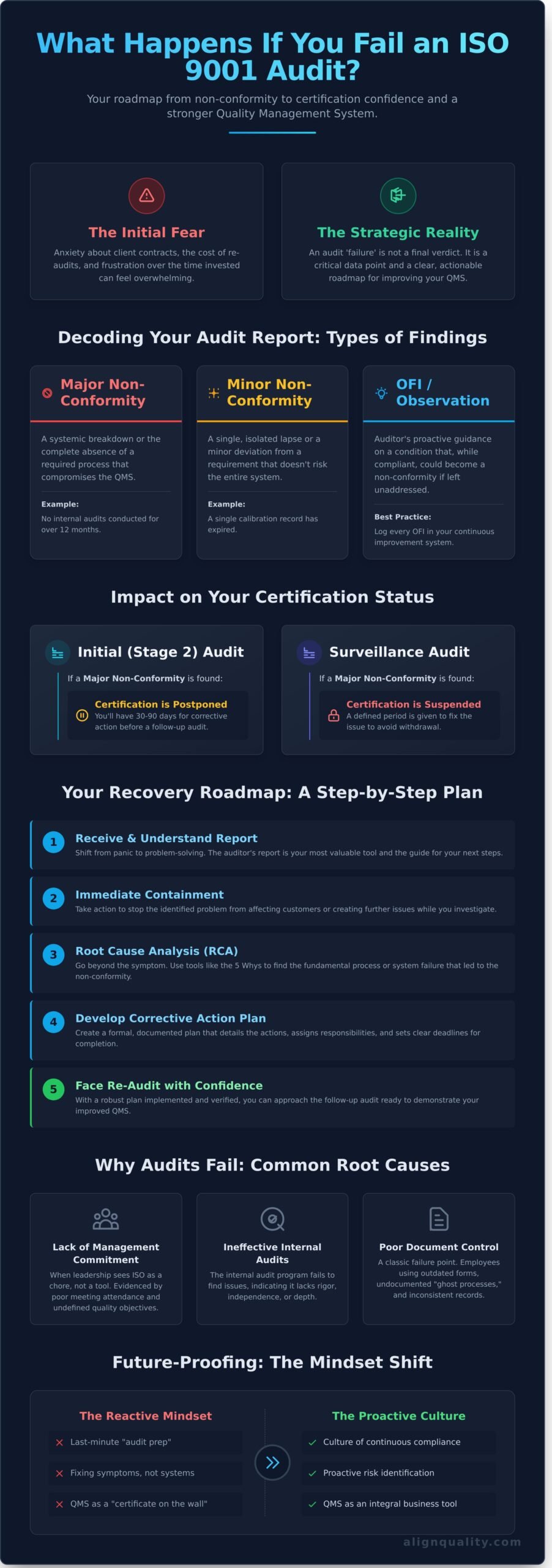
The word “fail” triggers immediate concern. But in the context of ISO 9001, it doesn’t mean your company is permanently barred from certification. An audit “failure” simply means the auditor has identified non-conformities (NCs) where your Quality Management System (QMS) does not meet the standard’s requirements. This isn’t a final verdict; it’s a roadmap for improvement. The initial panic is understandable, but the most effective response is to shift immediately into a mode of professional, systematic problem-solving.
Your certification body, or registrar, isn’t there to deliver a simple “yes” or “no.” Their role is to provide a detailed, objective report that outlines exactly where your QMS aligns with the standard and where it deviates. This report is your most valuable tool. It assesses your processes against the core principles of the ISO 9000 family of standards, giving you specific, actionable findings. Understanding the audit report is central to knowing what happens if you fail an iso 9001 audit and how to respond effectively.
The immediate impact on your certification status depends entirely on the type of audit you’ve undergone:
- Initial (Stage 2) Audit: If major non-conformities are found, your certification will be postponed. You will be given a specific timeframe, typically 30 to 90 days, to implement corrective actions. The auditor will then need to return to verify that the issues have been resolved before recommending certification.
- Surveillance Audit: For an existing certification, a major NC can lead to a suspension. Your certification is not immediately revoked. You’ll have a defined period to fix the systemic issue. Failure to do so can result in withdrawal of your certificate. Minor NCs usually require a corrective action plan submitted within a few weeks.
Major vs. Minor Non-Conformities: The Critical Difference
Understanding the severity of a finding is crucial. A Minor Non-Conformity is a single, isolated lapse or a minor deviation from a requirement that doesn’t compromise the entire QMS. An example is a single calibration record that has expired. A Major Non-Conformity, however, indicates a systemic breakdown or a complete absence of a required process. For instance, discovering that no internal audits have been conducted for over 12 months is a major failure. Multiple minor NCs related to the same clause can be elevated to a major NC, as this points to a systemic weakness in that part of your QMS.
Opportunities for Improvement (OFI) and Observations
Auditors don’t just identify failures; they also provide proactive guidance. An Opportunity for Improvement (OFI) or Observation is an auditor’s note on a condition that, while currently compliant, could become a non-conformity in the future if left unaddressed. Think of it as a free piece of expert advice. Ignoring OFIs is a common mistake that leads to future audit findings. The best practice is to log every OFI in your continuous improvement or corrective action log and assign it for review. This demonstrates a mature and proactive approach to quality management to your auditor.
The Root Causes: Why Businesses Fail ISO 9001 Audits in 2026
An ISO 9001 audit failure is never a surprise; it’s a symptom of underlying systemic issues. Understanding these root causes is the first critical step toward recovery and successful recertification. While every business is unique, non-conformities typically trace back to a few common, preventable failures in the Quality Management System (QMS).
Often, the answer to “what happens if you fail an iso 9001 audit” is a period of intense correction. But proactive prevention is far more effective. The most resilient companies don’t just fix the immediate problem; they diagnose and cure the organizational habit that caused it. Four areas consistently emerge as the primary drivers of audit failure:
- Lack of Top Management Commitment: This is the number one cause of QMS failure. When leadership views ISO 9001 as a “quality department problem” or a certificate to hang on the wall, the system stagnates. Auditors spot this immediately through poorly attended management reviews, undefined quality objectives, and a clear disconnect between business strategy and quality policy.
- Ineffective Internal Audits: Your internal audit program is your best defense. It’s designed to find problems before an external auditor does. A “clean” internal audit report followed by multiple external non-conformities is a major red flag, indicating your self-assessment process is either not rigorous enough or lacks independence.
- Poor Document Control: This classic failure point persists. It includes employees using outdated forms saved to their desktops, undocumented “ghost processes” that don’t match the official procedure, and a general inability to locate current-version documents when requested.
- The CAPA Trap: Many organizations are proficient at logging non-conformities but fail at the most critical part of Corrective and Preventive Action (CAPA): verifying effectiveness. Simply closing a ticket isn’t enough. An auditor needs objective evidence that you not only fixed the issue but confirmed the solution prevents its recurrence.
The Documentation Gap in Modern QMS
A common mistake is believing more documentation equals better compliance. A 200-page quality manual that no one has read since 2022 is just as dangerous as a missing procedure. The goal is effective, streamlined documentation that reflects reality. Missing training records, for example, are a frequent source of non-conformities because they directly challenge an employee’s competence to perform their role. This goes back to the core of the standard; understanding what is ISO 9001 is about embedding quality, not just creating paperwork.
New Risks in 2026: AI and Risk-Based Thinking
As we approach the anticipated 2026 revision, new risks are emerging. The rapid integration of AI tools in operations, from customer service chatbots to predictive maintenance algorithms, presents a significant compliance challenge. Failing to formally assess the risks of these new technologies on quality outcomes can lead to a major non-conformity. Similarly, auditors are cracking down on generic, “template-based” risk registers. Your risk assessment must be a living document that reflects the specific operational threats and opportunities your business faces today, not a checklist you completed three years ago. Understanding the AI impact on ISO 9001 is now essential for future-proofing your QMS and avoiding preventable audit failures.
The Consequences: Analyzing the Real Cost of Audit Failure
Receiving a non-passing result on your ISO 9001 audit is more than a procedural setback. It triggers a cascade of direct and indirect costs that can impact your entire organization. Understanding these consequences is the first step in building a robust recovery plan. The real answer to what happens if you fail an ISO 9001 audit extends far beyond the audit report itself, touching your finances, operations, and market reputation.
The immediate financial impact is often the most visible. Correcting the nonconformities identified requires a significant investment of resources that were likely allocated elsewhere. These costs typically include:
- Follow-Up Audit Fees: Your certification body will charge for a special or limited-scope audit to verify your corrective actions. This can range from $1,500 to $4,000, depending on the scope and severity of the findings.
- Consultant Costs: If the nonconformities are systemic, you may need external expertise to guide your corrective action plan. This ensures the root cause is fixed, not just the symptom.
- Internal Labor Hours: Your team’s time is your most valuable asset. Diverting key personnel from their primary duties to investigate root causes, implement changes, and prepare for a follow-up audit represents a substantial hidden cost.
Certification Delays and Contractual Risks
For many businesses, ISO 9001 certification is a non-negotiable requirement for winning and retaining key contracts. A failed audit means your certification is delayed, putting current and future revenue at risk. Most major supply chain contracts and tenders require an active certificate; a “pending” status is often insufficient. This delay can sideline your company from high-value bids for 3-6 months while you address the findings. Communicating this delay to stakeholders requires transparency and a clear action plan to maintain trust and demonstrate your commitment to quality.
The Follow-Up Audit Process
When an audit results in a Major Nonconformity (NC), the certification body typically provides a 90-day window to implement corrective actions. To verify these actions, they will conduct a follow-up visit, often called a “Special Audit.” This audit is not a full system review; its scope is limited specifically to the processes related to the identified NC. The auditor’s goal is to confirm that you have not only fixed the immediate problem but also addressed its root cause to prevent recurrence. Failure to close out Major NCs within the required timeframe can lead to the suspension or even withdrawal of your existing certificate.
Beyond the direct costs, the lost opportunity cost is immense. Every hour your team spends fixing past mistakes is an hour not spent on innovation, customer engagement, or future growth. To move forward effectively, it’s crucial to understand the common reasons for failing an ISO 9001 audit and ensure your corrective actions are permanent. This prevents you from being stuck in a reactive cycle and allows you to focus on building a resilient QMS, one that is ready for challenges like the upcoming ISO 9001:2026 revision.
The 2026 Recovery Roadmap: A Step-by-Step Response Plan
An audit non-conformance isn’t a final verdict; it’s a critical data point that reveals an opportunity for improvement. Knowing what happens if you fail an ISO 9001 audit is stressful, but a structured response transforms that stress into focused action. This five-step roadmap provides a clear, methodical path to recovery, ensuring you address the issue completely and regain your certification status with confidence.
Follow this proven process to manage your corrective action and prepare for a successful re-audit.
- Step 1: Immediate Containment. Your first priority is to stop the problem from escalating. If the non-conformance relates to a faulty measurement device, for example, immediately quarantine any products inspected with that device since its last valid calibration. This action contains the potential impact and demonstrates responsible control to your registrar.
- Step 2: Root Cause Analysis (RCA). You must dig deeper than the surface-level symptom. Tools like the ‘5 Whys’ or a Fishbone (Ishikawa) diagram are essential for moving past “human error” to find the systemic weakness. Did a process fail because of inadequate training, unclear documentation, or a lack of resources? The RCA must identify the true source to prevent recurrence.
- Step 3: Corrective Action Plan (CAPA) Submission. Once you’ve identified the root cause, you must document a formal plan. Your CAPA submission to the registrar will detail the cause, the specific corrective actions to be taken, assigned responsibilities, and a realistic timeline for completion, typically within 30 to 90 days.
- Step 4: Implementation and Verification. Executing the plan is only half the battle. You must then gather evidence over a set period (e.g., 60 days) to verify that the fix is effective. This could involve reviewing updated training records, analyzing production data, or conducting targeted spot-checks to prove the new process works as intended.
- Step 5: The Pre-Re-Audit Internal Audit. Before the external auditor returns, conduct your own focused internal audit. This “dress rehearsal” should specifically challenge the implemented corrective action. It’s your final opportunity to confirm the solution is embedded in your Quality Management System and that your team can demonstrate compliance effectively.
Managing Team Morale and Internal Communication
Present the audit findings as a system weakness, not an individual failure. This approach shifts the focus from blame to collaborative problem-solving and turns the recovery process into a valuable training opportunity for the entire team. Reinforce that the goal is strengthening the QMS for everyone’s benefit. Corrective Action is the process of implementing a permanent solution to prevent recurrence, not just applying a temporary patch.
Leveraging Expert Support for Rapid Recovery
If the root cause is complex or your internal resources are stretched thin, an external consultant can accelerate your recovery. Deciding between an ISO consultancy vs an in-house team often comes down to the urgency and complexity of the non-conformance. An expert can facilitate an objective RCA and often uses a comprehensive gap analysis checklist to identify other potential system vulnerabilities before your next audit.
Future-Proofing: Ensuring You Never Fail an Audit Again
A failed audit is more than a temporary setback; it’s a critical data point that signals a disconnect between your Quality Management System (QMS) and your daily operations. Understanding what happens if you fail an ISO 9001 audit is the first step; building a system to prevent it from ever happening again is the ultimate goal. The key is to shift your company culture from frantic, last-minute ‘Audit Prep’ to a state of ‘Continuous Compliance.’
This proactive approach embeds quality into your organization’s DNA, making audit readiness a natural outcome of your everyday processes, not a separate event you scramble for. It means your team is consistently following procedures, management reviews are driving real improvements, and your documentation accurately reflects your operations. By implementing robust internal audit schedules that mirror the intensity of a registrar audit, you eliminate surprises. Align Quality’s proven 5-stage process is designed to help you build and maintain this ‘Audit-Ready’ status year-round, transforming your QMS from a liability into a strategic asset.
Preparing for the ISO 9001:2026 Revision
Looking ahead, the next major challenge is the anticipated ISO 9001:2026 revision. Getting ahead of these changes is the best defense against a future failure. Early transition avoids the ‘re-certification shock’ that catches many businesses off guard, giving you ample time to adapt your QMS without the pressure of a looming audit deadline. Based on current technical committee discussions, auditors will likely focus on new and expanded requirements. For a detailed breakdown, you can review the latest ISO 9001:2026 update news, but key areas of focus are expected to include:
- Supply Chain Resilience: Greater emphasis on managing risks related to global supply chain disruptions.
- Digital Transformation: Integrating requirements for managing digital processes, data security, and new technologies.
- Sustainability and ESG: Incorporating elements of environmental, social, and governance (ESG) factors into the quality framework.
- Enhanced Risk-Based Thinking: A more sophisticated approach to identifying and mitigating organizational risks and opportunities.
The Ultimate Prevention Tool: Regular Gap Analysis
The single most effective tool for maintaining continuous compliance is a regular, comprehensive gap analysis. Think of it as preventative maintenance for your QMS. It provides leadership with a clear, unbiased snapshot of your system’s health, identifying not just non-conformances but also opportunities for greater efficiency and cost savings. The investment is minimal compared to the consequences of failure; the cost of an annual gap analysis is often less than 25% of the potential financial fallout from a failed audit, which includes re-audit fees, lost productivity, and brand damage.
This is how Align Quality helps leaders ‘Achieve with Confidence.’ A gap analysis provides the data-driven roadmap for improvement, ensuring your system remains robust and effective long after the registrar has left. Take the first step toward permanent audit readiness and build a culture of quality that stands up to any scrutiny.
Download the Ultimate ISO 9001 Gap Analysis Checklist and start your journey toward confident compliance today.
Transforming Audit Findings into Future Success
An ISO 9001 audit failure isn’t the end of your certification journey; it’s a critical turning point that provides precise data for strengthening your Quality Management System. While knowing what happens if you fail an ISO 9001 audit is important, your structured response is what truly matters. By focusing on root cause analysis and decisive corrective action, you can turn this challenge into a strategic advantage for long-term operational excellence.
Our team of Certified ISO 9001 Lead Auditors has guided hundreds of companies using our proven 5-Stage Certification Process. As specialists in the ISO 9001:2026 transition, we can help you navigate your recovery with confidence. The first step toward a successful re-audit is gaining complete clarity on every gap in your system. Start your recovery with the right tool, built by the experts.
Download the Ultimate ISO 9001 Gap Analysis Checklist and build your confident path back to certification.
Frequently Asked Questions About a Failed ISO 9001 Audit
Can I lose my ISO 9001 certificate immediately after a failed audit?
No, you won’t lose your certificate immediately. A major non-conformity triggers a suspension process, giving you a chance to fix the issue. Your certification body will provide a specific timeframe, typically 60 to 90 days, to submit and implement a corrective action plan. Your certificate is only withdrawn if you fail to resolve the non-conformity within this designated period, so prompt action is essential.
How much time do I have to fix a major non-conformity?
You generally have between 60 and 90 days to correct a major non-conformity. The precise deadline will be clearly stated in the audit report provided by your registrar. Within this timeframe, you are required to conduct a thorough root cause analysis, implement a permanent fix, and submit objective evidence of the correction to the certification body. A follow-up audit may be required to verify the solution.
Will my customers be notified if my company fails an ISO audit?
No, your certification body will not directly notify your customers of an audit failure. The audit report is a confidential document shared only between your organization and the registrar. However, if your certificate status is changed to “suspended” or “withdrawn,” this will be reflected in public databases. Customers who check these records will see the change, so it’s often best to manage communications proactively.
What is the difference between an ‘observation’ and a ‘non-conformance’?
A non-conformance is a direct failure to meet a requirement, while an observation highlights a potential future weakness. A non-conformance means there is objective evidence that your system doesn’t comply with an ISO 9001 clause or your own procedures. An observation, or Opportunity for Improvement (OFI), points to an area that, if not addressed, could become a non-conformance later. It doesn’t require a formal corrective action but should be taken seriously.
Do I need to pay for a full re-audit if I only have one minor non-conformity?
No, a single minor non-conformity doesn’t require a full, on-site re-audit. For minor findings, you’ll typically submit your corrective action plan and evidence of implementation to the auditor for a desk review. If the documentation is sufficient to demonstrate the issue is resolved, the finding is closed. The effectiveness of your solution will then be verified during your next regularly scheduled surveillance audit.
How can a consultant help if we’ve already received a major non-conformity report?
An experienced ISO 9001 consultant provides the expert guidance needed to navigate the corrective action process with confidence. They can facilitate an effective root cause analysis to ensure you’re fixing the underlying problem, not just the symptom. A consultant also helps structure a response and implementation plan that will satisfy the auditor’s requirements, dramatically increasing your chances of closing the finding successfully within the 60-90 day window.
What are the most common reasons for failing an ISO 9001 audit?
The most common failures in ISO 9001:2015 audits stem from a few critical areas. These frequently include an inadequate process for risk-based thinking, insufficient evidence of management review, and poorly defined organizational objectives. Other top reasons are a lack of process control and an ineffective internal audit program. As you prepare for the future, understanding these pitfalls is key to navigating the upcoming ISO 9001:2026 revision successfully.
Is a failed internal audit the same as failing an external registrar audit?
No, the consequences of a failed internal audit are completely different. Finding a non-conformance during an internal audit is a positive event because it allows you to fix a problem before it affects your customers or your certification. It shows your quality management system is working. Understanding what happens if you fail an ISO 9001 audit conducted by an external registrar is crucial, as that outcome directly threatens your certified status.