Pursuing ISO 9001 certification can feel like navigating a complex maze without a map. The process often seems overwhelmingly bureaucratic, raising valid concerns about the significant investment of time, resources, and the daunting possibility of a failed final audit. For many organizations, the journey towards certification for iso 9001 is clouded by this uncertainty, creating a paralyzing fear of where to even begin and how to manage the meticulous requirements effectively.
This guide was created to eliminate that ambiguity and provide a clear path forward. Our ultimate ISO 9001 certification checklist is a comprehensive, step-by-step resource designed to transform complexity into a manageable plan. It provides the actionable roadmap you need to navigate every stage, from initial gap analysis to the final audit. Follow this expert guide to streamline your preparation, ensure all compliance requirements are met, and approach your certification journey methodically. Achieve compliance and pass your audit on the first attempt with confidence.
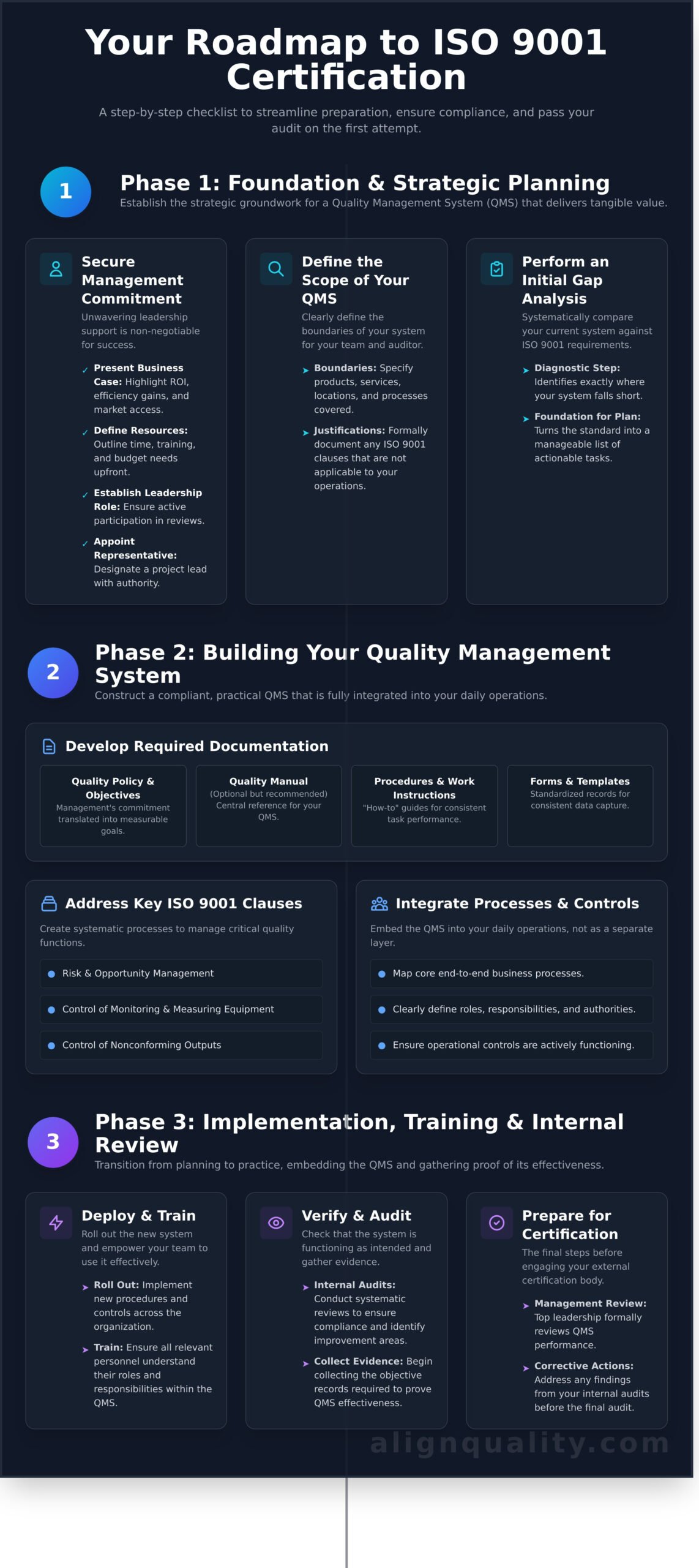
Phase 1: Foundation and Strategic Planning
The journey toward ISO 9001 certification begins long before the first procedure is written. This initial phase is the most critical, as it establishes the strategic foundation for your Quality Management System (QMS). Proper planning at this stage prevents costly rework, aligns the project with key business objectives, and ensures the entire process is efficient and effective. It is about building a system that delivers tangible value, not just a certificate for the wall.
Secure Management Commitment
Without unwavering support from top management, any QMS initiative is destined to struggle. Leadership must understand that the goal is not merely compliance, but business improvement. Gaining this commitment requires a clear, strategic approach.
- Present the Business Case: Articulate the benefits beyond certification, such as improved operational efficiency, reduced waste, enhanced customer satisfaction, and access to new markets.
- Define Required Resources: Clearly outline the necessary investments in terms of employee time, potential training, and budget to demonstrate foresight and planning.
- Establish Leadership’s Role: Top management is directly responsible for the QMS’s effectiveness. Their active participation in reviews and policy-setting is a non-negotiable requirement of the standard.
- Appoint a Representative: Designate a management representative or project lead with the authority to oversee implementation and report on QMS performance.
Define the Scope of Your QMS
Your QMS does not necessarily need to cover every department or process in your organization. The scope defines the precise boundaries of your system. This documented statement clarifies which products, services, locations, and processes will be included in your pursuit of certification for iso 9001. It is also where you will formally justify any clauses from the ISO 9000 family of standards that are not applicable to your operations (e.g., a company that does not perform design and development). A well-defined scope provides clarity for your team and your auditor.
Perform an Initial Gap Analysis
Before you build, you must understand your starting point. A Gap Analysis is a systematic review that compares your existing processes, policies, and records against the specific requirements of the ISO 9001 standard. This diagnostic step identifies exactly where your current system falls short and what needs to be developed or improved. The findings from this analysis form the basis of your implementation project plan, turning a complex standard into a manageable list of actionable tasks.
A professional assessment ensures no requirement is overlooked, setting a clear path forward. Let our experts conduct a thorough Gap Analysis for you.
Phase 2: Building Your Quality Management System (QMS)
Following your gap analysis, this phase is the core of your implementation journey. The objective is to construct a Quality Management System that is both compliant and practical-a system that enhances your operations, rather than simply satisfying an auditor. A robust QMS is the foundation for achieving a successful and sustainable certification for iso 9001. The focus here is on creating clear, usable documentation and embedding quality principles directly into your business processes.
Develop Required Documentation
Effective documentation is the backbone of your QMS. It provides consistency and clarity for your team. The goal is to be concise and precise, creating documents that will be actively used. Your key deliverables include:
- Quality Policy and Objectives: A high-level statement from management defining your commitment to quality, which is then translated into measurable objectives.
- Quality Manual: While optional in the latest standard, a Quality Manual is a highly recommended best practice. It serves as a central reference for the scope of your QMS, procedures, and process interactions.
- Procedures and Work Instructions: These are the “how-to” guides for your key processes. They ensure tasks are performed consistently and correctly, reducing errors and improving efficiency.
- Forms and Templates: Establish standardized forms for records such as internal audits, corrective actions, and management reviews to ensure consistent data capture.
Address Key ISO 9001 Clauses
Your QMS must be structured to meet the specific requirements of the standard. This involves creating systematic processes to manage critical quality functions. Addressing these clauses is not just a procedural step; according to the American Society for Quality, it demonstrates a fundamental commitment to risk-based thinking and continual improvement. Key areas to establish include a formal process for identifying and managing risks and opportunities, a system for controlling, calibrating, and maintaining monitoring and measuring equipment, and a clear procedure for identifying and controlling nonconforming outputs to prevent their unintended use.
Integrate Processes and Controls
A successful QMS is not a separate layer of bureaucracy; it is fully integrated into your daily operations. Begin by mapping your core business processes from end to end, from sales and design to production and delivery. Clearly define the roles, responsibilities, and authorities for all personnel whose work affects quality. This integration ensures that operational planning and controls are not just documented but are actively functioning within your business. This unified approach makes the system more effective and simplifies the long-term management of your certification for iso 9001.
Phase 3: Implementation, Training, and Internal Review
With your Quality Management System (QMS) documented, this phase transitions your organization from planning to practice. The objective is to roll out the new processes and integrate them into your daily operations. This is a critical stage where you verify that the system is functioning as intended and begin collecting the objective evidence needed to prove its effectiveness. Successfully navigating this phase builds the foundation for a smooth and confident external audit, moving you closer to achieving certification for iso 9001.
Conduct Employee Training and Awareness
A QMS is only effective if your team understands and uses it. Conduct thorough training for all relevant staff on the new procedures and policies that affect their roles. It is essential to communicate the company’s Quality Policy and ensure every employee understands their specific contribution to maintaining quality standards. This step fosters a culture of quality awareness and accountability across the entire organization.
Perform a Full Internal Audit
Before the external auditor arrives, you must conduct a comprehensive internal audit. This “dress rehearsal” is performed by a trained internal auditor to systematically review the entire QMS. The audit’s purpose is to verify compliance with the requirements of the international standard for a quality management system and your own documented procedures. All findings, including nonconformities and opportunities for improvement, must be meticulously documented in a formal report. This provides a clear action plan for any necessary corrections.
Hold a Management Review Meeting
The management review is a formal, mandatory meeting where top leadership assesses the QMS’s performance and suitability. This is not a simple status update; it is a strategic evaluation based on hard data. Key inputs for this meeting must include:
- Results from the internal audit
- Customer feedback and satisfaction levels
- Process performance and product conformity data
- The status of preventive and corrective actions
- Recommendations for improvement and resource allocation
Detailed minutes from this meeting are a required record for your certification for iso 9001 audit, demonstrating leadership’s commitment to the quality system.
Phase 4: The External Certification Audit
After diligent implementation and internal review, you have reached the final phase of your certification journey: the external audit. This formal assessment is conducted by an independent, third-party organization to verify that your Quality Management System (QMS) meets every requirement of the ISO 9001 standard. Meticulous preparation is the cornerstone of a smooth and successful audit experience, transforming it from a stressful test into a confident validation of your hard work.
The external audit is methodically structured into two distinct parts, ensuring a thorough and fair evaluation of your system.
Select an Accredited Certification Body (Registrar)
Choosing the right partner for your audit is a critical first step. This organization, known as a certification body or registrar, will assess your QMS and, upon successful review, issue your certificate. Ensure you perform due diligence:
- Research and Vet: Identify registrars with proven experience and positive reputations within your specific industry.
- Verify Accreditation: Confirm that the registrar is accredited by a recognized authority, such as ANAB in the United States. This accreditation validates their competence and impartiality.
- Define the Scope: Obtain detailed quotes and agree on the audit scope, schedule, and terms before committing.
Navigate the Stage 1 Audit
The Stage 1 audit serves as a crucial readiness review. An auditor from your chosen certification body will conduct a high-level assessment of your QMS documentation, such as your quality manual, key procedures, and objectives. Often performed as a desktop review or a brief site visit, its primary goal is to identify any major gaps or “non-conformities” that could prevent a successful Stage 2 audit. This step provides a valuable opportunity to address potential issues beforehand.
Undergo the Stage 2 (Certification) Audit
This is the comprehensive, on-site evaluation where the auditor verifies your QMS in action. They will observe your processes, interview staff at all levels to confirm their understanding of their roles, and review records to find objective evidence of compliance. The auditor’s goal is to confirm that your QMS is not just documented but is a living, effective system. A successful outcome from this audit leads directly to the recommendation for your certification for iso 9001.
Go into your audit with confidence. See how we prepare you.
Phase 5: Post-Certification and Continual Improvement
Achieving your ISO 9001 certificate is a significant milestone, but it marks the beginning of your quality journey, not the end. Your certification is valid for a three-year cycle, and maintaining compliance requires a sustained commitment to the principles you have implemented. This final phase is about transforming your Quality Management System (QMS) from a project into a core part of your business operations-a dynamic tool for driving measurable improvement.
Address Audit Findings and Corrective Actions
Following your certification audit, your registrar may have identified nonconformities or opportunities for improvement. It is critical to address these findings systematically. Your first step is to develop a robust corrective action plan that not only fixes the immediate issue but also investigates and resolves the root cause to prevent recurrence. You must then provide documented evidence of these actions to the registrar for closure.
Prepare for Annual Surveillance Audits
To ensure your QMS remains effective, your registrar will conduct surveillance audits in the first and second years of your certification cycle. These are not full system audits but rather partial reviews focusing on key processes and any previous areas of concern. To prepare, you must continue to operate your QMS diligently. This includes:
- Conducting your scheduled internal audits.
- Holding regular management review meetings.
- Maintaining accurate records and documentation.
Drive Continual Improvement
The true value of your QMS lies in its ability to foster continual improvement. Use the data your system generates-from customer feedback, internal audits, and process performance metrics-to make informed business decisions. As your business evolves, your processes and documentation must evolve with it. The goal is not just to pass audits but to leverage the system, ensuring your certification for iso 9001 drives tangible business results and prepares you for your full recertification audit before the third year concludes.
By embedding these practices, you ensure the long-term success and relevance of your quality management system. To navigate your post-certification journey with confidence, explore how Align Quality supports businesses in maintaining and enhancing their QMS for sustained growth.
Embark on Your ISO 9001 Journey with Confidence
Achieving ISO 9001 certification is a transformative process, not just a one-time audit. As this guide illustrates, success hinges on a methodical approach-from strategic planning and building a robust Quality Management System to diligent implementation and a commitment to continual improvement. The path to certification for iso 9001 is a strategic investment that reinforces your dedication to quality, efficiency, and customer satisfaction.
While this checklist provides the map, the journey can be complex. At Align Quality, our team of Certified ISO 9001 Lead Auditors is here to guide you with precision and expertise. Our proven 5-Stage Certification Process, backed by multi-industry experience, is designed to streamline your path to compliance and ensure a successful outcome.
Ready to take the next step with an expert partner? Book a free consultation to discuss your ISO 9001 certification journey. Your commitment to quality is the foundation, and with the right guidance, certification is a powerful catalyst for lasting business excellence.
Frequently Asked Questions About ISO 9001 Certification
How long does it take to get ISO 9001 certification?
For a small to medium-sized business, the journey to certification typically takes between 3 and 6 months. Larger or more complex organizations may require 6 to 12 months. This timeline is influenced by factors such as your company’s size, the complexity of its processes, and the current maturity of your quality systems. A structured approach and dedicated resources are key to achieving certification efficiently and with confidence.
What is the total cost of getting certified for ISO 9001?
The total investment for ISO 9001 certification is comprised of three main parts: consultancy fees for system development and implementation, the certification body’s fees for conducting the audits, and any internal costs for new software or employee training. Costs vary significantly based on company size, number of sites, and process complexity. We provide a clear, detailed proposal to ensure you have a full understanding of the financial commitment from the start.
What is the difference between an accredited and an unaccredited certificate?
An accredited certificate is issued by a certification body that has been independently verified by a national authority (like UKAS or ANAB). This accreditation ensures the certification body is impartial, competent, and credible, giving your certificate global recognition. An unaccredited certificate lacks this official oversight and may not be accepted by clients, especially for tenders or in regulated industries. For maximum commercial value, always pursue accredited certification.
Can we fail the certification audit? What happens next?
An outright “fail” is rare. It is more common for an auditor to identify “non-conformities,” which are specific areas where your system does not meet the standard’s requirements. You will then be given a set period, typically 30-90 days, to submit a corrective action plan. Once the auditor approves your resolutions, your organization will be recommended for certification. A thorough preparation process minimizes these findings and ensures a smooth audit experience.
Do we need to hire a full-time quality manager to maintain the system?
No, the ISO 9001 standard does not mandate a full-time quality manager. For many businesses, especially SMEs, these responsibilities can be assigned to an existing manager or team member who has the authority to oversee the Quality Management System (QMS). The critical factor is that someone has clear ownership for maintaining the system, managing internal audits, and reporting on performance to top management, making ongoing compliance both practical and cost-effective.
What’s the difference between a consultant (like Align Quality) and a registrar?
A consultant, like Align Quality, is your strategic partner. We guide you through building, documenting, and implementing your QMS to ensure it is effective and ready for auditing. A registrar, also known as a Certification Body, is the independent third party that conducts the official audit. To maintain impartiality, a registrar cannot provide advice or consult on building your system; their sole function is to assess your compliance against the ISO 9001 standard.
How often do we need to be re-audited to keep our certification?
Your certification for ISO 9001 operates on a three-year cycle. Following your initial certification, you will undergo annual “surveillance audits” in year one and year two. These are shorter audits to verify that your QMS is being maintained and improved. In the third year, a more comprehensive “recertification audit” is performed to renew your certificate for the next three-year period, ensuring the long-term integrity of your quality processes.