As the timeline for the next revision of ISO 9001 approaches, uncertainty can create significant challenges for any organization. Questions about the cost of transition, the validity of your current certificate, and the official compliance deadlines are common and valid concerns. Navigating the upcoming iso 9001 certification requirements 2026 requires a clear and methodical approach, not speculation. This guide is designed to provide that clarity and remove the anxiety from your planning process.
Here, we provide the definitive breakdown you need to prepare your Quality Management System. We will detail the confirmed key changes, outline the official timeline for compliance, and give you an actionable checklist to begin your transition journey. Our goal is to equip you with the expert knowledge to manage this update smoothly, ensuring your organization achieves compliance with confidence and minimal disruption.
The Road to ISO 9001:2026: Official Timeline & Key Milestones
The speculation is over. The International Organization for Standardization (ISO) has officially confirmed the revision of ISO 9001, with the process now moving into defined stages. As the world’s most recognized quality management standard and a cornerstone of the ISO 9000 family of standards, it undergoes periodic reviews to ensure it remains relevant to the modern business landscape. Understanding this structured process provides clarity and a strategic advantage for your business.
The revision journey follows a meticulous, multi-stage path, beginning with a formal proposal and culminating in final publication. A critical milestone has already been achieved: the approval of the Draft International Standard (DIS). This is the first comprehensive draft that provides a reliable look at the updated iso 9001 certification requirements 2026, allowing organizations to move from speculation to proactive preparation.
Confirmed Publication and Transition Timeline
Clarity on timelines is essential for strategic planning. ISO and the International Accreditation Forum (IAF) have established a clear framework for the standard’s release and the subsequent transition period for certified organizations. Here are the key dates to mark in your compliance calendar:
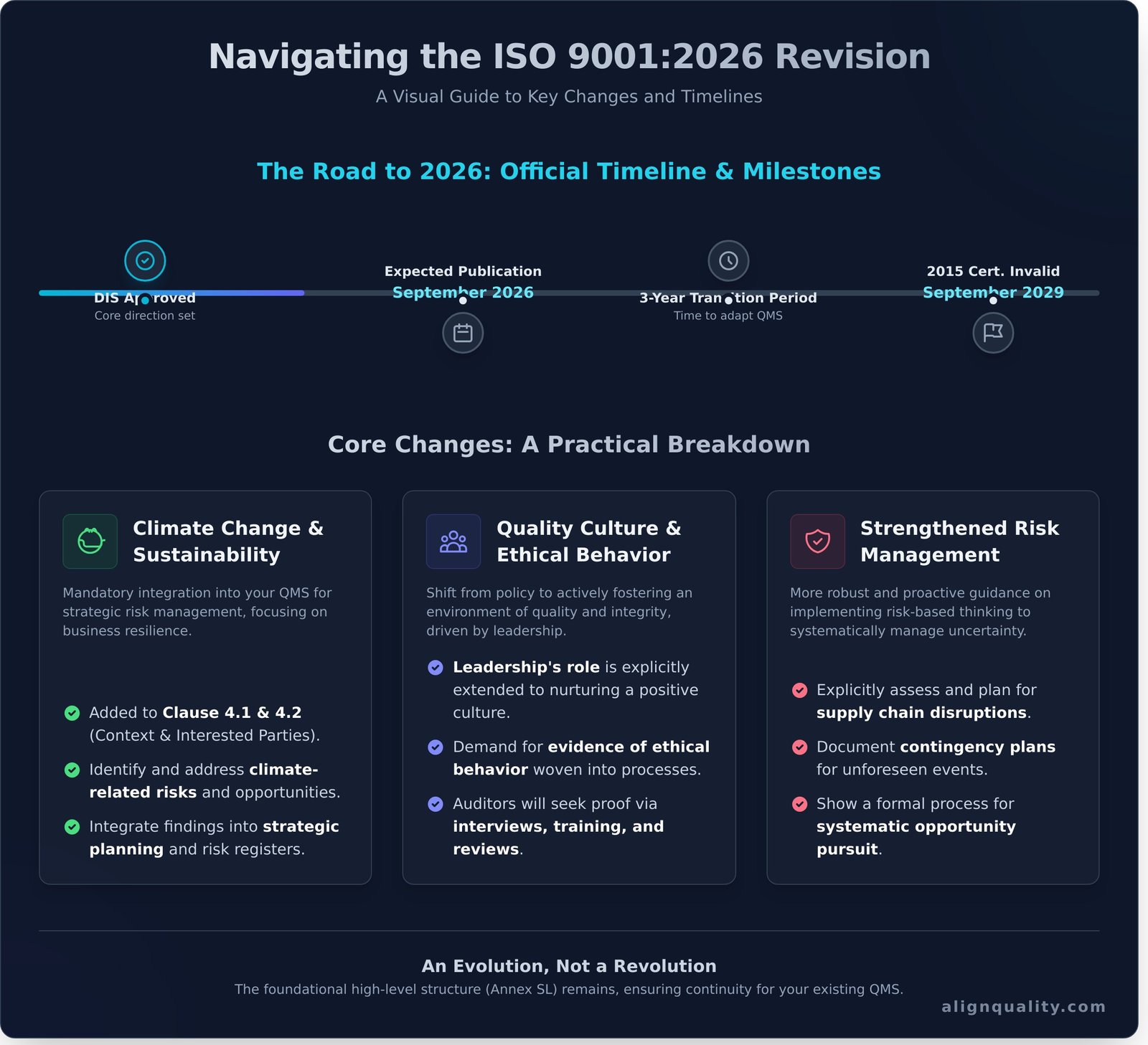
- Expected Publication: The final version of ISO 9001:2026 is scheduled for publication around September 2026.
- Transition Period: A standard three-year transition period will commence upon publication.
- Certificate Validity: Your existing ISO 9001:2015 certificate will remain valid until September 2029, giving your organization ample time to adapt its Quality Management System (QMS) and undergo a transition audit.
What Does the DIS Approval Mean for Your Business?
The approval of the DIS signifies that the core direction of the new standard is set. While minor changes may occur before final publication, businesses can now plan with a high degree of confidence. The most important takeaway is that this is an evolution, not a revolution. The foundational high-level structure (Annex SL) will remain, ensuring continuity for your existing QMS. However, significant refinements are confirmed, and understanding them now is the first step toward a seamless transition. By analyzing the draft iso 9001 certification requirements 2026 today, you can avoid last-minute scrambling and integrate changes methodically, ensuring your journey to renewed certification is smooth and efficient.
Core Changes: A Practical Breakdown of the New ISO 9001:2026 Requirements
The upcoming revisions to the standard are more than just new clauses to memorize; they represent a strategic evolution in quality management. The focus shifts from procedural compliance to building a resilient, ethical, and value-driven organization. Understanding the updated iso 9001 certification requirements 2026 means looking beyond the text to the intent. While the American Society for Quality (ASQ) defines a quality management system as a foundational structure, the 2026 revision elevates this by embedding forward-thinking concepts directly into the framework. These changes are opportunities to strengthen your operations, not just new boxes to tick for an audit.
Integrating Climate Change and Sustainability
This mandatory addition to Clauses 4.1 (Context of the Organization) and 4.2 (Interested Parties) requires you to consider climate-related risks and opportunities. This is not about environmentalism for its own sake, but about strategic risk management. Your QMS must now demonstrate how you have identified the relevance of climate change to your business purpose and the needs of your stakeholders. An auditor will expect to see this analysis integrated into your risk register and strategic planning.
Emphasis on Quality Culture and Ethical Behavior
Leadership’s role is now explicitly extended beyond policy-setting to actively fostering a positive quality culture. The new requirements demand evidence that ethical behavior is woven into your processes, from sales to service delivery. Auditors will look for more than a code of conduct; they will seek proof through employee interviews, training records, and management review minutes that show ethical considerations are a living part of your continual improvement cycle. This directly links quality management to employee engagement and trust.
Strengthening Risk and Opportunity Management
The 2026 revision provides clearer, more robust guidance on implementing risk-based thinking throughout your QMS. The updated iso 9001 certification requirements 2026 compel organizations to be more proactive and systematic in managing uncertainty. Key actions include:
- Supply Chain Resilience: Explicitly assess and plan for disruptions to your critical suppliers.
- Contingency Planning: Document your plans for handling unforeseen events, such as natural disasters or technological failures.
- Systematic Opportunity Pursuit: Show a formal process for identifying, evaluating, and acting on opportunities for improvement, not just reacting to problems.
Clause-by-Clause Impact: How the 2026 Revision Affects Your QMS
To prepare your Quality Management System (QMS) for a successful transition, it is essential to understand where the changes will have the most impact. While the revision builds upon the solid foundation of the current standard, understanding the existing requirements for ISO 9001:2015 is the first step. This clause-by-clause breakdown pinpoints the key areas requiring attention, providing a clear basis for your internal gap analysis and helping you meet the new iso 9001 certification requirements 2026 with confidence.
Clause 4: Context of the Organization
Your organization’s context must now explicitly address broader global challenges. This means updating your SWOT analysis to include risks and opportunities related to climate change, such as supply chain disruptions from extreme weather. You will also need to review your list of interested parties to ensure their evolving needs, like regulatory demands for sustainability reporting, are captured. Consequently, the documented scope of your QMS must be revised to reflect how it manages these new external issues.
Clause 5: Leadership
Top management’s role is expanding to champion a more holistic quality culture. You will need to document how leadership actively promotes and sustains this culture, including a commitment to ethical behavior. These principles should be integrated into formal documents like your quality policy or leadership commitment statements. Furthermore, management review inputs must be updated to include these topics, ensuring consistent oversight of organizational culture, ethics, and sustainability goals.
Clause 6: Planning
The approach to risk management becomes more forward-looking. Your risk and opportunities register must be expanded to formally include potential disruptions from supply chain vulnerabilities and climate-related events. Quality objectives should now be established to address these new focus areas, with measurable targets related to sustainability or organizational culture. Your change management process will also require strengthening to ensure all changes are assessed for their impact on resilience and compliance.
Clause 8: Operation
Operational processes must embed the new principles of resilience and sustainability. During design and development, inputs must now consider factors like product lifecycle and material recyclability. Supplier evaluation criteria should be updated to assess their resilience and business continuity plans, not just their quality performance. Finally, your operational controls must be reviewed and updated to ensure they effectively mitigate the new risks identified in your planning phase, from resource scarcity to logistical disruptions.
Your Transition Strategy: A 4-Step Plan to Prepare for ISO 9001:2026
While the transition deadline may seem distant, a proactive approach is essential for a seamless and cost-effective certification journey. Waiting until the last minute creates unnecessary risk and pressure on your team. Preparing for the updated iso 9001 certification requirements 2026 now ensures you have ample time to implement changes correctly and effectively.
This structured, 4-step plan is the proven methodology we use to guide our clients. Following these steps will streamline your efforts, minimize disruption, and prepare your organization to face your first transition audit with confidence.
Step 1: Awareness and Training
A successful transition begins with clear communication and education. Your leadership team must understand the strategic implications of the revised standard, while your internal auditors and quality team require specific training on the DIS changes. Communicating the upcoming adjustments and a clear timeline across the organization ensures alignment and fosters a culture of preparedness from the start.
Step 2: Perform a Gap Analysis
Before you can create a roadmap, you must know your starting point. A gap analysis involves a meticulous comparison of your current Quality Management System (QMS) against the new DIS requirements. This process identifies specific deficiencies in your documentation, processes, and practices. For a truly objective assessment, let our experts conduct a professional gap analysis to deliver a detailed report with prioritized findings.
Step 3: Develop and Execute an Implementation Plan
With your gap analysis report in hand, the next step is to take decisive action. Develop a formal project plan that outlines specific tasks, assigns clear responsibilities, and sets realistic deadlines. This is the phase where you will update QMS documents, revise policies, and implement new or modified processes to close the identified gaps. Remember to gather evidence to demonstrate the effectiveness of these changes.
Step 4: Conduct an Internal Audit and Management Review
The final preparatory step is verification. Conduct a full internal audit of your updated QMS against the ISO 9001:2026 DIS. This critical step verifies that all new requirements have been met and that your implemented changes are working as intended. Presenting the audit findings at a formal management review provides the ultimate confirmation that your organization is ready for its official transition audit.
Should You Wait for 2026 or Get Certified to ISO 9001:2015 Now?
As the next revision of ISO 9001 approaches, many business leaders ask a critical question: should we pursue certification now or wait? The answer is unequivocally clear. The strategic advantages of achieving ISO 9001:2015 certification today far outweigh the perceived benefits of waiting.
Delaying certification means postponing tangible improvements in operational efficiency, customer satisfaction, and market access. For years, your organization could miss out on contracts that mandate ISO 9001 compliance, while competitors who are already certified gain a significant competitive edge. It is crucial to understand that even after the new standard is published, certification bodies will not offer audits against it for at least 12-18 months, pushing potential certification out to late 2027.
The Strategic Advantage of Acting Now
Achieving certification now provides immediate and lasting business value. A robust Quality Management System (QMS) built on the proven ISO 9001:2015 framework allows you to streamline processes and win new business right away. Waiting for the future iso 9001 certification requirements 2026 simply puts these benefits on hold.
- Build a Strong Foundation: Implement a mature QMS that delivers results now. This makes the future transition a simple update rather than a complex, from-scratch implementation.
- Secure Immediate Opportunities: Don’t let valuable contracts pass you by while you wait. Your ISO 9001:2015 certificate is a powerful tool for growth today.
- Ensure a Smooth Transition: Organizations with an existing, certified QMS find it far easier and more cost-effective to adapt to new requirements.
- Maintain a Valid Certificate: Your ISO 9001:2015 certificate will remain valid for its full three-year cycle, providing you with ample time to transition.
How Align Quality Ensures a Future-Proof Certification
At Align Quality, we don’t just help you meet today’s standards; we prepare you for tomorrow’s. Our expert consultants build your ISO 9001:2015 QMS with a forward-looking perspective, incorporating best practices and structures that anticipate the direction of the upcoming iso 9001 certification requirements 2026. This proactive approach ensures your certification journey is efficient and that your QMS is resilient and easy to adapt when the time comes.
We streamline the process so you can achieve certification quickly, unlock its benefits, and be perfectly positioned for a seamless transition in the future. Start your certification journey with confidence today.
Navigate Your ISO 9001:2026 Transition with Confidence
The upcoming revision to the ISO 9001 standard represents a significant opportunity for organizational improvement. As we’ve explored, proactive preparation is the cornerstone of a successful transition. By understanding the official timeline, the core changes, and their impact on your QMS, you can strategically position your business for future success. Mastering the new iso 9001 certification requirements 2026 is not just about compliance; it’s about refining your processes to deliver superior value and resilience.
You do not have to navigate this journey alone. With expert guidance from certified ISO 9001 lead auditors, you can future-proof your QMS and streamline your path to certification. Our proven 5-stage process ensures a confident transition, removing uncertainty and complexity from the process. Take the definitive next step in your quality management journey. Book a free consultation to discuss your ISO 9001:2026 transition plan and embrace the future of quality with a trusted partner.
Frequently Asked Questions About ISO 9001:2026
When will the final version of ISO 9001:2026 be published?
The International Organization for Standardization (ISO) is targeting a publication date in late 2025, although this could extend into early 2026. The final iso 9001 certification requirements 2026 are determined after several review stages, including member feedback on draft versions. Any significant comments can adjust the final timeline, so it is crucial to monitor official ISO communications for the definitive publication announcement.
How long will my ISO 9001:2015 certificate be valid for?
Your ISO 9001:2015 certificate remains valid for its full three-year cycle. However, all certified organizations must transition to the 2026 version before the end of the official transition period, which is expected to be three years after publication (likely ending in 2029). Your certification body will conduct your transition audit during one of your scheduled surveillance or recertification audits within that timeframe to ensure compliance.
Can I get certified directly to ISO 9001:2026 as soon as it’s released?
Typically, you cannot get certified to a new standard immediately upon its publication. Certification bodies must first complete their own accreditation process to audit against the new requirements, which takes several months. They usually begin by offering transition audits to existing clients. For a short period post-release, new certifications will likely still be to the 2015 standard, with a clear plan for a future transition.
What is the main difference between an ‘amendment’ and a ‘revision’?
An ‘amendment’ involves minor changes, clarifications, or corrections to a standard without altering its core structure or fundamental principles. In contrast, a ‘revision’ is a comprehensive review that can introduce significant structural changes, like the shift to the Annex SL framework in 2015. The upcoming ISO 9001:2026 update is planned as an amendment, suggesting the changes will be less extensive than a full revision.
How much effort will be required to transition from the 2015 to the 2026 version?
Because the 2026 update is expected to be an amendment, the transition effort should be significantly less than the 2015 update. The focus will be on understanding and integrating the specific new clauses related to topics like sustainability and risk. A thorough gap analysis is the critical first step to identify where your Quality Management System needs adjustment. Understanding the new iso 9001 certification requirements 2026 early will ensure a smooth and efficient transition journey.
Do the new requirements apply to small businesses as well?
Yes, the ISO 9001 standard is intentionally designed to be scalable and applicable to any organization, regardless of its size or industry. The requirements are framed to allow flexibility in how they are met, enabling small businesses to implement them effectively. The core principles of quality management are universal and provide a robust framework for improvement and customer satisfaction for businesses of all scales, ensuring consistent quality and operational excellence.
What happens if my company doesn’t transition by the 2029 deadline?
Failure to transition to the ISO 9001:2026 standard by the end of the official transition period (tentatively 2029) will result in the withdrawal of your ISO 9001:2015 certification. Your certificate will become invalid. This can have serious commercial consequences, as many contracts and client relationships depend on maintaining a valid certification. To avoid this risk, it is crucial to plan your transition well ahead of the deadline.