For many businesses, the prospect of an ISO audit can seem intimidating. It’s a critical milestone on your certification journey, but the process often feels complex, raising valid concerns about team readiness, documentation, and the fear of not achieving certification. This apprehension can overshadow the true purpose of the audit: to validate and strengthen your quality management system, proving your commitment to excellence.
For international teams, ensuring clear and confident communication with the auditor is especially critical. To support this, many leaders discover more about accent reduction to ensure their key personnel can explain complex processes without ambiguity.
This comprehensive guide is designed to remove that uncertainty and empower your team. We provide a clear, methodical roadmap to help you navigate every stage of the audit process with confidence. You will learn exactly how to prepare, what to expect during the assessment, and how to manage follow-up actions effectively. By the end, you will have a practical plan to ensure a smooth audit, allowing you to achieve your certification goals without major issues or delays.
What Is an ISO Audit? (And Why It’s More Than Just a Test)
Many business leaders view an upcoming audit with apprehension, picturing a high-stakes exam. However, an ISO audit is fundamentally different. It is a systematic, independent, and documented process for obtaining objective evidence and evaluating it to determine the extent to which your Quality Management System (QMS) fulfills the requirements of the ISO 9001 standard. Think of it less as a test and more as a collaborative verification tool.
At its core, this specific type of quality audit is designed to confirm that your organization’s processes are not only documented but also consistently followed in practice. A successful audit provides impartial, third-party validation of your commitment to quality, customer satisfaction, and continual improvement-a powerful differentiator in any industry.
The Dual Purpose: Verifying Conformance & Driving Improvement
An effective iso audit serves two critical functions. First, it verifies conformance by checking that your documented procedures align with the ISO 9001 standard and that your teams are adhering to them. Second, it drives improvement by methodically identifying weaknesses, inefficiencies, and non-conformities. This process uncovers valuable opportunities to strengthen operations, reduce business risk, and enhance overall efficiency.
Who Performs Audits? Key Players and Their Roles
The auditing process involves several distinct roles, each with a specific function on your certification journey:
- Internal Auditors: These are trained members of your own team (or a hired consultant) who conduct regular internal checks. Their goal is to ensure your QMS is working as intended and to prepare you for the external audit.
- Consultants: Expert firms, like Align Quality, guide you through the entire preparation process. We help you conduct gap analyses, implement necessary changes, and ensure you are fully prepared to achieve certification with confidence.
- Certification Body (Registrar): This is the independent, accredited third-party organization that performs the official certification audit. Their auditors make the final determination on whether your QMS meets the standard and can be certified.
Fundamental Principles of Auditing
To ensure credibility and value, all ISO audits are built on a foundation of professional principles. These guiding rules ensure the process is fair, consistent, and delivers reliable results.
- Evidence-Based Approach: Conclusions are drawn only from verifiable facts, records, and observations-not from assumptions or personal opinions.
- Impartiality and Independence: The auditor must remain unbiased and free from any conflict of interest to ensure the findings are objective and trustworthy.
- Fair Presentation: All findings, both positive and negative, must be reported truthfully, accurately, and completely to provide a clear picture of the QMS’s status.
The Three Main Types of ISO Audits Explained
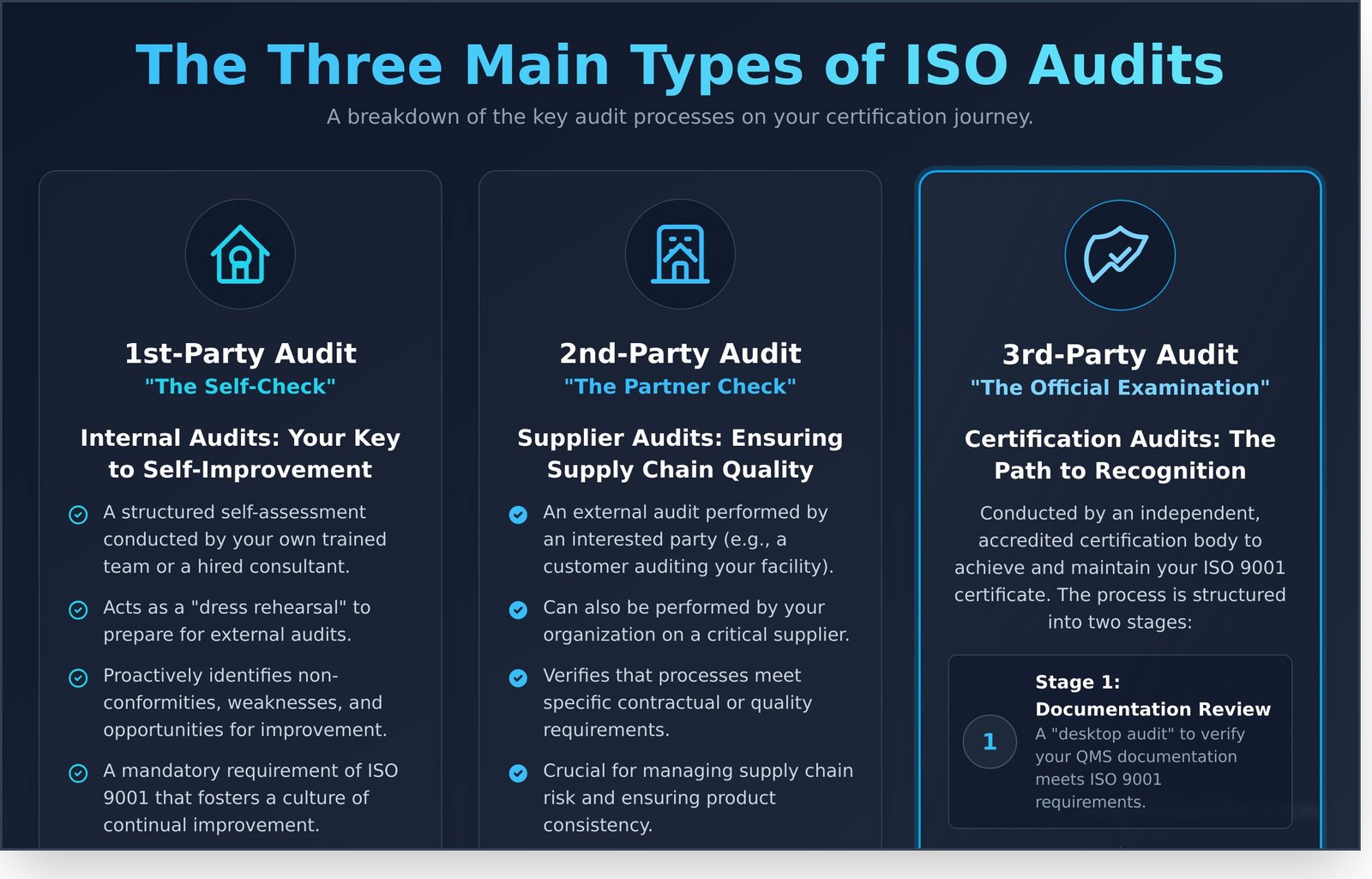
Navigating your ISO 9001 certification journey requires a clear understanding that not all audits are created equal. The term “audit” can refer to several distinct processes, each serving a vital purpose within your quality management system (QMS). To simplify, think of them as a logical sequence: a self-check to prepare, a partner check to ensure alignment, and the final, official examination for certification. Differentiating between these is fundamental to achieving compliance with confidence.
First-Party Audits (Internal Audits): Your Key to Self-Improvement
A first-party, or internal, audit is your organization’s structured self-assessment. It is a mandatory requirement of the ISO 9001 standard and acts as a dress rehearsal for your certification audit. This proactive process allows your team to identify non-conformities, system weaknesses, and opportunities for improvement before an external auditor does. Regularly performing effective internal audits is the cornerstone of a healthy QMS, fostering a culture of continual improvement and operational excellence. For an objective and expert evaluation, many businesses partner with certified consultants to conduct this critical internal review.
Second-Party Audits (Supplier Audits): Ensuring Supply Chain Quality
A second-party audit is an external review performed on your organization by an interested party, such as a major customer, or performed by your organization on a critical supplier. The primary purpose is to verify that processes and outputs meet specific contractual or quality requirements. For example, a customer may audit your facility to confirm you have the controls in place to deliver a reliable product. These audits are crucial for managing supply chain risk and ensuring consistency, especially in industries like manufacturing, aerospace, and automotive where component integrity is non-negotiable.
Third-Party Audits (Certification Audits): The Path to Recognition
This is the formal iso audit that everyone associates with certification. It is conducted by a completely independent, accredited certification body (also known as a registrar) with no affiliation to your organization. A successful third-party audit is the only way to achieve and maintain your ISO 9001 certificate. The process is methodically structured into two stages:
- Stage 1 Audit: Often called a “desktop audit,” this is a thorough review of your QMS documentation. The auditor verifies that your written procedures, policies, and objectives meet the requirements of the ISO 9001 standard.
- Stage 2 Audit: This is a comprehensive on-site evaluation where the auditor observes your operations, interviews staff, and reviews records to confirm that your organization is following its own documented system and adhering to the standard.
Passing this final audit validates your commitment to quality and results in globally recognized certification.
Your Step-by-Step Guide to Preparing for a Certification Audit
Success in your certification audit is not a matter of chance; it is a direct result of meticulous preparation. A well-executed plan removes uncertainty, reduces stress for your team, and ensures a smooth and successful process. This practical guide mirrors Align Quality’s proven 5-stage methodology, providing a clear roadmap to prepare your organization for its assessment with confidence.
Step 1: Conduct a Thorough Gap Analysis
The gap analysis is the foundational first step. It is a detailed comparison of your current Quality Management System (QMS) against the specific requirements of the ISO 9001 standard. This process systematically identifies every ‘gap’-areas where your system is non-compliant. The resulting report becomes the essential roadmap for all your implementation and preparation efforts, ensuring you focus resources exactly where they are needed. Let our experts conduct a professional gap analysis for you.
Step 2: Assemble Your Documentation and Records
An auditor needs objective evidence that your QMS is both established and effective. Your documentation provides this proof. Ensure all key documents are complete, approved, and readily accessible. This includes:
- Your Quality Manual
- Documented procedures and policies
- Work instructions and process flowcharts
- Records of training, reviews, and corrective actions
Tip: Organize documents in a logical digital structure with clear naming conventions to facilitate quick retrieval during the audit.
Step 3: Run a Comprehensive Internal Audit
This is arguably the most critical step in your preparation. An internal audit acts as a full-scale dress rehearsal for the final certification assessment. It simulates the conditions of the real iso audit, allowing your team to gain confidence and experience. More importantly, it provides a final opportunity to identify and correct any lingering non-conformities before the external auditor arrives, ensuring there are no surprises on the day.
Step 4: Prepare Your Team and Foster the Right Mindset
Your people are central to your QMS. Ensure every relevant team member understands the quality policy, their specific role, and how their work contributes to quality objectives. Coach them on how to interact with an auditor: answer questions honestly and concisely, provide evidence when asked, and maintain a helpful, non-defensive attitude. A positive and prepared team demonstrates a strong quality culture, which is a key indicator of a successful system.
What to Expect on Audit Day: Navigating the On-Site Process
The certification audit day is a pivotal moment in your ISO 9001 journey. While it can feel intimidating, a well-prepared organization will find it a constructive and straightforward process. The purpose is not to find fault, but to verify that your Quality Management System (QMS) is effectively implemented and meets the standard’s requirements. Understanding the structure of the day will help your team navigate the process with confidence.
The Opening Meeting: Setting the Stage
The day begins with a formal opening meeting. This brief session serves to introduce the audit team to your key personnel, confirm the audit scope and schedule, and outline the day’s activities. Your management representative and relevant department heads should attend. This is the designated time to ask the auditor any logistical questions before the main assessment commences.
The Audit Trail: Interviews, Observations, and Document Review
The core of the iso audit involves the auditor gathering objective evidence. They do this by following an “audit trail,” which typically includes three main activities: interviewing staff to confirm their understanding of processes, observing operations to verify they align with documented procedures, and reviewing records like training logs or corrective action forms as proof of compliance. The auditor methodically connects these pieces of evidence to build a clear picture of your system’s effectiveness.
Understanding Audit Findings: Non-conformities vs. Observations
As the auditor works, they will classify their findings into distinct categories. It is crucial for your team to understand the difference:
- Major Non-conformity: A significant failure to meet an ISO 9001 requirement that could prevent certification until a robust corrective action is implemented and verified.
- Minor Non-conformity: An isolated lapse or a minor weakness in the system that does not undermine the entire QMS. These must be addressed but are less critical.
- Observation: Also known as an Opportunity for Improvement (OFI), this is a suggestion from the auditor to enhance your system. It is not a compliance failure.
The Closing Meeting: Reviewing the Results
The day concludes with a closing meeting where the lead auditor presents a formal summary of their findings, including any non-conformities raised. This is not a forum for debate, but a crucial opportunity to ensure you clearly understand the results. The auditor will then explain the next steps, which typically involve submitting a corrective action plan before a final certification decision is made. This final report marks a critical milestone in your certification journey.
After the Audit: Responding to Findings and Maintaining Compliance
The conclusion of your certification audit is a significant milestone, but it marks the beginning of your ongoing quality journey, not the end. Successfully achieving and maintaining ISO 9001 certification requires a proactive approach to addressing findings and embedding a culture of continual improvement. This final phase ensures the long-term value and integrity of your Quality Management System (QMS).
Developing an Effective Corrective Action Plan (CAP)
If your audit identifies any non-conformities, you will be required to submit a Corrective Action Plan (CAP). This is more than a simple checklist; a strong CAP demonstrates your commitment to quality by performing a root cause analysis to prevent the issue from recurring. Your certification body must review and approve this plan before issuing your certificate. We help you build robust corrective action plans that satisfy auditors and drive genuine improvement.
The Role of Surveillance Audits in Your Certification Cycle
ISO 9001 certification is valid for three years, contingent on maintaining compliance. To ensure this, your organization must undergo annual surveillance audits. These are smaller-scale assessments, less intensive than your initial iso audit, designed to verify that your QMS is being effectively maintained and continually improved. They confirm that the principles of ISO 9001 are an active and consistent part of your daily operations.
Leveraging Audit Results for Continual Improvement
View the findings from any iso audit as a valuable, objective assessment of your operations-essentially, a form of expert consulting. Instead of seeing non-conformities as failures, treat them as clear opportunities for enhancement. A strategic response to audit feedback allows you to:
- Refine and streamline critical business processes for greater efficiency.
- Identify gaps in employee training and development programs.
- Strengthen risk management and improve operational resilience.
By integrating these findings into your regular management review meetings, you transform the audit process from a periodic requirement into a powerful engine for continual business growth. For expert guidance on navigating your post-audit journey, contact Align Quality today.
Transform Your ISO Audit from a Challenge into an Opportunity
An ISO audit is more than a compliance checkpoint; it is a powerful mechanism for refining processes and demonstrating your commitment to excellence. The key takeaways are clear: success is built on thorough preparation, a deep understanding of the audit process, and a proactive approach to continuous improvement. Viewing your iso audit through this lens transforms it from a daunting task into a valuable strategic advantage for your business.
Navigating this journey requires expertise and a methodical plan. At Align Quality, our Certified ISO 9001 Lead Auditors utilize our proven 5-Stage Certification Process to deliver success. With multi-industry experience, we provide the expert guidance needed to streamline your preparation and build a resilient quality management system.
Don’t leave your certification to chance. Let our experts guide you every step of the way.
Prepare for Your Audit with Confidence. Book a Free Consultation.
Frequently Asked Questions About the ISO Audit Process
What is the difference between an ISO audit and an inspection?
An ISO audit and an inspection serve different purposes. An audit evaluates whether your overall management system processes conform to the ISO 9001 standard. It focuses on systemic effectiveness. In contrast, an inspection is a more focused activity that verifies if a specific product, service, or activity meets its defined requirements and specifications. An audit looks at the “how,” while an inspection looks at the “what,” ensuring the final output is correct.
How long does a typical ISO 9001 certification audit take?
The duration of an ISO 9001 certification audit depends on several key factors, including the size of your organization, the number of employees, the complexity of your processes, and the number of physical locations being audited. For a small to medium-sized business at a single site, the audit typically takes between one and three days. Larger, more complex organizations with multiple sites will require a significantly longer timeframe, which is determined by the certification body.
What are the most common non-conformities found during an ISO 9001 audit?
The most common non-conformities found during an ISO 9001 audit often relate to documentation and process adherence. These frequently include inadequate document control, where outdated procedures are still in use; insufficient evidence of management reviews; and a lack of robust corrective action processes. Another common issue is failing to properly define and monitor quality objectives, which are critical for demonstrating a commitment to continual improvement and satisfying the standard’s requirements.
Can you ‘fail’ an ISO audit? What happens if major non-conformities are found?
You cannot ‘fail’ an ISO audit in a simple pass/fail sense. Instead, the auditor identifies non-conformities. If major non-conformities are found-meaning a significant failure to meet an ISO 9001 requirement-the certification body will not grant certification until you provide evidence of effective corrective action. Typically, you are given a set period, such as 90 days, to resolve the issue, which may require a follow-up visit from the auditor to verify the solution is implemented.
What is the role of a consultant like Align Quality during the audit process?
A consultant like Align Quality acts as your expert guide and partner throughout the certification journey. Our role is to prepare your organization for a successful audit. This includes conducting a thorough gap analysis, assisting in the development and implementation of your Quality Management System, training your staff, and performing internal audits. During the external audit, we provide support, help interpret auditor questions, and ensure the process proceeds smoothly, giving your team confidence.
How much does an ISO audit cost?
The cost of an ISO 9001 certification audit varies widely based on factors specific to your business. The primary cost drivers are the size of your company (number of employees), the number of sites to be audited, and the complexity of your operations. The fees charged by accredited certification bodies also differ. For a small business, costs can range from $3,000 to $7,000, while larger organizations can expect to pay significantly more. It is essential to obtain a detailed quote.