ISO 9001:2026 Update: The Latest News & How to Prepare Your Business
With any upcoming revision to a major standard like ISO 9001, uncertainty can create anxiety for business leaders. Conflicting information and speculation online can make it difficult to know what’s really changing, when it will happen, and what it means for your Quality Management System (QMS).
This article cuts through the noise. Here, you’ll get a clear, authoritative summary of the ISO 9001 revision, including the official timeline, the most significant proposed changes based on the current draft, and a practical, step-by-step plan to prepare your business with confidence.
The Road to ISO 9001:2025: Official Timeline and Current Status
To understand the latest ISO 9001:2025 news, it’s helpful to first understand the official revision process. ISO standards undergo a systematic review approximately every five years to ensure they remain relevant. While the last version was published in 2015, the 2020 review concluded that no revision was needed at that time. However, a new review process has since begun.
The journey to a new standard involves several key stages, and while many search for “ISO 9001:2025,” the current official timeline suggests a final publication date is more likely to be in the second half of 2025 or early 2026.
Understanding the Revision Stages
The development of a new ISO standard is a structured, collaborative process:
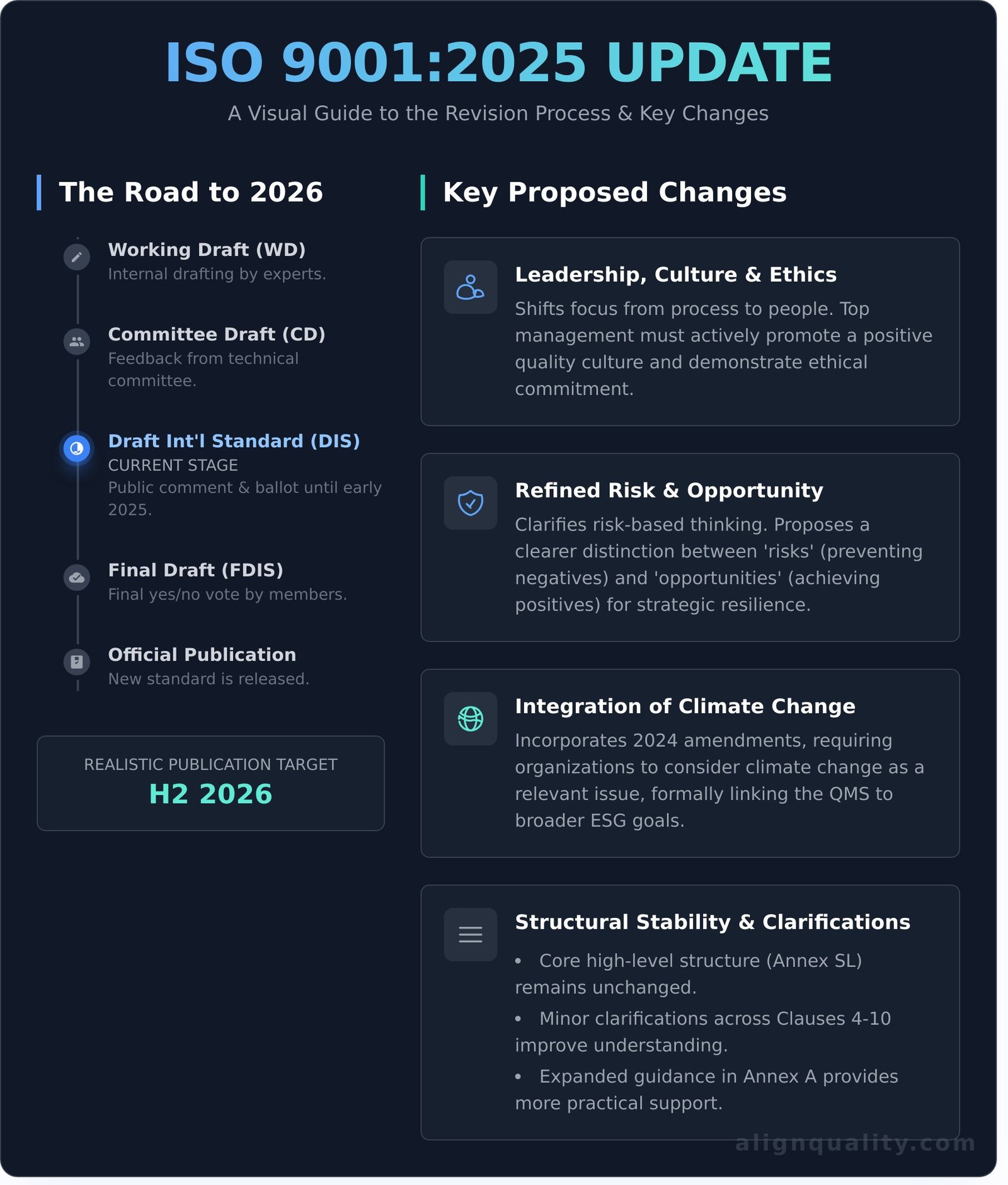
- Working Draft (WD): An internal document where the appointed working group brainstorms and develops the initial text.
- Draft International Standard (DIS): The first version released for public comment and ballot by ISO member bodies. This is a critical stage where the proposed changes become clear.
- Final Draft (FDIS): This version incorporates feedback from the DIS ballot. It is the final text submitted for a yes/no vote before publication.
- Official Publication: The final, approved version of the standard is published and made available.
Where Are We Now in the Process?
The ISO technical committee responsible for quality management, ISO/TC 176/SC 2, has formed a working group to manage the revision.
As of now, the revision process is moving into its critical phases. The working group has been developing the draft, and the next major public milestone will be the release of the Draft International Standard (DIS) for its commenting and voting period. This stage provides the first official look at the proposed changes and allows stakeholders to provide feedback. Based on the typical ISO timeline, the Final Draft (FDIS) would follow, with an expected publication in late 2025 or early 2026.
Key Proposed Changes in the ISO 9001:2025 Draft (DIS)
Based on the available information and draft documents, the upcoming revision appears to be an evolution, not a revolution. The changes aim to align the standard with modern business challenges and future trends. It’s important to remember that these points are based on the draft stage and could be refined before final publication.
The proposed changes are grouped thematically to help business leaders understand the strategic intent behind them.
A Stronger Focus on Leadership, Culture, and Ethics
The new version is expected to place a greater emphasis on the human elements of quality. This moves beyond simply having documented processes to ensuring the right values and behaviors are embedded in the organization.
- Quality Culture: There is a new emphasis on leadership’s role in promoting and sustaining a positive quality culture.
- Ethical Behavior: The draft proposes including ethical considerations as part of leadership’s commitment, ensuring integrity is at the core of the QMS.
Refining Risk and Opportunity Management
While risk-based thinking was the cornerstone of the 2015 version, the update seeks to provide greater clarity and a more systematic approach.
- Clearer Definitions: The draft aims to provide a clearer separation between “risks” (the potential for negative outcomes) and “opportunities” (the potential for positive outcomes).
- Systematic Approach: Expect expanded guidance on how to identify, analyze, and act on both risks and opportunities, strengthening strategic planning and organizational resilience.
Integrating Future-Focused Concepts like Climate Change
Aligning with ISO’s broader commitment to sustainability, the revision will formally incorporate the climate change amendments released in early 2024.
- Context of the Organization: Clauses 4.1 and 4.2 will require organizations to determine if climate change is a relevant internal or external issue for their QMS.
- Strategic Alignment: This links the QMS to broader organizational sustainability goals, ensuring quality management contributes to long-term resilience.
Other Notable Adjustments and Clarifications
The revision will also include minor amendments throughout the standard to improve clarity and consistency.
- Clause Clarifications: Expect minor wording changes in clauses 4-10 to make requirements easier to understand and implement.
- Expanded Annex A: The informative Annex A is likely to be updated with more detailed guidance to help users apply the standard’s principles effectively.
- Core Structure Remains: Reassuringly, the high-level structure (Annex SL) and the core concepts of the PDCA cycle remain unchanged, ensuring a familiar framework.
What the ISO 9001:2025 Update Means for Your QMS
Understanding the proposed changes is the first step; the next is translating them into practical impacts on your day-to-day quality management activities. The key takeaway is that this is an evolution of your current system, not a mandate for a complete overhaul.
Impact on Documentation and Processes
Many leaders fear having to rewrite their entire quality manual. This is highly unlikely. Instead, you should anticipate targeted updates.
- Context of the Organization (Clause 4): Your documentation for this section will need to be updated to show you have considered new issues like climate change.
- Risk and Opportunity Registers: Your processes for risk assessment may need to be refined to reflect the clearer distinction between risks and opportunities.
Changes to Your Internal Audit Program
Your internal audits are a key tool for verifying compliance and driving improvement. They will need to be adapted.
- Updated Checklists: Your internal audit checklists must be updated to include the new and clarified requirements.
- Auditor Training: Your auditors will need training on how to assess new, more abstract concepts like “quality culture” and leadership’s commitment to ethical behavior.
Implications for Management Reviews
Management reviews are the forum for strategic evaluation of the QMS. The inputs for these meetings will need to expand.
- New Agenda Items: Discussions on climate change impacts and the health of the quality culture will need to become standard agenda items.
- Demonstrating Commitment: Leadership will need to use this forum to actively demonstrate their engagement with these new focus areas, ensuring the QMS is aligned with the organization’s strategic direction.
How to Prepare for the Transition to ISO 9001:2025
While the final publication may seem far away, proactive preparation reduces stress, minimizes costs, and turns the transition from a compliance exercise into a strategic business improvement opportunity. You can begin with these high-impact steps now.
Step 1: Educate Your Team and Leadership
The first step is building awareness and understanding.
- Share Reliable Resources: Circulate authoritative articles (like this one) with key stakeholders to ensure everyone is working from the same information.
- Brief Your Leadership: Explain the strategic implications of the changes, focusing on how they can enhance resilience and culture.
- Appoint a Transition Leader: Designate an individual or a small team to monitor updates and lead the transition project.
Step 2: Perform a Preliminary Gap Analysis
Understand where your current QMS stands in relation to the proposed changes.
- Review the Draft Changes: Use the key changes outlined above as a preliminary checklist against your current system.
- Identify Potential Gaps: Note any areas in your processes, documentation, or practices that may not align with the new focus areas.
- Create an Action Plan: Use this analysis to develop a high-level plan of the tasks required to close those gaps.
Our certified ISO 9001 lead auditors specialize in identifying these gaps with precision. Let our experts conduct a professional gap analysis for you.
Step 3: Begin Integrating New Concepts Now
Don’t wait for the final standard to be published. You can start embedding these future-focused concepts into your QMS today.
- Discuss Quality Culture: Start conversations about “what quality culture means to us” in management and team meetings.
- Update Your Strategic Analysis: Formally add climate change and other environmental factors to your SWOT or PESTLE analysis when discussing the Context of the Organization.
- Review Leadership Commitments: Begin assessing how leadership currently demonstrates its commitment to ethics and values.
By starting early, you position your organization not just for a smooth transition, but for a stronger, more resilient future.
Ready to Plan Your Transition with Confidence?
The upcoming ISO 9001 revision is an opportunity to refine your QMS and align it with the business challenges of tomorrow. Our expert consultants are here to guide you every step of the way, from initial gap analysis to successful certification.
Book a Free Consultation to Discuss Your ISO 9001:2025 Transition Plan.
- Expert Guidance: Our team consists of certified ISO 9001 lead auditors.
- Proven Process: We use a proven 5-stage process to ensure certification success.
- Industry Experience: We have multi-industry experience guiding businesses through standard updates.
Frequently Asked Questions
When will ISO 9001:2025 be officially published?
While the exact date is not yet fixed, the current official timeline from the ISO committee suggests a publication date in late 2025 or early 2026.
Will our ISO 9001:2015 certificate become invalid immediately upon publication?
No. There is always a transition period after a new standard is published, typically lasting three years. During this time, your ISO 9001:2015 certificate will remain valid.
How long is the typical transition period for a new ISO standard?
The standard transition period for major ISO management system standards is 36 months (3 years) from the date of the new version’s publication.
Is the 2025 version a major or minor revision of the standard?
Current information from the draft stages indicates this will be a minor revision, or an “amendment.” The core structure and principles of ISO 9001:2015 will remain, with targeted updates and clarifications to enhance the standard’s relevance.
Do we need a consultant to help us transition to ISO 9001:2025?
While not mandatory, an experienced consultant can streamline the transition process, save your team significant time and resources, and provide expert interpretation of the new requirements to ensure a successful and stress-free audit.
What is the most significant change we should prepare for?
The most significant shift is thematic: the increased focus on non-process elements like establishing a positive quality culture, leadership’s role in ethics, and considering external issues like climate change. This requires a shift in mindset from pure process compliance to a more holistic view of quality management.