To many business leaders, the term ISO 9001 brings to mind complex audits, dense jargon, and a significant investment of time and resources. You may be questioning if the return is worth the effort, or perhaps you’re simply unsure where to even begin the process. These are valid concerns that can make the standard feel more like a barrier than a benefit, preventing companies from leveraging one of the most powerful frameworks for operational excellence and sustainable growth.
This definitive guide is designed to demystify the entire process. We will provide a clear, practical understanding of what the standard truly is and why it matters for your business. You will learn the clear steps involved in the certification journey, enabling you to confidently decide if it is the right strategic move for your organization. By the end, you will have a high-level roadmap for implementation and a firm grasp on the tangible value certification can bring to your operations and bottom line.
What is ISO 9001? A Plain-English Explanation for Leaders
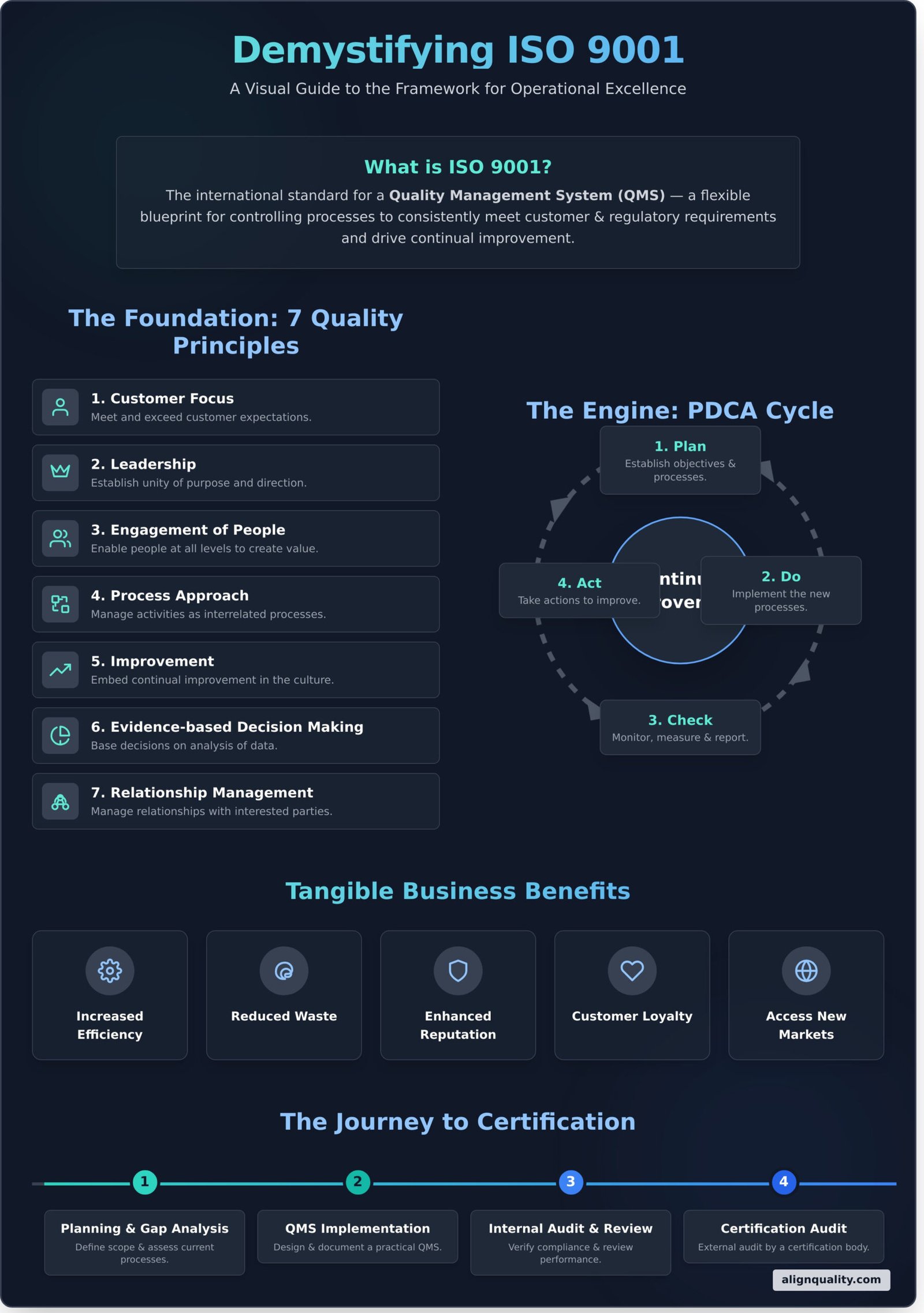
At its core, ISO 9001 is the internationally recognized standard for a Quality Management System (QMS). It provides a proven framework for controlling your processes to consistently meet customer and regulatory requirements. Think of it not as a rigid set of rules for your products, but as a flexible blueprint for operational excellence. It is universally applicable to any organization, regardless of size or industry-from manufacturing to service-based businesses.
Crucially, it is the only standard within the ISO 9000 family of standards for which an organization can achieve formal certification. This certification serves as a powerful testament to your commitment to quality, consistency, and customer satisfaction.
Beyond the Certificate: The True Goal of ISO 9001
While the certificate is a valuable asset, the true purpose of implementing a QMS is to drive tangible business results. The standard guides you toward greater operational efficiency, reducing waste and costly errors. This commitment to quality enhances brand reputation, fosters customer loyalty, and often provides access to new markets or contracts that mandate certification as a prerequisite for partnership.
The ‘Process Approach’: The Engine of ISO 9001
The standard is built on the ‘process approach’-a method of managing your activities as a system of interrelated processes. Instead of viewing departments in isolation, you see how their activities link together to deliver the final product or service. This leads to more consistent and predictable results. An effective analogy is a recipe: by following defined steps (the process) in the right order, you ensure a high-quality outcome every time.
Plan-Do-Check-Act (PDCA): The Cycle of Improvement
The methodology for implementing and maintaining the standard is the Plan-Do-Check-Act (PDCA) cycle. This common-sense framework ensures continual improvement is embedded in your organization’s culture. It is a logical, iterative four-stage approach:
- Plan: Establish objectives and processes necessary to deliver results in accordance with customer requirements and your policies.
- Do: Implement the new processes on a small scale.
- Check: Monitor and measure processes and results against objectives and report the outcomes.
- Act: Take actions to improve process performance based on the results.
The 7 Quality Management Principles: The Foundation of Your QMS
To fully leverage the power of iso 9001, it is essential to understand that it is more than a set of rules; it is a framework built upon a guiding philosophy. These are not rigid requirements but sound business principles that drive organizational excellence. At the core of the ISO 9001:2015 standard are seven fundamental quality management principles (QMPs) that form the foundation of a robust and effective Quality Management System (QMS).
Mastering these principles is the key to transforming your QMS from a compliance tool into a strategic asset. The seven principles are:
- Customer Focus
- Leadership
- Engagement of People
- Process Approach
- Improvement
- Evidence-based Decision Making
- Relationship Management
Customer Focus and Leadership Commitment
Customer focus is the primary principle, centered on understanding current and future customer needs to meet and exceed their expectations. This directly drives loyalty and repeat business. Paired with this is Leadership, where top management establishes a unity of purpose and direction. They create the internal environment where people can become fully involved in achieving the organization’s objectives. Leadership buy-in is non-negotiable for a successful QMS implementation.
Process Approach and Continual Improvement
The process approach involves managing activities and related resources as a coherent system of interrelated processes. This method produces more consistent and predictable results, improving efficiency and eliminating waste. This principle works hand-in-hand with Improvement, which establishes the permanent objective to continually enhance performance. Together, these two principles form the core operational engine of your QMS, ensuring it evolves and adapts for sustained success.
Evidence-Based Decisions and Relationship Management
Effective decisions are always based on the analysis and evaluation of data and information. Evidence-based decision making moves your organization away from intuition and toward factual, repeatable success. This is complemented by Relationship Management, which focuses on building and maintaining mutually beneficial relationships with interested parties, such as suppliers and partners. These principles lead to smarter, more strategic operations built on clarity and strong alliances.
The Journey to Certification: A High-Level Roadmap
Achieving certification is not an administrative burden; it is a strategic project designed to strengthen your organization from the inside out. The journey is a methodical process focused on building a robust Quality Management System (QMS) that drives real-world results. The ultimate goal is not just a certificate for the wall, but a more efficient, resilient, and customer-focused business. In fact, adopting the principles of the standard can transform your small business by instilling a culture of continuous improvement. This high-level roadmap breaks the journey into four distinct and manageable phases.
Phase 1: Decision, Planning, and Gap Analysis
Success begins with a firm commitment from leadership and a clearly defined scope for your QMS. This foundational phase answers two critical questions: ‘Where are we now?’ and ‘Where do we need to be?’ A thorough Gap Analysis is performed to assess your existing processes against the iso 9001 requirements. This analysis provides a clear, actionable plan, identifying precisely what needs to be developed or improved to achieve compliance.
Phase 2: QMS Design, Documentation, and Implementation
With a clear plan, the next step is to design and document your QMS. The focus here is on creating processes that are both compliant and practical for your daily operations-not on generating unnecessary paperwork. This involves creating essential documentation, such as a quality manual and procedures, followed by comprehensive employee training. The system is then rolled out across the relevant departments, embedding quality into your organization’s workflow.
Phase 3: Internal Audits and Management Review
Before engaging an external auditor, you must verify that your new QMS is working as intended. The internal audit serves as a crucial ‘dress rehearsal,’ allowing you to identify and correct any non-conformities in a low-pressure environment. Following the audit, a formal Management Review is conducted to evaluate the QMS’s performance, suitability, and effectiveness, ensuring it aligns with your strategic business objectives and is ready for external scrutiny.
Phase 4: The Certification Audit
This is the final step, conducted by an accredited third-party registrar. The audit typically occurs in two stages:
- Stage 1: A review of your QMS documentation to confirm it meets the standard’s requirements.
- Stage 2: An on-site (or remote) audit to verify that your organization is following the documented processes in practice.
Upon successful completion and resolution of any findings, the registrar will issue your ISO 9001 certificate, formally recognizing your commitment to quality.
Key Players in the Process: Who Does What?
One of the most common points of confusion when embarking on the certification journey is understanding who is responsible for each part of the process. Achieving certification is a collaborative effort, but it requires a clear division of labor between your company, your consultant, and the certification body. Understanding these distinct roles is the first step toward a streamlined and successful implementation.
Your Internal Team: The Owners of the System
Ultimately, your Quality Management System (QMS) belongs to you. For an iso 9001 system to deliver real value, it cannot be a separate function managed by an outsider. Your leadership and employees must own and operate the QMS as an integral part of their daily work. Management’s role is to provide the necessary resources, drive commitment from the top down, and ensure the system is aligned with strategic business objectives.
The ISO Consultant: Your Expert Guide and Partner
An ISO consultant acts as your strategic partner and expert guide. Their primary role is to interpret the standard’s requirements, provide a proven framework for implementation, and accelerate your journey to certification. A skilled consultant streamlines the entire process, helping you avoid common mistakes, build internal confidence, and develop a QMS that is both compliant and genuinely useful for your business. They provide the map, but your team drives the vehicle.
See how our 5-stage process provides a clear, methodical path that ensures your success.
The Certification Body (Registrar): The Independent Auditor
The certification body, or registrar, is the impartial third party that conducts the official audit. It is critical to understand that consultants cannot issue certificates; this separation maintains the integrity and credibility of the entire ISO certification process. The registrar’s sole function is to independently verify that your QMS conforms to the requirements of the standard. Upon successful verification, they are the organization that issues your official certification.
Debunking the Top 3 Myths About ISO 9001
Despite its global recognition and proven benefits, several persistent myths surround the iso 9001 standard. These misconceptions can deter organizations from pursuing a certification journey that offers significant strategic advantages. By addressing these common concerns directly, we can provide the clarity and confidence needed to make an informed decision for your business.
Myth 1: ‘It’s only for large manufacturing companies.’
Reality: This is one of the most outdated misconceptions. The ISO 9001 framework is intentionally designed to be generic and adaptable, making it applicable to any organization, regardless of size, sector, or complexity. Its core principles-customer focus, a process-based approach, and continual improvement-are universal. We have guided technology startups, healthcare providers, consulting firms, and non-profits through successful certification. The standard is tailored to fit your unique operational context, not the other way around.
Myth 2: ‘It’s just a mountain of useless paperwork.’
Reality: While older versions of the standard were more prescriptive, the modern approach emphasizes effective processes, not mandatory documents. The guiding principle is simple: document only what is necessary to ensure consistent, high-quality outcomes for your business. A correctly implemented Quality Management System (QMS) actually reduces bureaucracy by clarifying roles, streamlining workflows, and eliminating redundant activities. It is a tool for creating lean, efficient operations, not for generating paperwork.
Myth 3: ‘The cost and effort outweigh the benefits.’
Reality: Viewing certification as a cost overlooks its true value as an investment in efficiency, resilience, and growth. The initial effort yields a significant and sustainable return by transforming your operations. A well-managed QMS delivers tangible business improvements, including:
- Reduced Costs: Minimizing errors, rework, and waste directly impacts your bottom line.
- Increased Efficiency: Clear processes and defined responsibilities lead to greater productivity and consistency.
- New Business Opportunities: Certification opens doors to new markets and contracts where compliance is a prerequisite.
When implemented correctly, ISO 9001 is a powerful framework for building a more robust and profitable company. Navigating this journey with an expert partner ensures you unlock these benefits efficiently, turning the standard into a catalyst for sustainable success.
Embark on Your ISO 9001 Journey with Confidence
As we have explored, achieving iso 9001 certification is far more than a procedural requirement; it is a strategic commitment to operational excellence and customer satisfaction. By understanding its core principles and demystifying the process, it becomes clear that the path to certification is a structured and manageable journey toward building a more resilient and reputable organization.
Navigating this path requires expertise and a proven methodology. At Align Quality, our team of Certified ISO 9001 Lead Auditors utilizes a proven 5-Stage Certification Process, refined through extensive multi-industry success, to guide you at every step. We provide the expert guidance needed to streamline the process and achieve your goals efficiently, removing complexity and uncertainty.
Take the first definitive step toward transforming your quality management system. Book Your Free Consultation to Start Your Certification Journey and let us help you achieve compliance with the confidence your business deserves.
Frequently Asked Questions About ISO 9001
How long does it take to get ISO 9001 certified?
The timeline for ISO 9001 certification varies based on your organization’s size, complexity, and current level of compliance. For a small to medium-sized business, the journey typically takes between 3 to 6 months. This includes conducting a gap analysis, implementing necessary process changes, performing internal audits, and completing the external certification audit. A well-prepared organization with existing quality processes may achieve certification more quickly, while larger businesses may require a longer timeframe.
What is the difference between ISO 9001 certification and accreditation?
Certification is the process by which a third-party registrar audits your organization and confirms its compliance with the ISO 9001 standard. Accreditation, on the other hand, is the formal recognition of a certification body’s competence to perform these audits. In short, your business receives certification from an accredited body. This ensures the certification body itself operates to a high standard, lending credibility and international recognition to your certificate and the processes it validates.
Do I need a consultant to get ISO 9001 certified?
While engaging a consultant is not a mandatory requirement for certification, it is highly recommended to streamline the process. An experienced iso 9001 consultant provides expert guidance, helps avoid common pitfalls, and ensures your Quality Management System (QMS) is robust and effective. This partnership can significantly reduce the internal workload and increase the likelihood of a successful first-time audit, allowing you to achieve compliance with confidence and efficiency in your operations.
How much does ISO 9001 certification cost?
The cost of certification is not a single fee but a combination of factors. Key expenses include the certification body’s audit fees, which depend on your company’s size and complexity. Additional costs may involve consultant fees if you choose expert guidance, training for your staff, and any necessary software or system upgrades. It is crucial to view this as an investment in quality that yields long-term returns through improved efficiency and customer satisfaction.
What happens after we get the ISO 9001 certificate? Is it permanent?
An ISO 9001 certificate is not permanent; it is valid for three years. To maintain certification, your organization must undergo annual surveillance audits. These audits confirm that your Quality Management System continues to comply with the standard and is being effectively maintained. At the end of the three-year cycle, a more comprehensive recertification audit is required to renew your certificate. This process ensures a commitment to continuous improvement within your organization.
What is the current version of the ISO 9001 standard?
The current and most recent version of the standard is ISO 9001:2015. This version places a greater emphasis on a process-based approach, risk-based thinking, and leadership engagement. It is designed to be more flexible and easily integrated with other management system standards. Organizations seeking certification today must align their Quality Management System with the requirements outlined in the iso 9001:2015 version to achieve compliance and demonstrate their commitment to quality.