
What if the biggest risk to your ISO 9001 certification isn’t an external threat, but the very way you’re documenting risk itself?
It’s a common challenge. Many quality managers spend weeks creating complex spreadsheets, trying to capture every conceivable business risk, only to face confusion and potential non-conformances during an audit. This stems from the difficulty of distinguishing broad business risks from the specific quality risks the standard requires you to address. If your risk register feels overly complicated or disconnected from your daily operations, you’re not alone.
This guide cuts through that complexity. We provide clear, practical iso 9001 risk management examples broken down by department, from sales to production, to help you master risk-based thinking. You’ll leave with a simple framework for identifying and documenting the risks and opportunities that matter, ensuring you are fully prepared for your audit and the upcoming transition to ISO 9001:2026.
Key Takeaways
- Understand the shift from ‘preventive action’ to proactive Risk-Based Thinking, a core requirement for ISO 9001:2026 compliance.
- Learn a structured 4-step framework to systematically identify quality risks by analyzing your organizational context and interested parties.
- Discover practical ISO 9001 risk management examples for key departments and specific scenarios in both manufacturing and service industries.
- Clarify exactly what auditors look for regarding risk documentation, including how to effectively present your process during a management review.
What is Risk-Based Thinking in ISO 9001:2026?
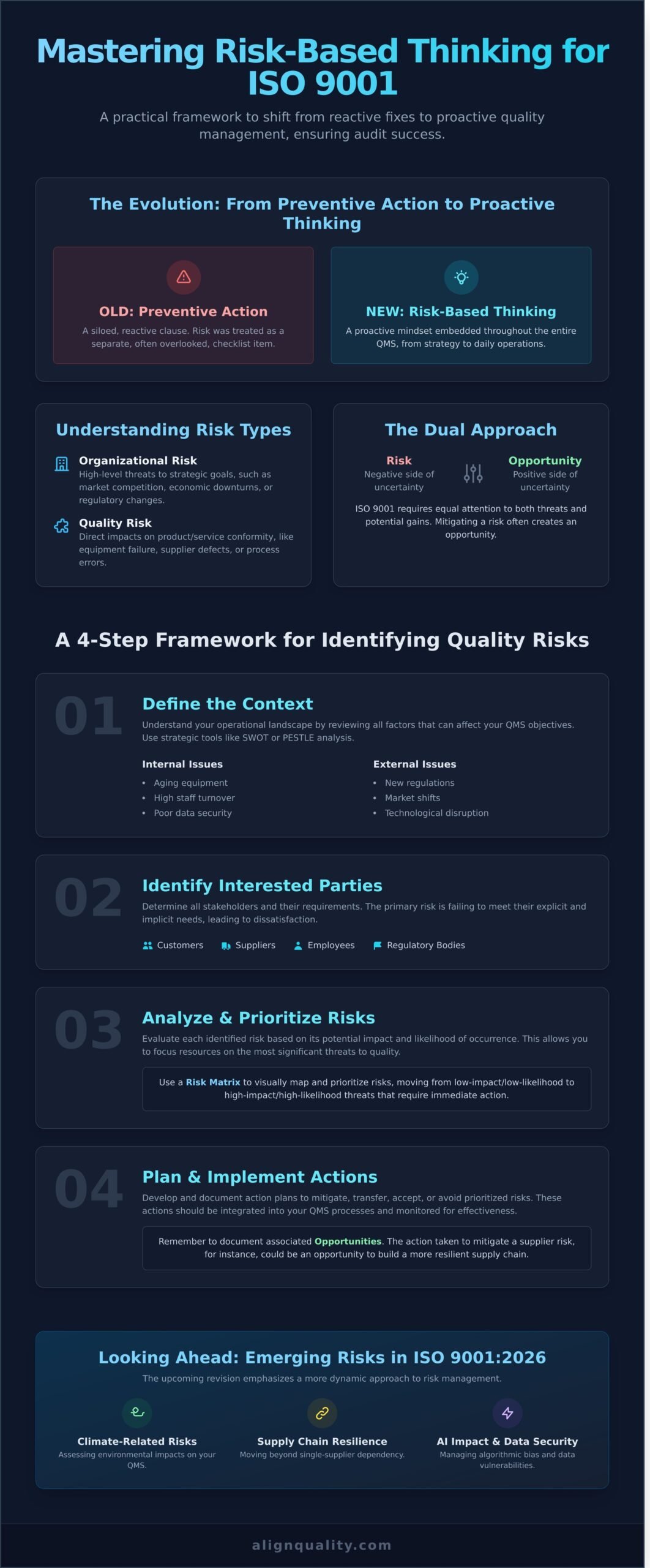
Risk-Based Thinking (RBT) is the foundation of a modern, effective Quality Management System (QMS). Instead of a reactive checklist, it’s a proactive mindset that must be embedded throughout your entire operation. The standard defines it as the coordinated activity to direct and control an organization with regard to risk. This represents a significant evolution from older versions, which siloed risk into a single ‘preventive action’ clause. By integrating RBT, you can develop powerful iso 9001 risk management examples that drive continuous improvement. This philosophy is central to the entire ISO 9000 family of standards.
A critical first step is to distinguish between two primary types of risk. Understanding this difference is essential for developing practical iso 9001 risk management examples that truly protect your organization.
- Organizational Risk: These are high-level threats to the business itself. Think of market competition, economic downturns, regulatory changes, or reputational damage. They affect the organization’s ability to achieve its strategic goals.
- Quality Risk: These risks directly impact your ability to deliver conforming products and services. Examples include equipment failure, supplier defects, employee training gaps, or process errors that lead to customer dissatisfaction.
Your QMS must address both, ensuring that operational controls align with broader business strategies to maintain resilience and customer focus.
The Evolution of Risk in the 2026 Revision
The upcoming ISO 9001:2026 revision places an even greater emphasis on a dynamic approach to risk. Static risk registers, updated once a year, are no longer sufficient for certification. The new standard expects organizations to actively monitor emerging threats, with a specific focus on climate-related risks and enhancing supply chain resilience. Furthermore, understanding how AI will impact ISO 9001 is crucial, as it introduces new risk categories like data security and algorithmic bias while also providing powerful data-driven tools for predictive risk analysis.
Risks vs. Opportunities: The Dual Approach
ISO 9001 mandates that you don’t just focus on the negative. For every risk, there is a potential opportunity. An ‘opportunity’ is defined as the positive side of uncertainty, a set of circumstances that can lead to improved performance. The 2026 revision requires equal attention to both threats and potential gains. For instance, identifying a high-risk dependency on a single supplier (a threat) can create the opportunity to diversify your supply chain. This action not only mitigates the original risk but can also lead to benefits like better pricing, access to innovation, and a more robust operational footprint.
A 4-Step Framework for Identifying Quality Risks
Effective risk management isn’t guesswork; it’s a structured process. ISO 9001:2015 champions a proactive approach, moving beyond simple corrective actions to anticipate and prevent quality issues before they occur. This philosophy, central to the standard’s concept of risk-based thinking in ISO 9001, can be implemented using a clear, four-step framework that transforms uncertainty into a competitive advantage.
Step 1: Define the Context. Before you can identify risks, you must understand your operational landscape. This involves a high-level review of the factors that can affect your QMS objectives. Strategic tools like a SWOT (Strengths, Weaknesses, Opportunities, Threats) or PESTLE (Political, Economic, Social, Technological, Legal, Environmental) analysis provide a structured way to evaluate your position.
Analyzing Internal and External Issues
A deep dive into your operational environment is critical. Many risks hide in plain sight, often overlooked in day-to-day operations. A structured approach using our gap analysis checklist can systematically reveal vulnerabilities within your QMS. Consider these common issues:
- Internal Issues: These originate from within your organization. Examples include aging manufacturing equipment leading to higher defect rates, high staff turnover causing knowledge gaps, or poor data security protocols creating compliance vulnerabilities.
- External Issues: These arise from the broader environment. Examples include new environmental regulations impacting your production process, sudden market shifts that make your product obsolete, or technological disruption from a new competitor.
Step 2: Identify Interested Parties. Next, identify your interested parties and their requirements. This includes customers, suppliers, employees, and regulatory bodies. The primary risk here is the failure to meet their explicit and implicit needs. What is the impact of a product recall on customer trust? What are the legal penalties for non-compliance with a new industry regulation?
Step 3: Analyze and Prioritize Risks. Once risks are identified, you must determine their significance. A risk matrix is a simple yet powerful tool for visualizing and prioritizing threats. Create a 3×3 or 5×5 grid, labeling one axis ‘Likelihood’ (e.g., Low, Medium, High) and the other ‘Impact’ (e.g., Minor, Moderate, Severe). Plotting each risk on the matrix provides a clear visual hierarchy, showing which issues demand immediate attention. Your leadership team must define its ‘risk appetite’-the level of risk it’s willing to accept to achieve strategic objectives. This ensures that resources are allocated effectively.
Effective risk management prioritizes high-impact quality failures over minor administrative variances.
Step 4: Determine Treatment. The final step is to decide how to handle each prioritized risk. This is where you can find practical iso 9001 risk management examples in action. There are four primary strategies:
- Avoid: Eliminate the risk by discontinuing the activity that causes it.
- Mitigate: Reduce the likelihood or impact of the risk through controls or process changes.
- Transfer: Shift the financial impact of the risk to a third party, such as through insurance.
- Accept: Acknowledge the risk and proceed without implementing controls, typically for low-impact, low-likelihood events.
Choosing the right treatment strategy requires careful consideration of costs, benefits, and operational feasibility, an area where expert ISO 9001 consultation often provides critical clarity.
Functional ISO 9001 Risk Management Examples by Department
Effective risk-based thinking isn’t confined to the boardroom; it must be embedded in the daily operations of every department. A robust Quality Management System (QMS) identifies and addresses threats and opportunities at a functional level, preventing small issues from escalating into major non-conformities. Looking at practical iso 9001 risk management examples within each business unit transforms the standard from a theoretical framework into a powerful operational tool.
By dissecting potential failures department by department, you can build a more resilient and efficient organization. Consider these common scenarios:
- Sales and Marketing: The risk of miscommunicating customer requirements during the sales process. A salesperson might promise a feature that engineering cannot deliver, leading to a contract breach, customer dissatisfaction, and a potential 20% increase in product returns for that quarter.
- Human Resources: The risk of a ‘single point of failure’ where critical process knowledge is held by only one employee. If that senior technician suddenly resigns, a key production line could face a 4-week shutdown, directly impacting delivery schedules and revenue. Documenting processes is crucial for building the operational resilience that will be emphasized in the upcoming ISO 9001:2026 revision.
- Purchasing/Procurement: The risk of relying on a sole-source supplier for a critical component. If that supplier goes bankrupt or faces a major disruption, as seen during the 2021 global supply chain crisis, your production could halt completely, costing upwards of $100,000 per day in lost output.
- Operations/Production: The risk of using uncalibrated or improperly maintained equipment. A single miscalibrated torque wrench on an assembly line could result in faulty products, leading to a recall of over 5,000 units and significant damage to your brand’s reputation for quality.
Identifying these departmental vulnerabilities is a primary objective of a thorough QMS review. Using a structured tool like our gap analysis checklist can systematically uncover these risks before they impact your customers.
Supply Chain and Procurement Risks
Global logistics volatility presents a constant threat. A delay in raw materials from an overseas supplier, perhaps due to port congestion, can create a domino effect, halting production for weeks. A key mitigation strategy is to pre-qualify a secondary supplier in a different geographic region and establish ‘safety stock’ protocols for critical materials, holding an extra 15% of inventory. The opportunity here involves turning risk management into a strategic advantage by consolidating spend with a primary, high-performing partner to negotiate better payment terms or a 5-10% volume discount.
Leadership and Governance Risks
One of the most damaging yet overlooked risks is a lack of genuine management commitment, leading to a ‘culture of non-compliance’ where quality is seen as someone else’s job. This directly contradicts the foundational principles of ISO 9001, which place a heavy emphasis on leadership’s role. To mitigate this, implement monthly quality review meetings with mandatory executive attendance and display transparent KPI dashboards tracking quality objectives. This creates an opportunity to directly align QMS goals with strategic business growth, demonstrating how achieving a 99.5% product conformity rate contributes to increasing market share.
Industry-Specific Risk Scenarios and Mitigation Strategies
Risk-based thinking is a core principle of ISO 9001, but its application looks vastly different across industries. A software company’s critical risks aren’t the same as a medical device manufacturer’s. Understanding these distinctions is key to developing a robust QMS. The following iso 9001 risk management examples are tailored to specific sectors, providing a practical framework for your own risk register.
Manufacturing and Engineering Examples
A common risk is a high rate of scrap material from poorly maintained CNC machines, directly impacting profitability. A powerful mitigation strategy involves implementing a strict Preventive Maintenance (PM) schedule and installing IoT sensors to monitor machine health. This also presents an opportunity to transition to ‘Predictive Maintenance,’ using data to fix components just before they fail, which can reduce overall maintenance costs by up to 25%.
Software and Tech Industry Examples
A critical risk for any tech company is deploying a software update with a security vulnerability, exposing customer data and eroding trust. Effective mitigation includes integrating automated regression testing into the CI/CD pipeline and enforcing mandatory peer code reviews. This process control ensures that what it means to be ISO 9001 certified in a tech context-delivering reliable, secure products-is consistently upheld.
Other sectors face equally critical, though different, challenges that require a tailored approach to risk management.
In the service sector, risks are often intangible but can have severe consequences for reputation and customer trust:
- Service Consistency: Inconsistent service delivery damages brand perception. A consulting firm failing to use a standardized project methodology can see a 30% drop in client satisfaction.
- Customer Data Privacy: A breach of customer data risks financial penalties under regulations like GDPR (up to 4% of annual global turnover) and a near-total loss of customer trust.
- Communication Gaps: Poor communication between teams often leads to unmet customer expectations and project scope creep, increasing costs by an average of 15-20%.
For healthcare and medical device companies, the stakes are highest, where quality failures can have life-or-death consequences:
- Patient Safety: A non-conforming medical device could lead to misdiagnosis or patient harm, making compliance with standards like ISO 13485 and FDA regulations non-negotiable.
- Regulatory Changes: Failure to adapt to a new regulation, like the EU’s Medical Device Regulation (MDR), can block market access entirely.
- Sterilization Failure: An incomplete sterilization process for surgical instruments poses an immediate risk of infection, leading to patient injury and severe legal liability.
Identifying and mitigating these diverse, industry-specific risks is a complex task. If you’re unsure where to begin, our team of certified auditors can help you conduct a thorough risk assessment tailored to your sector.
Documenting Risks and Opportunities for Audit Success
While the ISO 9001:2015 standard doesn’t mandate a formal document called a “Risk Register,” this is a classic case of expectation versus requirement. An auditor won’t fail you for not having a specific spreadsheet, but they absolutely expect to see clear, objective evidence that a systematic process for identifying and addressing risks and opportunities exists. Without documented proof, you can’t demonstrate compliance with Clause 6.1.
One of the most effective places to document this process is within your Management Review minutes. These meetings should feature a standing agenda item to review the organization’s top risks and opportunities. Auditors will scrutinize these minutes for evidence of discussion, decisions made regarding risk treatments, and assignment of responsibilities. This shows that risk management is an active, top-level concern, not a one-time exercise.
Evidence of Risk-Based Thinking
To truly satisfy an auditor, your risk management activities must be woven into the fabric of your QMS. A Risk Register is a living document that captures the identification, analysis, and treatment of quality threats. Don’t just list generic risks; directly connect them to your quality objectives and KPIs. For example, if a key objective is “achieve 99% customer satisfaction,” a corresponding risk could be “delayed response times from a new software vendor,” with a treatment plan to “conduct quarterly performance reviews with the vendor.” Internal audits then play a critical role by verifying that these treatment plans are actually implemented and effective.
Preparing for the Certification Audit
When presenting your process to a Lead Auditor, be prepared to narrate your risk journey. Show them how your understanding of risks has evolved. A common pitfall is presenting a “perfect” register with no open risks or issues. This is an immediate red flag. Auditors know that every business faces ongoing challenges; a flawless document suggests the process is for show, not for genuine improvement.
An auditor will methodically check for the following:
- Identification: Is there a clear method for determining risks and opportunities relevant to your QMS?
- Analysis: Have you evaluated the potential impact and likelihood of these items?
- Action Planning: Are there defined actions to address the identified risks and opportunities?
- Integration: How are these actions integrated into your existing QMS processes?
- Effectiveness Review: How do you verify that the actions taken were effective?
If an audit reveals significant ISO 9001 nonconformances, a sharp auditor will trace them back to your risk assessment. Was the root cause an unmanaged risk? This isn’t a failure but a critical input to refine your process, demonstrating a commitment to continual improvement. Showcasing a few well-documented iso 9001 risk management examples from your own operations is far more powerful than a clean sheet.
Ready to ensure your risk documentation will impress auditors and drive real improvement? Our experts can help you build a robust, practical system that guarantees audit success.
Book a free consultation with our ISO experts today.
Turn Risk into Opportunity for Your QMS
Mastering risk-based thinking is the core of a resilient and continually improving Quality Management System. It’s not just about compliance; it’s a strategic shift that turns potential threats into measurable opportunities. The functional iso 9001 risk management examples we’ve explored show that a systematic, 4-step framework provides clarity and control, helping you prepare for a successful audit. Documenting these efforts methodically is your proof of a robust QMS that is ready for the future.
As you prepare for the ISO 9001:2026 transition, the first step is understanding precisely where your system stands today. Our team of Certified ISO 9001 Lead Auditors has the expertise to guide you. Start your journey by identifying potential gaps and vulnerabilities with our proven template. Download the Ultimate ISO 9001 Gap Analysis Checklist and take the first decisive step toward achieving certification with confidence.
Frequently Asked Questions
Does ISO 9001:2026 require a formal Risk Register?
No, the current ISO 9001:2015 standard doesn’t mandate a formal risk register, and the initial drafts for the upcoming ISO 9001:2026 revision maintain this flexibility. However, a risk register is considered a best practice by over 90% of certified organizations. It provides auditors with clear, documented evidence that you have a systematic process for identifying, analyzing, and treating risks and opportunities, which is the core of risk-based thinking.
What is the difference between a risk and a non-conformance?
A risk is the potential for a future problem, while a non-conformance is a failure that has already happened. Risk management is proactive; it’s about anticipating what could go wrong with a process or product and taking steps to prevent it. A non-conformance is reactive; it’s the identification of an output that has failed to meet a specific requirement, which then requires corrective action. Effective risk management directly reduces the frequency of non-conformances.
How often should we review our ISO 9001 risk examples?
Your risks and opportunities must be reviewed at least once per year as a required input for your management review meeting. For a more dynamic system, we recommend a quarterly review of your key ISO 9001 risk management examples. You should also trigger an immediate review whenever a significant internal or external change occurs, such as onboarding a new major client, installing new equipment, or facing a new competitor, to ensure your QMS remains effective.
Can we use AI to identify risks for our Quality Management System?
Yes, AI can be a powerful tool to supplement your risk identification process, but it shouldn’t replace human analysis. AI algorithms can analyze thousands of data points from production logs, customer complaints, and supplier performance metrics to detect patterns and predict potential failures that a team might miss. This provides valuable input, but your team must still apply context and strategic judgment to evaluate and prioritize these machine-identified risks.
What is the most common risk-related audit finding?
The most common risk-related audit finding is a disconnect between the identified risks and the actual QMS processes. Auditors frequently find organizations with a well-documented risk register that isn’t integrated into day-to-day operations. For example, a company lists “single-source supplier failure” as a major risk but has no evidence of actions taken in its purchasing process (Clause 8.4) to mitigate it. Performing a thorough review with our gap analysis checklist can help you spot these gaps before an audit.
How do I explain ‘Risk-Based Thinking’ to my employees?
Explain risk-based thinking as simply being proactive by asking “what if?” before starting a task. Instead of just reacting to problems, it encourages every employee to consider what could potentially go wrong and what could be done better. For a warehouse operator, it might be asking, “What if this shipment is delayed?” and then confirming logistics ahead of time. It empowers everyone to take ownership of quality and continuous improvement in their specific role.