ISO 9001 Nonconformance: A Guide to Findings, Fixes, and Prevention
Receiving a nonconformance report during an ISO 9001 audit can feel like a significant setback. The pressure to respond correctly and the uncertainty surrounding the process can be a source of considerable anxiety for any quality manager. However, a finding of an ISO 9001 nonconformance is not a failure; it is a critical opportunity for improvement. The key is knowing exactly how to respond, what distinguishes a major finding from a minor one, and how to implement corrective actions that prevent recurrence.
This guide provides a clear, methodical path forward. We will walk you through a proven process for investigating, correcting, and documenting nonconformances effectively. You will learn not only how to satisfy your auditor but also how to leverage these findings to strengthen your quality management system. By the end, you will have the tools and understanding needed to manage audit findings and prepare for your next certification cycle with confidence.
Key Takeaways
- Understand that a nonconformance is a failure to meet a requirement, allowing you to identify findings clearly and accurately.
- Learn to distinguish between major and minor nonconformances to understand their impact on your certification and prioritize your response effectively.
- Adopt a systematic corrective action process to address any iso 9001 nonconformance, demonstrating control and satisfying auditor requirements.
- Move beyond fixing issues by learning proactive strategies to prevent findings, strengthening your QMS for long-term success.
What Is a Nonconformance in ISO 9001?
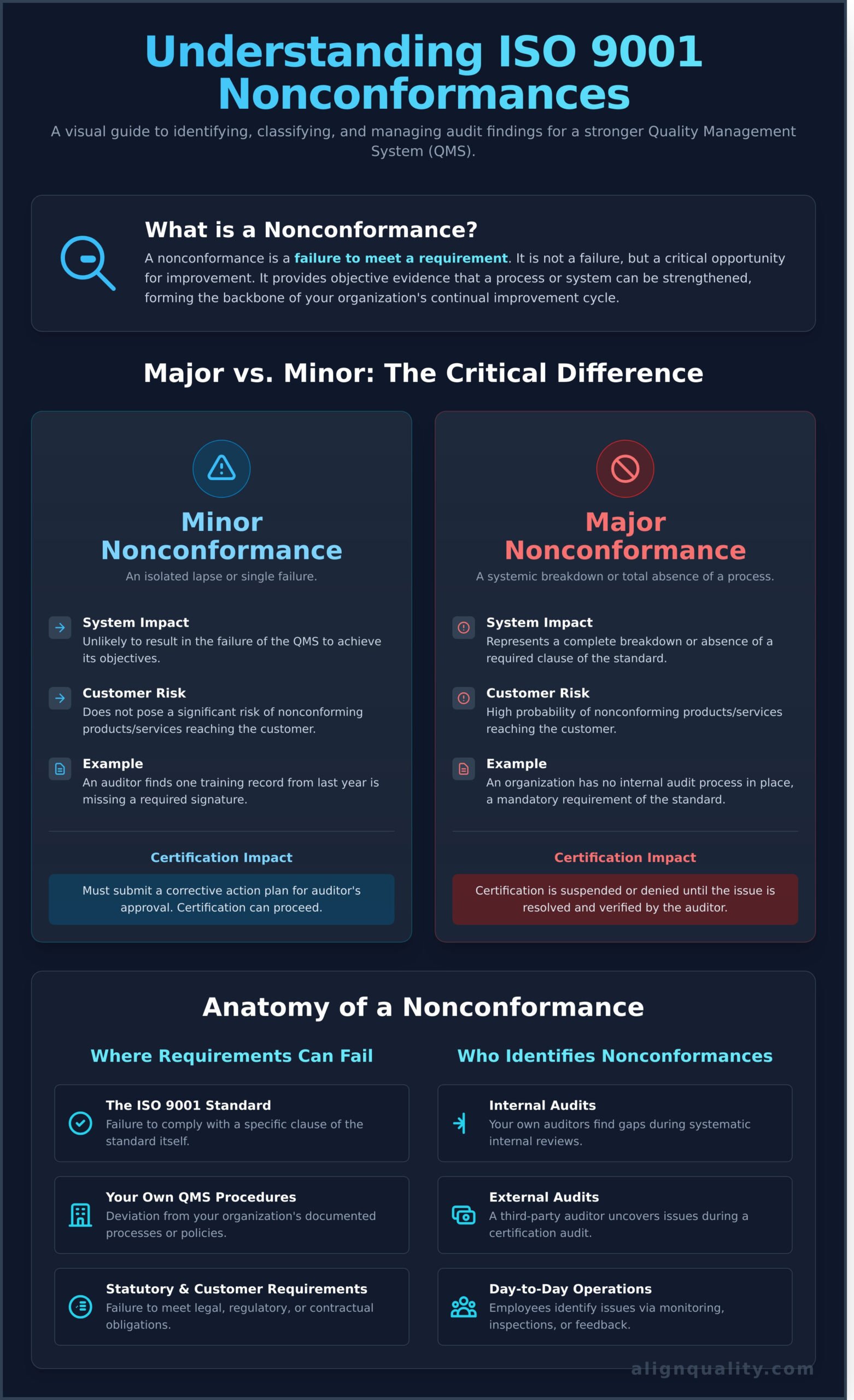
In the context of ISO 9001, a nonconformance is simply a failure to meet a requirement. This broad definition of nonconformity covers any deviation from a planned or expected outcome within your Quality Management System (QMS). While the term may sound negative, an ISO 9001 nonconformance is not a failure but a critical opportunity. It provides objective evidence that a process or system can be improved, forming the backbone of your organization’s continual improvement cycle.
It is important to distinguish a nonconformance from an ‘observation’ or an ‘Opportunity for Improvement’ (OFI). A nonconformance is a clear breach of an established requirement. In contrast, an observation highlights a potential future weakness or a risk that could lead to a nonconformance if left unaddressed. An OFI is a suggestion for enhancement where no requirement has been violated. Understanding this distinction is key to managing your QMS effectively.
Breaking Down the ‘Requirement’
A nonconformance occurs when one of three primary types of requirements is not met. These requirements are the pillars of your quality framework:
- The ISO 9001 Standard: A failure to comply with a specific clause of the standard itself. For example, not having records of equipment calibration as required by clause 7.1.5.
- Your Own QMS Procedures: A deviation from your organization’s own documented processes, policies, or work instructions. If your procedure states a form must be signed by two managers, and it is only signed by one, that is a nonconformance.
- Statutory and Customer Requirements: A failure to meet legal, regulatory, or contractual obligations. This could include not adhering to industry-specific safety regulations or failing to meet quality specifications agreed upon with a client.
Who Identifies Nonconformances?
Nonconformances can be identified at any time and by various parties, highlighting the comprehensive nature of a robust QMS. The most common sources include:
- Internal Audits: Your own trained auditors identify gaps between your documented procedures and actual practices during systematic internal reviews.
- External Audits: A certified third-party auditor uncovers nonconformances during a certification, surveillance, or recertification audit.
- Day-to-Day Operations: Employees may identify issues through process monitoring, product inspections, customer feedback, or supplier performance reviews.
Major vs. Minor Nonconformance: Understanding the Critical Difference
During an ISO 9001 audit, any identified gaps are classified by the auditor as either a major or minor nonconformance. This classification is not arbitrary; it directly determines the severity of the issue and has significant consequences for your certification journey. Understanding this distinction is crucial for effectively managing your Quality Management System (QMS).
To put it simply, think of a minor nonconformance as a single typo in a book-an isolated error that doesn’t compromise the overall story. A major nonconformance, however, is like a missing chapter-a fundamental failure that prevents the reader from understanding the plot.
Characteristics of a Minor Nonconformance
A minor nonconformance is an isolated lapse or a single observed failure to meet a requirement of the ISO 9001 standard. While it must be addressed, it does not represent a systemic failure of your QMS. These are the most common type of findings during an audit.
- System Impact: It is unlikely to result in the failure of the QMS to achieve its objectives.
- Customer Risk: It does not pose a significant risk of nonconforming products or services reaching the customer.
- Example: An auditor finds one training record from last year is missing a required signature.
- Certification Impact: Your organization must submit a corrective action plan for the auditor’s approval. The process is so fundamental that it is even codified in other quality frameworks, such as the FDA regulations on corrective action for medical devices.
Characteristics of a Major Nonconformance
A major nonconformance indicates a significant breakdown or a total absence of a required process within your QMS. It suggests a systemic problem that could lead to the failure of the entire quality system or parts of it, creating substantial risks for your customers and your business.
- System Impact: Represents a complete breakdown of a process or the absence of a required clause of the standard.
- Customer Risk: There is a high probability of nonconforming products or services reaching the customer.
- Example: The organization has no documented evidence that any internal audits have ever been conducted.
- Certification Impact: A major iso 9001 nonconformance will prevent initial certification. For an already certified company, it can lead to the suspension of your certificate until effective corrective action is verified.
It is critical to note that auditors can elevate multiple minor nonconformances related to the same process or clause into a single major nonconformance. This demonstrates a systemic weakness rather than an isolated incident, underscoring the importance of addressing every finding with diligence.
Common Examples of ISO 9001 Nonconformances by Clause
An ISO 9001 nonconformance can arise from any clause of the standard. Understanding where they most frequently occur helps you proactively strengthen your Quality Management System (QMS). By reviewing these practical examples, organized by key sections of the standard, you can better identify potential weaknesses in your own processes before an auditor does.
Context, Leadership, and Planning (Clauses 4-6)
Nonconformances in these foundational clauses often point to a lack of strategic integration of the QMS. Common issues include:
- Management reviews are not held or minutes are not recorded. This demonstrates a failure in leadership commitment and oversight, a core principle of Clause 5.
- Quality objectives are not measurable or tracked. Objectives like “improve customer satisfaction” are too vague. Without specific metrics (e.g., “achieve a 95% customer satisfaction rating”), you cannot demonstrate performance as required by Clause 6.2.
- Risks and opportunities have not been adequately identified. An auditor will expect to see a formal process for identifying and addressing risks, not just an informal discussion. This is a direct requirement of Clause 6.1.
Support and Operation (Clauses 7-8)
This is where the day-to-day activities of the QMS are executed, making it a frequent source of nonconformances. An auditor may find:
- Employees are not aware of the quality policy. If staff cannot explain how their work contributes to quality objectives, it signals a breakdown in internal communication and training (Clause 7.3).
- Equipment calibration records are out of date or missing. Failure to maintain evidence that monitoring and measuring equipment is fit for purpose directly impacts the integrity of your product or service (Clause 7.1.5).
- Required documents are not under version control. Using an outdated procedure or form is a classic operational failure. It shows a lack of control over documented information as mandated by Clause 7.5.
Performance Evaluation and Improvement (Clauses 9-10)
These final clauses focus on checking and improving the QMS. A common ISO 9001 nonconformance here indicates that the system is not being maintained or used to drive real improvement. Examples include:
- Internal audits are not conducted according to schedule. Skipping or delaying internal audits means the organization is failing to check its own compliance and effectiveness (Clause 9.2).
- Customer satisfaction data is not being collected or analyzed. The standard requires you to actively monitor customer perception. Ignoring this data means you are missing a critical performance indicator (Clause 9.1.2).
- Corrective actions have not been verified for effectiveness. Simply closing an issue is not enough. You must have objective evidence that the action taken has permanently solved the problem (Clause 10.2).
The Corrective Action Process: A 5-Step Response to Nonconformances
An audit finding is not a failure; it is a critical opportunity for improvement. Auditors expect to see a methodical, documented response to any iso 9001 nonconformance, demonstrating your commitment to quality. A systematic corrective action process transforms a problem into a lasting enhancement for your Quality Management System (QMS). This entire journey is formally captured in a Non-Conformity Report (NCR), which serves as the official record of your analysis and resolution.
Following a structured 5-step process ensures a thorough and effective response that satisfies auditors and genuinely strengthens your operations.
Step 1 & 2: Containment and Root Cause Analysis (RCA)
Your first priority is containment-taking immediate action to control the problem. This is the “first aid” for your QMS. For example, if a batch of products is defective, you must quarantine it to prevent it from reaching the customer. Once contained, you must perform a Root Cause Analysis (RCA). Go beyond the symptom to find the underlying reason for the failure. A simple but powerful tool for this is the ‘5 Whys’ method, where you repeatedly ask “why” to drill down to the foundational issue.
Step 3 & 4: Planning and Implementing Corrective Action
With the root cause identified, you can develop a robust corrective action plan. This plan must be designed to eliminate the root cause, not just fix the initial symptom. For clarity and accountability, the plan should clearly define:
- The specific tasks required to correct the issue.
- The individual or team responsible for each task.
- A realistic deadline for completion.
Once the plan is approved, it must be implemented. This may involve updating procedures, providing new training, or modifying processes.
Step 5: Verifying Effectiveness
This is the most crucial and most frequently overlooked step. After implementing your corrective action, you must verify that it was effective. This involves gathering objective evidence to prove the solution has fixed the root cause and monitoring the situation over time to ensure the iso 9001 nonconformance has not recurred. This final check provides confidence that your QMS is stronger than before. Navigating this process correctly is vital for long-term compliance. Our experts can guide you through an effective corrective action process. Book a Consultation.
How to Proactively Prevent Nonconformances in Your QMS
Managing nonconformances is essential, but preventing them is the hallmark of a truly mature Quality Management System (QMS). Shifting from a reactive to a proactive mindset saves significant time, resources, and the stress associated with audit-day surprises. This strategic approach transforms your QMS from a compliance tool into a powerful driver for continual improvement and operational excellence.
By focusing on prevention, you build a resilient system that not only meets requirements but also enhances customer satisfaction and business performance. Here are three key areas to focus on to prevent issues before they arise.
Strengthen Your Internal Audit Program
Your internal audit program is your first line of defense. It is the most effective tool for identifying potential weaknesses and process gaps before they escalate into a formal iso 9001 nonconformance. To maximize its effectiveness, ensure your auditors are not only properly trained but also impartial, auditing areas outside their direct responsibility. Audits should rigorously assess compliance against both the ISO 9001 standard and your organization’s own documented procedures for a complete view of your system’s health.
Conduct Effective Management Reviews
Management reviews are more than a procedural checkbox; they are strategic opportunities to steer your QMS. Use these meetings to analyze performance data, customer feedback, and internal audit results to identify negative trends. Treating these reviews as high-level planning sessions ensures that top management remains engaged and that data-driven decisions guide your quality objectives. This proactive oversight is critical for allocating resources where they are needed most to prevent problems.
Foster a Culture of Quality
A robust QMS is supported by a strong organizational culture. Encourage all employees to identify and report potential issues without fear of blame, creating a system of shared ownership for quality. Provide ongoing training that reinforces the importance of following processes and understanding their role in the bigger picture. Most importantly, top management must consistently demonstrate an unwavering commitment to the QMS, setting the tone for the entire organization.
If you need expert guidance to strengthen your QMS and streamline your prevention strategies, the certified auditors at Align Quality can help you build a system that delivers results with confidence.
Mastering Nonconformance for a Stronger QMS
Ultimately, nonconformances are not setbacks but valuable opportunities to strengthen your Quality Management System. The key takeaways are clear: move beyond simply fixing isolated issues by implementing a robust corrective action process, and build a proactive culture of prevention. Viewing each iso 9001 nonconformance through this strategic lens transforms it from a potential liability into a powerful catalyst for continuous improvement and sustained operational excellence.
Navigating this journey ensures your QMS is not only compliant but truly effective and audit-ready. If you are committed to achieving certification with confidence, our team of experts is prepared to lead the way. Guided by Certified ISO 9001 Lead Auditors with extensive multi-industry experience, we implement our proven 5-Stage Certification Process to streamline your path to success. We don’t just prepare you for an audit; we help you build a lasting culture of quality.
Take the next step. Book Your Free ISO 9001 Consultation today and turn quality management into your greatest competitive advantage.
Frequently Asked Questions
What is a Non-Conformity Report (NCR) and what should it include?
A Non-Conformity Report (NCR) is a formal document used to record any ISO 9001 nonconformance-a deviation from a specified requirement in your Quality Management System. It provides a clear, objective record of the issue. A comprehensive NCR should include a detailed description of the nonconformance, the specific ISO 9001 clause not met, objective evidence supporting the finding (e.g., document numbers, locations), and the immediate correction taken to contain the problem.
How long do I have to fix a nonconformance after an audit?
The timeline for resolving a nonconformance is determined by your certification body and the severity of the finding. For a minor nonconformance, you typically have 30 to 90 days to submit a corrective action plan and evidence of its implementation. Major nonconformances require a much shorter timeline, often necessitating a follow-up visit. Always confirm the specific deadline with your auditor to ensure timely compliance and maintain your certification status with confidence.
Can you fail an ISO 9001 audit because of one nonconformance?
It is highly unlikely to fail an audit from a single minor nonconformance. However, a single *major* nonconformance can prevent initial certification or lead to the suspension of an existing one. A major finding indicates a systemic failure in the QMS, such as not conducting internal audits at all. The key is the severity and impact of the issue. The audit process is designed to identify opportunities for improvement, not simply to pass or fail your organization.
Is it possible to challenge a nonconformance finding from an auditor?
Yes, you can professionally challenge a nonconformance finding if you have objective evidence supporting your position. First, discuss the issue respectfully with the auditor during the closing meeting, presenting your evidence that demonstrates compliance. This might include specific records, procedures, or other documentation. If the matter is not resolved, you can escalate it through your certification body’s formal appeals process. A clear, evidence-based approach is always the most effective strategy.
What is the difference between correction and corrective action?
Correction and corrective action are distinct but related concepts. A correction is the immediate fix to contain the problem. For example, if an uncalibrated measuring device is used, the correction is to remove it from service. Corrective action, however, addresses the root cause to prevent recurrence. In this case, it might involve improving the calibration schedule or enhancing training procedures to ensure the mistake does not happen again.
Do we need to document every single nonconformance, even minor ones?
Yes, documenting every single nonconformance is a fundamental requirement and a best practice for a robust QMS. Even minor issues, when tracked over time, can reveal systemic problems or negative trends that require a formal corrective action. This documentation provides valuable data for management reviews and is essential for demonstrating your commitment to continual improvement. Consistent recording ensures that no issue is overlooked and strengthens your quality management processes.