When you hear ‘ISO 9001’, you might picture a factory floor, not a hospital ward. For many healthcare leaders, the thought of implementing this standard raises immediate concerns: Will it just add another layer of bureaucracy? How will our clinical staff respond? Is the process too complex and costly for a patient-focused environment? These are critical questions that deserve clear answers.
This guide was created to address these challenges directly and provide a path forward with confidence. We will demonstrate that far from being a rigid manufacturing system, the iso 9001 healthcare framework is a powerful tool for enhancing patient safety and operational excellence. In this article, you will discover the concrete benefits of a Quality Management System for patient outcomes, get a clear roadmap for implementation in a hospital or clinic, and learn how to build a business case that justifies the investment. Prepare to transform your organization by building a more efficient, reliable, and patient-centric culture of continuous improvement.
Key Takeaways
-
View ISO 9001 not as a manufacturing standard, but as a strategic framework to systematize quality and consistency in patient care delivery.
-
Discover how iso 9001 healthcare certification directly enhances patient safety, streamlines operational workflows, and builds a resilient organizational culture.
-
Translate abstract quality management principles into tangible actions that your clinical staff can apply to improve daily processes and outcomes.
-
Navigate the path to certification with a clear implementation roadmap designed to guide your facility from initial planning to audit success.
Table of Contents
-
What is ISO 9001 and Why is it Critical for Modern Healthcare?
-
The Core Benefits of ISO 9001 for Patients, Staff, and Your Bottom Line
-
Implementing ISO 9001 in Your Healthcare Facility: A 5-Stage Roadmap
-
Partnering for Success: Why an ISO 9001 Consultant is Your Best Ally
What is ISO 9001 and Why is it Critical for Modern Healthcare?
At its core, ISO 9001 is the internationally recognized standard for a Quality Management System (QMS). It provides a systematic framework for organizations to consistently meet customer and regulatory requirements. While often associated with manufacturing, its principles are universally applicable to service delivery. The standard is part of the ISO 9000 family of standards, which outlines a process-oriented approach to quality management and continuous improvement. For healthcare, this means shifting the focus from a ‘product’ to the patient journey, ensuring that every process is designed to deliver consistent, high-quality, and safe outcomes.
Crucially, ISO 9001 complements, rather than replaces, existing clinical standards and regulations. It provides the robust operational backbone that helps healthcare providers meet and exceed those clinical benchmarks with proven, repeatable processes.
Moving Beyond the Factory Floor: ISO 9001 in a Clinical Context
In a healthcare setting, the ‘product’ is the patient care episode, and the ‘customer’ is the patient. ISO 9001 helps standardize the critical administrative and support processes that surround clinical care. By focusing on reducing variability in everything from patient intake and scheduling to billing and discharge procedures, it minimizes the risk of errors, improves efficiency, and enhances the overall patient experience. This framework is highly adaptable, making it valuable for hospitals, private clinics, diagnostic labs, and other providers committed to operational excellence.
ISO 9001 vs. ISO 13485: Clarifying a Common Confusion
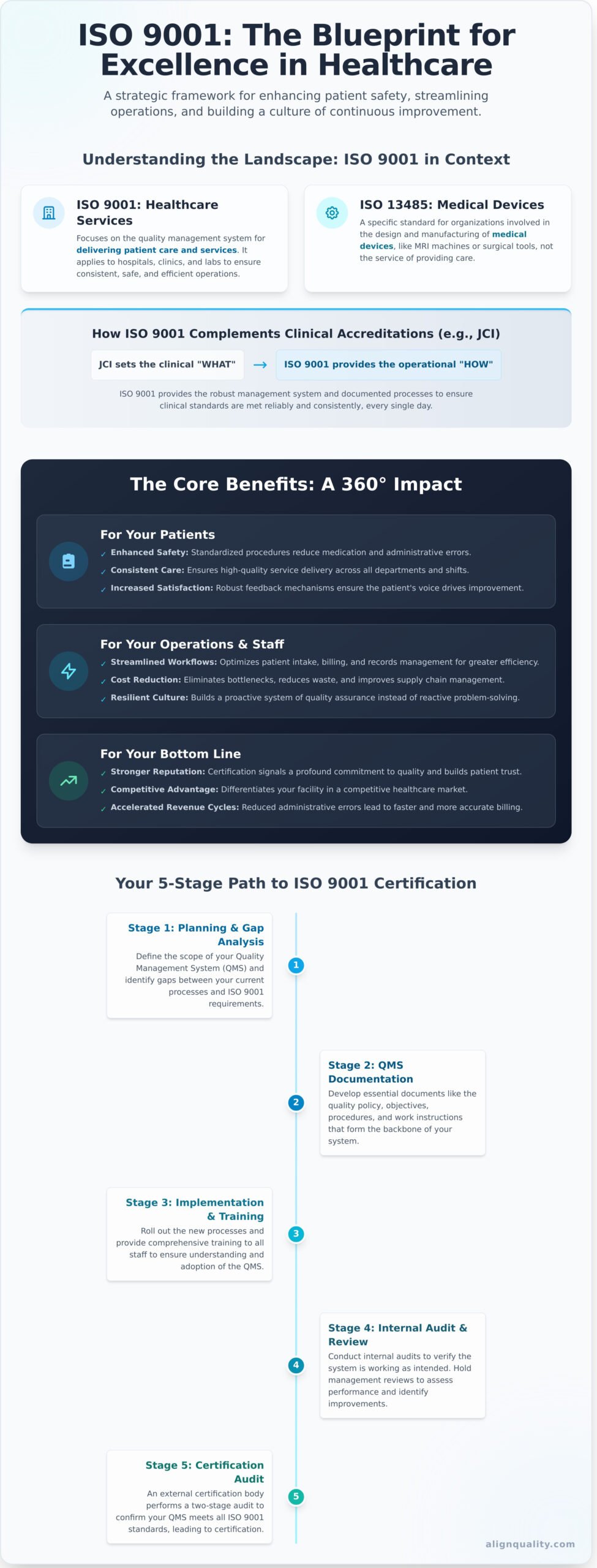
It is important to distinguish between ISO 9001 and ISO 13485. While both relate to quality, they serve different parts of the healthcare ecosystem. ISO 9001 applies to the quality of services provided by an organization. In contrast, ISO 13485 is a specific standard for organizations involved in the design and manufacturing of medical devices. For example, a hospital would implement ISO 9001 to manage its patient care processes, while the manufacturer of its MRI machines would use ISO 13485 to manage its production quality.
How ISO 9001 Integrates with Clinical Accreditations (e.g., JCI)
Implementing ISO 9001 in healthcare does not conflict with clinical accreditations like those from the Joint Commission International (JCI). Instead, it provides the underlying management system to achieve them reliably. Think of it as the ‘how’ behind the clinical ‘what’. While JCI sets the standards for patient safety and clinical outcomes (the ‘what’), ISO 9001 establishes the documented processes, risk management framework, and continuous improvement cycles (the ‘how’) that ensure those standards are met consistently, day after day.
The Core Benefits of ISO 9001 for Patients, Staff, and Your Bottom Line
Adopting a Quality Management System (QMS) under ISO 9001 transcends a simple compliance exercise; it represents a fundamental commitment to excellence that permeates every level of your organization. For healthcare providers, this commitment translates into tangible, measurable improvements that positively impact patient outcomes, operational performance, and organizational culture. Implementing iso 9001 healthcare standards means moving from reactive problem-solving to a proactive system of quality assurance.
Enhanced Patient Safety and Satisfaction
At its core, a QMS is designed to deliver consistent, predictable, and safe outcomes. In a clinical setting, this directly improves the patient experience. Standardized procedures for medication administration, for instance, drastically reduce the risk of human error. This systematic approach is a key reason why research on the Impact of ISO Certification on Patient Safety demonstrates a clear link to an improved safety culture in hospitals. Furthermore, ISO 9001 mandates robust mechanisms for patient feedback, ensuring that their voice is heard and used to drive improvements. This leads to consistent care delivery across all departments and shifts, building profound patient trust and confidence in your services.
Improved Operational Efficiency and Cost Reduction
A well-implemented QMS streamlines complex healthcare operations, eliminating bottlenecks and reducing waste. By mapping out and optimizing key processes, your facility can achieve significant efficiency gains and cost savings. Key areas of improvement include:
-
Streamlined Workflows: Standardizing patient intake, billing, and medical records management reduces administrative errors and accelerates revenue cycles.
-
Optimized Supply Chain: Improved inventory management for medical supplies and pharmaceuticals minimizes waste from expired stock and prevents critical shortages.
-
Reduced Rework: Clear protocols in laboratory and diagnostic services decrease the incidence of lost samples or incorrect tests, saving both time and resources.
-
Defined Roles: With clear roles and responsibilities, internal friction is reduced, allowing staff to focus more on value-added activities and patient care.
Building a Culture of Quality and Continuous Improvement
Perhaps the most transformative benefit of the iso 9001 healthcare framework is its ability to foster a true culture of quality. It provides a structured, data-driven approach to decision-making, replacing guesswork with evidence-based strategies. This empowers staff at all levels to identify systemic problems and contribute to solutions, boosting morale and engagement. A certified QMS is not a static achievement; it is a dynamic framework for continuous improvement, ensuring your organization can systematically adapt to new regulations, integrate emerging technologies, and consistently elevate its standard of care.
Key ISO 9001 Principles Translated into Healthcare Practice
The seven Quality Management Principles of ISO 9001 are not abstract business theories; they are the foundation of effective, safe, and patient-centered care. When applied to a hospital, clinic, or other medical facility, these principles provide a structured framework to formalize and enhance the high standards that healthcare professionals already strive for.
Principle 1: Patient-Centric Focus
In healthcare, the "customer" is the patient. This principle shifts the focus to systematically understanding and exceeding patient needs and expectations. This goes beyond clinical outcomes to encompass the entire patient experience. Practical applications include:
-
Implementing regular patient satisfaction surveys to gather structured feedback on care, communication, and facilities.
-
Designing care pathways from the patient’s perspective, ensuring clear navigation, coordinated appointments, and transparent billing.
-
Establishing formal communication protocols to keep patients and their families informed and involved in care decisions.
Principles 2 & 3: Leadership & Team Engagement
Quality in healthcare is driven by strong leadership and an engaged team. Leaders must define a clear quality policy-a mission statement for patient safety and care-that every staff member understands. This commitment empowers the entire team, from surgeons to administrative staff, to contribute to quality improvement. When clinical staff are involved in process improvement teams, their frontline expertise becomes a vital asset for identifying risks and creating practical solutions.
Principles 4 & 5: A Process Approach to Improvement
Healthcare delivery is a series of interconnected processes. The iso 9001 healthcare framework encourages mapping the patient journey from admission to discharge to identify potential failure points and inefficiencies. Using structured improvement cycles like Plan-Do-Check-Act (PDCA), clinical teams can test and refine protocols in a controlled way. When an incident or near-miss occurs, the focus is not on blame but on a root cause analysis to understand systemic weaknesses. This approach turns every error into a learning opportunity, preventing recurrence and systematically improving patient safety. Understanding how to manage a deviation is critical, which is why a clear process for handling an ISO 9001 nonconformance is essential.
Principles 6 & 7: Evidence-Based Decisions & Relationship Management
Effective quality management relies on data, not intuition. This means tracking Key Performance Indicators (KPIs) such as hospital-acquired infection rates, patient readmission statistics, and medication error frequency. The results from internal audits and performance data should directly inform strategic decisions about resource allocation, training, and technology adoption. A compelling case study on ISO 9001 implementation shows how this data-driven approach yields tangible benefits. This principle also extends to managing relationships with external partners-such as diagnostic labs, pharmaceutical suppliers, and equipment vendors-to ensure their performance meets your quality standards and supports excellent patient care.
Implementing ISO 9001 in Your Healthcare Facility: A 5-Stage Roadmap
Embarking on the path to certification can seem complex, but with a structured approach, it becomes a manageable and highly rewarding journey. Our proven 5-stage roadmap demystifies the process, providing a clear framework to implement ISO 9001 in healthcare settings efficiently and with minimal disruption to patient care. This methodical plan ensures every requirement is met with confidence.
Stages 1 & 2: Leadership Buy-In and Gap Analysis
The journey begins with a foundational commitment from senior management. This leadership buy-in is critical for allocating the necessary resources and authority to drive change. Following this, we conduct a thorough gap analysis. This diagnostic step compares your facility’s current procedures-from patient admissions to clinical protocols-against the ISO 9001 standard. It precisely identifies where processes need to be developed or better documented, forming the basis of your project plan and timeline.
Stage 3: QMS Development and Documentation
This stage involves building the core of your Quality Management System (QMS). Here, you will define and document your quality policy, measurable objectives, and key operational procedures. For a healthcare provider, this includes formalizing processes like:
-
Patient records management and confidentiality
-
Staff training and competency verification
-
Infection control protocols
-
Medical equipment calibration and maintenance
The goal is not to create bureaucracy, but to establish clarity, consistency, and accountability. Learn more about the full process in our guide on how to get ISO 9001 certification.
Stages 4 & 5: Implementation, Internal Audit, and Certification
Once your QMS is documented, the focus shifts to implementation. This involves training your staff on the new and formalized procedures to ensure they are understood and followed consistently. Next, you will conduct a full internal audit-a critical "dress rehearsal" to test your QMS, identify any non-conformities, and make corrective actions. After successfully completing your internal audit and a final management review, you are ready to select an accredited certification body for the external audit and achieve your certification.
To ensure your team is fully prepared for this final step, review our complete guide to the ISO audit.
Partnering for Success: Why an ISO 9001 Consultant is Your Best Ally
Embarking on the path to ISO 9001 certification is a significant commitment to quality and patient safety. While the standard provides a powerful framework, navigating its implementation within the high-stakes healthcare environment presents unique challenges. Many organizations consider a "do-it-yourself" approach, only to find their internal resources stretched thin, diverting critical focus from patient care.
An experienced ISO 9001 consultant acts as a strategic partner, transforming a complex compliance project into a streamlined and successful journey. They provide the dedicated expertise and objective oversight needed to build a quality management system that is both effective and sustainable.
Navigating Healthcare-Specific Challenges
Applying a universal quality standard to the nuanced world of clinical care requires specialized knowledge. A consultant with expertise in iso 9001 healthcare implementation knows how to translate abstract clauses into meaningful actions on the hospital floor or in the clinic. They help achieve crucial staff buy-in by framing the QMS around patient outcomes, not just procedural checklists, ensuring the system is a practical tool for improvement, not a theoretical exercise.
Saving Time and Ensuring Certification Success
Partnering with an expert guide provides a clear and direct path to certification, helping you avoid common pitfalls that can delay the process and inflate costs. The value of this guidance is clear:
-
Avoid Costly Missteps: Leverage a proven methodology to prevent common errors in documentation, internal audits, and management reviews that can derail your certification audit.
-
Streamline Implementation: An expert condenses years of learning into an efficient, structured process, saving your team hundreds of hours of research and trial-and-error.
-
Gain an Objective Perspective: Consultants bring a fresh, external viewpoint to identify ingrained inefficiencies and areas of non-conformance that internal teams might overlook.
At Align Quality, we provide the methodical guidance and industry-specific expertise necessary to achieve certification with confidence. Our role is to manage the complexities of implementation, allowing your team to remain focused on what they do best: delivering exceptional patient care. Let our experts guide your ISO 9001 journey with confidence.
Your Journey to Quality Excellence in Healthcare
In conclusion, ISO 9001 is far more than a regulatory hurdle; it is a strategic framework for embedding a culture of excellence and safety into the very DNA of your facility. By standardizing critical processes and committing to continuous improvement, you directly enhance patient outcomes, reduce operational risks, and build lasting trust within your community. Adopting an iso 9001 healthcare quality management system is a powerful declaration of your commitment to the highest standards of care.
Embarking on this journey requires a partner with proven expertise. The team at Align Quality consists of Certified ISO 9001 Lead Auditors with deep experience across multiple high-stakes industries. Our methodical 5-Stage Certification Process is designed to streamline your path to compliance, removing uncertainty and ensuring you achieve your goals with confidence.
Ready to transform your approach to quality management? Book a Free Consultation to Discuss Your Healthcare Quality Goals and let us guide you on the path to certification and enhanced patient safety.
Frequently Asked Questions
How long does it take for a hospital or clinic to get ISO 9001 certified?
The timeline for ISO 9001 certification depends on the size, complexity, and existing quality processes of the healthcare facility. For most hospitals and clinics, the journey typically takes between 6 and 12 months. This period covers the initial gap analysis, development of the Quality Management System (QMS), staff training, internal audits, and the final external certification audit. Our structured, five-stage process is designed to streamline this path and ensure an efficient and predictable timeline.
What is the typical cost of implementing ISO 9001 in a healthcare setting?
The cost of ISO 9001 implementation is a strategic investment in patient safety and operational excellence. Costs vary based on factors such as the size of your organization, the scope of the certification, and the level of internal resources available. Key expenses include consulting and training fees, and the certification body’s audit fees. We provide a transparent, tailored proposal after an initial assessment to ensure the investment aligns with your facility’s specific objectives and budget.
Can a small, private practice benefit from ISO 9001 certification?
Absolutely. The ISO 9001 standard is scalable and highly beneficial for small practices. It provides a proven framework to streamline clinical and administrative processes, reduce errors, and enhance patient satisfaction. For a smaller practice, certification demonstrates a serious commitment to quality care, creating a distinct competitive advantage. It builds a robust foundation for consistent service delivery and sustainable growth, helping to formalize processes that may currently be informal or inconsistent.
Does ISO 9001 require us to create a huge amount of new paperwork?
This is a common misconception. The modern ISO 9001 standard focuses on effective processes, not excessive documentation. It requires "documented information" only where it adds value and ensures consistency in your operations. Our approach is to integrate necessary documentation seamlessly into your existing workflows, leveraging digital tools where possible. The objective is to build a lean, efficient management system that supports your staff, not to burden them with unnecessary paperwork.
Our staff is already overworked. How can we get them on board with ISO 9001?
Staff engagement is crucial for a successful implementation. We recommend positioning ISO 9001 as a tool to simplify tasks and reduce recurring problems, which ultimately eases their workload. By involving your team in the process of improving workflows, they gain ownership of the system. Clear communication that focuses on the benefits-such as clarified roles, fewer errors, and improved patient outcomes-helps transform the initiative from an added burden into a shared goal for excellence.
How does ISO 9001 help with compliance to healthcare regulations like HIPAA?
While ISO 9001 is not a substitute for regulatory compliance, it creates a powerful framework that directly supports it. The standard’s requirements for process control, risk management, and control of documented information help you systematically manage regulatory duties like HIPAA. An ISO 9001 healthcare system establishes reliable mechanisms for protecting patient data, managing records, and ensuring consistent procedural adherence, which are all fundamental to maintaining robust regulatory compliance.