
What if your next gap analysis report did more than just list compliance failures? What if it became the single most powerful tool for securing the resources you need to streamline your certification journey?
It’s a common frustration. You spend weeks meticulously documenting non-conformities against the ISO 9001 standard, only to have the strategic importance lost when you present it to leadership. The technical details can easily overwhelm the business case, leaving you without the executive buy-in needed to move forward effectively.
This guide will change that. We provide a professional iso 9001 gap analysis report template designed not just for auditors, but for business leaders. You’ll discover how to transform your findings into a strategic roadmap, clearly linking compliance requirements to tangible business objectives and making a compelling case for investment. We will break down the essential sections of a high-impact report, show you how to present data effectively, and help you prepare for the upcoming ISO 9001:2026 revision.
Key Takeaways
- Understand how a formal gap analysis report moves beyond a simple checklist to become a strategic tool for management buy-in and resource allocation.
- Identify the essential components of a professional report, from a high-level executive summary to a detailed clause-by-clause compliance breakdown.
- Learn a proven, step-by-step process for using document reviews and interviews to accurately populate your iso 9001 gap analysis report template.
- Discover effective techniques for presenting your findings to leadership, securing the necessary quality budget, and turning identified gaps into an approved action plan.
- Prepare for the future by learning how the upcoming ISO 9001:2026 revision will impact your quality management system and reporting structure.
What Is an ISO 9001 Gap Analysis Report?
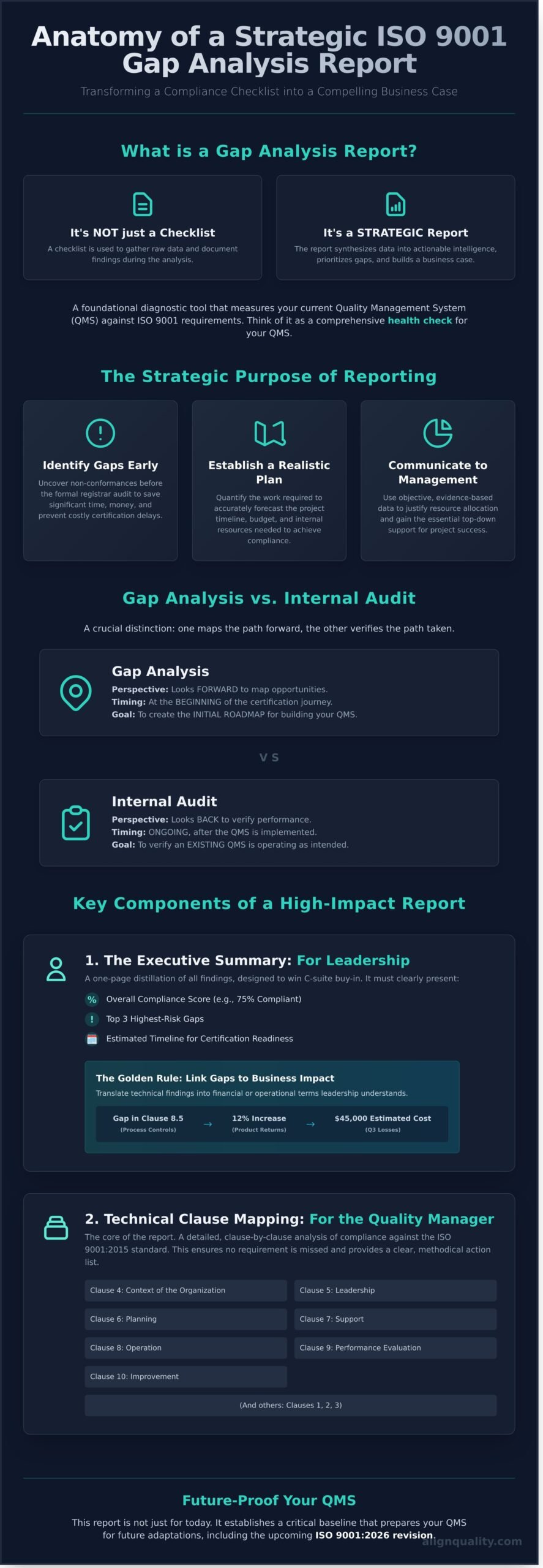
An ISO 9001 gap analysis report is a foundational diagnostic tool that measures your current processes against the requirements of the ISO 9001 standard. Think of it as a comprehensive health check for your Quality Management System (QMS). It provides a clear, documented snapshot of where your system excels and, more importantly, where it falls short of compliance. This isn’t just a simple checklist; it’s a formal management document that translates findings into a strategic action plan.
While a checklist is used to gather the raw data, the report synthesizes that data into actionable intelligence. It prioritizes non-conformities, estimates the effort required for remediation, and provides the evidence needed to secure management commitment. An effective iso 9001 gap analysis report template provides the structure to turn raw findings into this strategic document, ensuring no detail is overlooked.
At Align Quality, this report is the cornerstone of Stage 1 in our 5-Stage ISO 9001 Certification Process. It establishes the critical baseline from which your entire certification journey is planned. This initial assessment is also vital for future-proofing your QMS, creating a clear starting point for adapting to upcoming changes in the ISO 9001:2026 revision.
The Strategic Purpose of Gap Reporting
The report moves beyond simple compliance checking to become a powerful strategic asset. Its primary purpose is to provide leadership with the clarity needed to make informed decisions about the certification project. It achieves this by:
- Identifying non-conformances early. Uncovering gaps before the formal registrar audit saves significant time and money, preventing costly surprises and potential certification delays.
- Establishing a realistic project plan. By quantifying the gaps, you can accurately forecast the timeline, budget, and internal resources needed to achieve compliance.
- Communicating needs to management. The report serves as an objective, evidence-based tool to justify resource allocation and gain the top-down support essential for success.
Gap Analysis vs. Internal Audit
It’s crucial to understand that a gap analysis is not the same as an internal audit. A gap analysis is performed at the very beginning of your certification journey, often before a formal QMS is even fully implemented. Its goal is to create the initial roadmap for building your system.
In contrast, an internal audit, which we cover in our guide to ISO audits, is a systematic evaluation of an existing QMS to verify that it’s operating as intended and conforms to the standard. Internal audits are a mandatory, ongoing part of maintaining your certification once it’s achieved. The fundamental difference is one of perspective; the gap analysis looks forward to map the path, while the internal audit looks back to verify performance. It’s a shift from finding faults to mapping opportunities for building a robust and effective quality system from the ground up.
Essential Components of a Professional Report Template
A gap analysis is only as valuable as the report that communicates its findings. A disorganized document gets ignored, but a well-structured report becomes a strategic tool for improvement and certification. A professional iso 9001 gap analysis report template doesn’t just list non-conformities; it translates technical findings into a clear business case for action. It must be comprehensive for the quality manager yet immediately understandable for the C-suite. The five essential components ensure your report drives results, not confusion.
The Executive Summary: Winning Leadership Buy-In
Senior leadership won’t read a 40-page technical document. Your executive summary must distill every finding into a single, compelling page. The goal is to present three key takeaways: the overall compliance percentage (e.g., “75% compliant with ISO 9001:2015”), the top three highest-risk gaps, and the estimated timeline for certification readiness. Instead of just stating a gap, link it directly to business impact. For example, “A lack of documented process controls in production (Clause 8.5) contributed to a 12% increase in product returns in Q3, costing an estimated $45,000.” Conclude with a confident “Path to Certification” statement that outlines the high-level steps, resources, and commitment required.
Technical Clause Mapping
The core of the report is the detailed, clause-by-clause analysis. Your template must be logically structured around the 10 clauses of the ISO 9001:2015 standard. This methodical approach ensures no requirement is missed and makes the report easy to navigate for anyone familiar with the standard. For each clause, include these critical columns:
- Requirement: A brief summary of the specific ISO 9001 requirement.
- Evidence Observed: A factual, objective description of the current process, document, or record you reviewed.
- Evidence Required: A clear statement of what the standard mandates.
- Gap/Non-Conformity: A precise description of the discrepancy between the observed and required evidence.
- Compliance Status: A clear indicator (e.g., Compliant, Minor Non-Conformity, Major Non-Conformity).
Writing objective findings is critical. Avoid personal opinions or blame. Instead of “The team forgets to log maintenance,” write “Maintenance logs for Machine B were missing for 3 of the last 4 scheduled service dates.” This data-driven approach is fundamental to a quality management system, which the American Society for Quality defines a quality management system as a formalized system that documents processes, procedures, and responsibilities for achieving quality policies and objectives.
Beyond the detailed mapping, a complete iso 9001 gap analysis report template must include a risk assessment, a concrete action plan, and a visual dashboard. The risk assessment prioritizes gaps by evaluating their potential business impact versus the likelihood of occurrence, allowing you to focus on what truly matters. The action plan then turns these priorities into assigned tasks with clear ownership and deadlines, a core principle we build into our customized QMS implementation plans. Finally, a simple RAG (Red, Amber, Green) status dashboard provides an at-a-glance visual summary, making progress easy to track for all stakeholders.
How to Populate Your ISO 9001 Gap Analysis Report
Transforming a blank template into an actionable compliance roadmap requires a methodical approach. The goal isn’t just to find gaps; it’s to gather objective evidence that clearly defines your current state against the ISO 9001 standard. This systematic process, a cornerstone of effective ISO 9001 gap assessments, ensures your findings are credible and your subsequent actions are precise. Follow these four proven steps to gather the data needed for your report.
- Document Review: Begin by assessing your existing Quality Management System (QMS) documentation. This includes your quality manual, procedures, work instructions, and records. The objective is to understand what you claim to do on paper.
- Personnel Interviews: Next, verify that what is written is what is actually done. Interviews with department heads and front-line staff provide crucial context and reveal informal processes that may not be documented.
- Site Observation: Walk the floor. Observe operational workflows in real-time to confirm that procedures are being followed consistently and effectively. This step often uncovers discrepancies between documentation, interviews, and reality.
- Scoring Gaps: Finally, analyze your findings. Categorize each gap by its severity and the effort required for remediation to build a prioritized action plan.
Gathering Objective Evidence
Your analysis is only as strong as the evidence supporting it. To gather reliable data, start by using the ultimate ISO 9001 gap analysis checklist as your guide. This ensures you cover every clause of the standard systematically. When interviewing department heads, frame the conversation as a collaborative effort to understand their processes, not an interrogation. Ask open-ended questions like, “Can you walk me through how you handle customer feedback?” instead of a confrontational, “Show me where you document customer feedback.” If you find a “gray area” where a process exists but isn’t documented, note it as a gap in Clause 7.5 (Documented Information) but acknowledge the existing informal practice.
Analyzing and Categorizing Findings
Once you’ve collected the evidence, the next step is to interpret it for your iso 9001 gap analysis report template. It’s vital to distinguish between a missing process (e.g., no internal audit procedure exists) and an ineffective process (e.g., internal audits are performed, but they don’t lead to corrective actions). Assign priority levels (e.g., High, Medium, Low) to each finding based on risk. A critical gap is one that prevents certification. This prioritization ensures your team focuses on the most significant compliance issues first, creating a clear and efficient path toward a successful audit.
Presenting Findings to Leadership: From Gaps to Action
A completed gap analysis is not the end of a process; it is the beginning of a strategic conversation. The document you’ve meticulously prepared is the primary tool for securing executive buy-in and the resources needed for implementation. Your success hinges on your ability to translate technical audit findings into a compelling business case that resonates with decision-makers.
Leadership teams operate on the language of ROI, risk mitigation, and market opportunity. They don’t fund “compliance,” they invest in results. It’s your job to connect the dots between an ISO 9001 clause and a tangible business outcome. Before you even schedule the presentation, reframe every finding from your iso 9001 gap analysis report template into business terms:
- A “nonconformity in production control” becomes a “3% product defect rate costing the company $45,000 per quarter in rework and waste.”
- A “gap in supplier evaluation” becomes a “supply chain vulnerability that puts 20% of our raw material sourcing at risk of disruption.”
- “Achieving certification” becomes “unlocking access to enterprise-level contracts that require ISO 9001, representing a potential 15% revenue increase.”
This translation moves the discussion from a technical audit to a strategic business improvement plan, making the need for a “Quality Budget” self-evident.
Overcoming Resistance to Change
The most common objection you will face is institutional inertia: “We are already profitable, why do we need to change?” Counter this by positioning ISO 9001 not as a remedial fix, but as a framework for modern business growth. It’s about codifying what works well and building a system to sustain that success as you scale. Use benchmarking data to create urgency. For example, a 2022 study by the British Assessment Bureau found that 75% of ISO 9001 certified SMEs reported improved operational efficiency. Frame your findings as “Efficiency Gaps” and “Growth Opportunities” rather than “Compliance Failures.” The former invites collaboration, while the latter creates defensiveness.
Creating the Implementation Roadmap
An effective presentation concludes with a clear path forward. The findings from your report should be directly converted into a project management plan with clear accountability. For each identified gap, define a SMART (Specific, Measurable, Achievable, Relevant, Time-bound) goal. For instance, a gap in Clause 7.1.5 (Monitoring and measuring resources) becomes a project to “Implement a calibrated equipment tracking system by Q3, assigned to the Operations Manager, to reduce setup errors by 10%.” This transforms a vague finding into an actionable task with an owner and a deadline. During this remediation phase, the role of the ISO 9001 Lead Auditor shifts from investigator to internal consultant, guiding teams to implement solutions effectively and ensuring the project delivers its intended value.
To build a business case that gets immediate approval, start with a report that leaves no room for ambiguity. Download our comprehensive ISO 9001 Gap Analysis Checklist to ensure your findings are clear, actionable, and ready for the boardroom.
Future-Proofing Your Report for ISO 9001:2026
While ISO 9001:2015 remains the current standard, the next revision is already in development. The International Organization for Standardization’s technical committee, ISO/TC 176/SC 2, has confirmed the revision process is underway, targeting a 2026 publication. Preparing for these changes now is not just proactive; it’s a strategic necessity. Relying on an outdated gap analysis template designed only for the 2015 standard will leave your organization unprepared and could directly contribute to a failed transition audit in the future.
A modern quality management system must be resilient, agile, and forward-thinking. Your audit tools, especially your iso 9001 gap analysis report template, must reflect this evolution. It’s time to adapt your approach to align with the future of quality management.
Key Changes Anticipated in the 2026 Revision
Early indicators and the latest ISO 9001:2026 news suggest the revision will introduce a stronger emphasis on emerging business challenges. Two critical areas are supply chain resilience and digital security. Your gap analysis must evolve to assess these new risks. For example, instead of just verifying supplier contracts, your analysis will need to evaluate dependencies, single-source vulnerabilities, and contingency plans for disruptions. To prepare, add a dedicated “Transition Readiness” section to your report. This section should map current processes against anticipated 2026 requirements, identifying specific actions, responsibilities, and timelines for a smooth transition.
Leveraging AI in Quality Management
The next iteration of ISO 9001 will undoubtedly address the integration of emerging technologies. Understanding how AI will impact your QMS is no longer optional. An effective iso 9001 gap analysis report template should now include criteria for assessing both the risks and opportunities presented by artificial intelligence. This requires moving beyond traditional document reviews and into a more dynamic evaluation of your digital quality infrastructure.
Your report should document how your organization is preparing for this shift. Consider adding subsections within your gap analysis to evaluate:
- AI-Driven Opportunities: Assess the use of AI for predictive maintenance alerts, automated root cause analysis from non-conformance data, or sentiment analysis of customer feedback.
- AI-Related Risks: Document controls for potential data bias in AI algorithms, cybersecurity threats to AI systems, and the validation process for AI-driven decisions.
- Digital QMS Integrity: Evaluate the security and accessibility of cloud-based QMS platforms and the procedures for maintaining the integrity of digital records and electronic signatures.
By incorporating these elements today, you build a QMS that is not only compliant with the current standard but also primed for the next generation of quality excellence. You ensure your audit preparation is a strategic step toward future success, not just a backward-looking compliance check.
Your Roadmap to ISO 9001:2026 Compliance Starts Here
Your gap analysis report isn’t just a document; it’s the strategic blueprint for your quality management system’s future. A professional report effectively translates compliance gaps into actionable tasks for leadership and sets the stage for a seamless transition to the upcoming ISO 9001:2026 standard. By using a comprehensive iso 9001 gap analysis report template, you ensure no requirement is overlooked, creating a clear and direct path toward your certification goals.
Ready to take the next step on your certification journey? Our team of Certified ISO 9001 Lead Auditors has developed the definitive resource to guide you. Download The Ultimate ISO 9001 Gap Analysis Checklist Guide and leverage our proven 5-Stage Certification Process. As specialists in the ISO 9001:2026 transition, we’re here to help you navigate every change with confidence. Your path to certification is clear.
Frequently Asked Questions
What is the difference between a gap analysis and an internal audit?
A gap analysis is a high-level pre-assessment that compares your current practices against ISO 9001 requirements to identify missing elements before you build your QMS. An internal audit is a formal, detailed process conducted after your QMS is implemented. It systematically verifies that your established procedures conform to the ISO 9001 standard and are operating effectively. Think of the gap analysis as the blueprint check and the internal audit as the building inspection.
How long should an ISO 9001 gap analysis report be?
The length of the report is determined by your organization’s complexity, not a set page count. A small business with 10-15 employees might produce a 12-page report, while a multi-site manufacturer with 300 employees could require a report over 60 pages long. A quality iso 9001 gap analysis report template focuses on providing a clear, actionable summary of findings for each clause, including evidence, identified gaps, and recommended actions, regardless of the final length.
Can I use a free Excel template for my gap analysis?
Yes, a free Excel template can be a functional starting point, especially for smaller organizations with simple processes. However, you must verify that the template is fully aligned with the current ISO 9001:2015 standard. The primary risk is using an outdated or incomplete template, which can cause you to overlook critical requirements and lead to major non-conformities during your certification audit. Professional templates often provide more guidance and structure.
Who should be involved in the gap analysis process?
A gap analysis should be a collaborative effort led by a quality manager or an external consultant. It’s essential to involve a cross-functional team of 3-5 department heads from key areas like operations, engineering, and sales. Their direct input is necessary to accurately assess processes and gather evidence. Top management involvement is also critical to demonstrate commitment and authorize the resources needed to close any identified gaps.
How often should we update the gap analysis report during the certification journey?
The gap analysis report is a dynamic tool, not a one-time document. After the initial assessment, you should update it as you complete corrective actions, typically on a monthly or quarterly basis. This transforms the report into a live project plan that tracks your progress toward compliance. Regularly updating the document provides management with a clear, up-to-date view of your readiness for the Stage 1 and Stage 2 certification audits.
What is the most common gap found in ISO 9001 assessments?
One of the most common gaps identified during initial assessments relates to Clause 6.1: Actions to address risks and opportunities. Many companies lack a formalized, documented process for identifying and planning for risks beyond informal discussions. Another frequent finding involves inadequate documentation for Clause 7.1.6: Organizational knowledge, where businesses fail to properly capture and make available the critical knowledge held by experienced employees.