In the high-stakes world of oil and gas, quality isn’t just a goal-it’s a critical requirement for safety, compliance, and winning contracts. Navigating the landscape of quality management standards can be complex, leaving many to question the specific role of iso 9001 oil and gas operations. You may wonder if this foundational standard is robust enough for such a high-risk environment, or how it truly compares to industry-specific frameworks like ISO 29001 and API Q1.
This complete guide provides the clarity you need to move forward with confidence. We will break down how ISO 9001 serves as the essential bedrock for a world-class Quality Management System (QMS). You will gain a precise understanding of the differences between these key standards and identify the optimal certification path for your organization. The result is a clear roadmap to demonstrating compliance, enhancing safety, and building the operational resilience required to succeed in this demanding sector.
Key Takeaways
-
Understand how ISO 9001 establishes a critical foundation for quality management, mitigating the significant safety and environmental risks inherent in the industry.
-
Learn how the general framework of iso 9001 oil and gas operations is enhanced by sector-specific standards like ISO 29001 and API Q1 for comprehensive risk control.
-
Discover the practical application of key ISO 9001 clauses, translating abstract requirements into tangible actions for your daily oil and gas operations.
-
Gain a clear, 4-step roadmap to streamline your certification journey, making the implementation process manageable and structured.
Table of Contents
-
Why ISO 9001 is the Bedrock of Quality in the Oil and Gas Sector
-
Beyond ISO 9001: Understanding Sector-Specific Oil and Gas Standards
Why ISO 9001 is the Bedrock of Quality in the Oil and Gas Sector
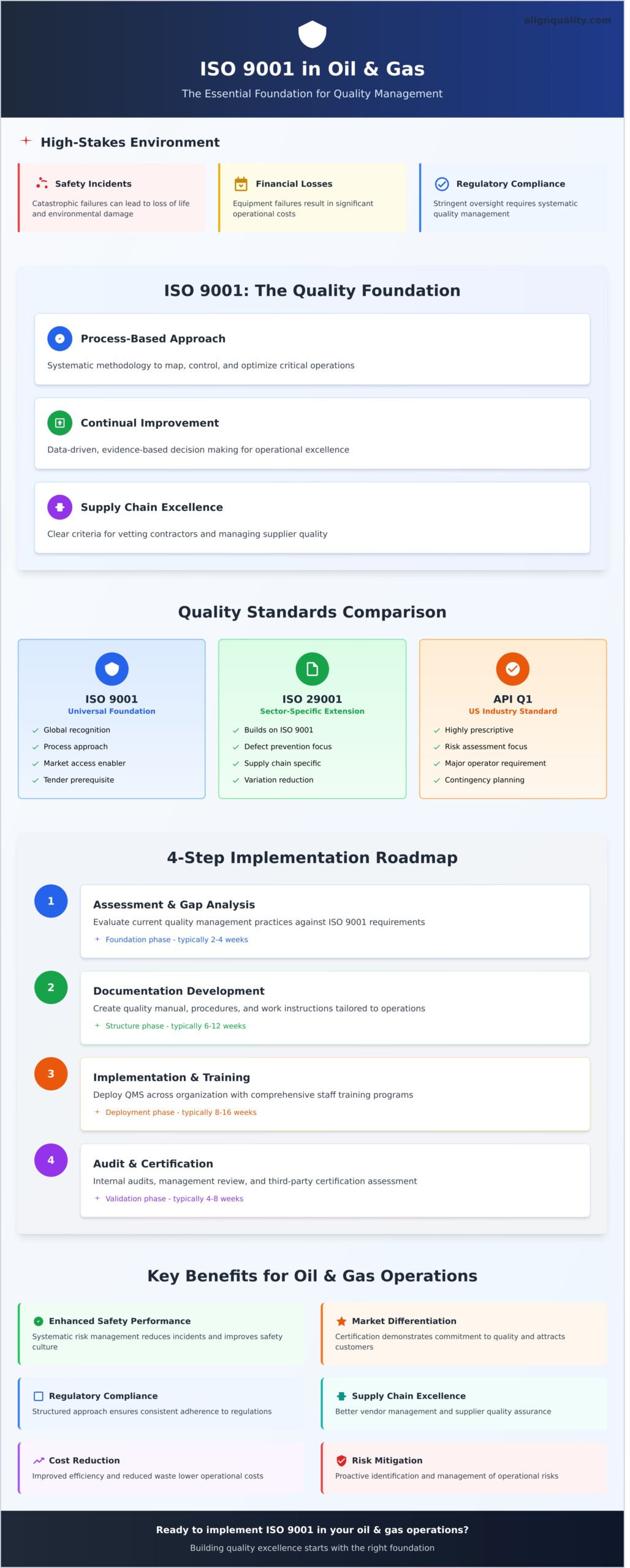
The oil and gas industry operates in an unforgiving environment where the stakes are exceptionally high. A single failure can lead to catastrophic safety incidents, severe environmental damage, and significant financial losses. Compounded by complex, global supply chains and stringent regulatory oversight, the need for a systematic approach to quality is not just a preference-it is an operational necessity.
This is where ISO 9001 provides the internationally recognized framework for a Quality Management System (QMS). It offers a robust, process-based foundation that helps standardize operations, reduce costly errors, and drive continual improvement. For companies navigating the complexities of iso 9001 oil and gas compliance, this standard is the essential first step. While industry-specific standards exist, they are built upon the proven principles of the core ISO 9000 family of standards, making a solid ISO 9001 implementation the critical starting point on your journey to operational excellence.
Establishing a Baseline for Operational Excellence
ISO 9001 introduces a powerful process approach, enabling your organization to map, control, and optimize every critical operation. This systematic methodology replaces guesswork with data-driven, evidence-based decision making, allowing you to identify risks and opportunities for improvement. The result is a culture of quality that permeates every level of the business, ensuring all personnel understand their role in maintaining the highest standards of performance and safety.
Strengthening Supply Chain Management and Consistency
Your operational integrity is only as strong as your weakest supplier. The principles of iso 9001 oil and gas management extend throughout your entire supply chain, establishing clear criteria for vetting contractors and managing suppliers. By implementing a certified QMS, you ensure the consistency and quality of products and services from a diverse supply base, drastically reducing the risk of costly failures caused by substandard components or services.
Meeting Tender Requirements and Gaining Market Access
In today’s competitive landscape, ISO 9001 certification is more than a quality benchmark-it is a key to market access. Major operators and national oil companies frequently list ISO 9001 as a mandatory prerequisite for bidding on major contracts. Certification demonstrates a verifiable commitment to quality and risk management, giving potential clients and partners the confidence to engage with your business. For a deeper dive, read our plain-English guide for business leaders.
Beyond ISO 9001: Understanding Sector-Specific Oil and Gas Standards
While ISO 9001 provides a robust and internationally recognized framework for quality management, its universal nature means it does not address the specific, high-consequence risks inherent in the oil and gas sector. Equipment failure, supply chain disruption, and environmental hazards demand a more rigorous and targeted approach. For this reason, organizations pursuing iso 9001 oil and gas compliance often find it necessary to adopt sector-specific standards that build upon the ISO 9001 foundation. These are not replacements, but critical additions for any organization committed to operational excellence and safety.
What is ISO 29001? The Sector-Specific QMS
Developed jointly by ISO and the international oil and gas industry, ISO 29001 is the sector-specific extension of ISO 9001. It incorporates the foundational principles of the base standard but adds supplemental requirements tailored to the petroleum, petrochemical, and natural gas supply chain. Its primary focus is on defect prevention, the reduction of variation and waste, and ensuring the reliability and safety of all products and services.
What is API Spec Q1? The American Petroleum Institute Standard
The American Petroleum Institute’s Specification Q1 is the premier quality management standard for manufacturers and service providers in the industry. It is highly prescriptive, with a stringent emphasis on documented risk assessment and management at every stage. Compliance is often a prerequisite for supplying major operators in the US and globally. The standard includes detailed requirements for supply chain management, contingency planning, and validating critical processes, which are often certified through frameworks like the API Quality Registrar program to ensure a consistent level of quality.
Comparison: ISO 9001 vs. ISO 29001 vs. API Q1
Understanding the distinctions between these standards helps your organization select the right certification journey. While they share a common goal of quality, their scope and application differ significantly.
-
ISO 9001: The Foundation
-
Scope: Universal; applicable to any industry.
-
Focus: Customer satisfaction and continual improvement.
-
Prescriptiveness: Flexible and adaptable framework.
-
Global Recognition: The world’s most recognized QMS standard.
-
ISO 29001: The Sector-Specific Enhancement
-
Scope: Petroleum, petrochemical, and natural gas industries.
-
Focus: Defect prevention, waste reduction, and supply chain control.
-
Prescriptiveness: More prescriptive, building directly on ISO 9001.
-
Global Recognition: High, specifically within the global oil and gas sector.
-
API Spec Q1: The Prescriptive Mandate
-
Scope: Primarily for equipment manufacturers and related service providers.
-
Focus: Rigorous risk assessment, management, and contingency planning.
-
Prescriptiveness: Highly prescriptive and detailed requirements.
-
Global Recognition: Essential for North American market access and highly respected worldwide.
Applying Key ISO 9001 Clauses to Oil and Gas Operations
Implementing ISO 9001 successfully means translating its framework into tangible actions on the ground. For the high-stakes environment of oil and gas, this requires a deep understanding of operational realities. The principles of quality management are so foundational that they have been expanded into sector-specific oil and gas standards. Here, we examine how key ISO 9001 clauses apply directly to your operations, from exploration to refining.
Clause 6.1: Actions to Address Risks and Opportunities
This clause moves beyond financial risk to address the severe operational, environmental, and safety hazards inherent in the industry. A robust QMS identifies and mitigates threats like the catastrophic failure of equipment on a remote offshore platform or a critical supply chain disruption for specialized drilling components. Proactive risk assessment becomes a core operational discipline, not just a compliance exercise.
Clause 7.2: Competence
In an industry where errors can have devastating consequences, competence is non-negotiable. This clause mandates verifiable training for personnel handling hazardous materials or executing emergency response protocols. It also requires rigorous processes to confirm the competence of subcontractors working on critical infrastructure, ensuring everyone on site understands and adheres to quality and safety policies without exception.
Clause 8.4: Control of Externally Provided Processes, Products, and Services
The oil and gas sector relies on a vast, global network of suppliers and service providers. This clause provides the framework for managing this complexity. It requires establishing clear criteria for supplier evaluation, selection, and ongoing performance monitoring. This ensures full traceability of critical materials and components-from the foundry to final installation-safeguarding the integrity of your assets.
Clause 8.5.1: Control of Production and Service Provision
This clause demands controlled conditions for every critical stage of production and service. For an iso 9001 oil and gas system, this includes documented procedures for specialized welding, non-destructive testing, and equipment maintenance. It emphasizes the importance of calibrated instruments and strict adherence to preventive maintenance schedules to ensure asset reliability and prevent unplanned downtime or incidents, including post-delivery activities like decommissioning. To manage the extensive documentation for these processes, many companies utilize specialized software; SOCWeld, for instance, provides a digital platform to automate and manage welding documentation.
Your Roadmap to Certification: A 4-Step Implementation Plan
Achieving ISO 9001 certification can seem complex, but with a systematic approach, it becomes a manageable journey. A structured implementation plan, guided by an expert partner, removes uncertainty and ensures a successful outcome. This proven 4-step process is tailored to address the unique operational risks and regulatory demands of the oil and gas sector, streamlining your path to compliance and enhanced performance.
Step 1: The Critical Gap Analysis
The first step is a comprehensive assessment to understand where your current systems meet ISO 9001 requirements and where they fall short. For the oil and gas industry, this analysis must go beyond standard quality checks to evaluate HSE integration, regulatory compliance (e.g., API specifications), and critical supply chain risks. A thorough analysis prevents surprises during the formal audit. You can use our ultimate ISO 9001 gap analysis checklist to get started.
Step 2: Building an Integrated QMS
Based on the gap analysis, we develop a robust Quality Management System (QMS) that is fully integrated with your existing Health, Safety, and Environment (HSE) protocols. The goal is not to create more bureaucracy but to build practical, value-adding processes that enhance operational control. This unified approach is essential for achieving a successful iso 9001 oil and gas certification and fostering a culture of safety and quality.
Step 3: Internal Audits and Management Review
Before the final audit, we conduct rigorous internal audits to test the effectiveness of your new QMS. This serves as a critical dress rehearsal, identifying any areas for refinement in a low-stakes environment. Following the audit, a formal management review ensures leadership commitment, confirms resource allocation, and aligns the QMS with your strategic business objectives. Learn how to prepare with our complete guide to ISO audits.
Step 4: Certification and Continual Improvement
With a proven QMS in place, the final step is engaging an accredited certification body for the external audit. Achieving certification is the start of your continual improvement journey, not the end. The system provides the framework to drive ongoing gains in efficiency, safety, and client satisfaction. Any audit findings are addressed with a robust corrective action plan to prevent future ISO 9001 nonconformances and strengthen your operations.
Elevate Your Operations with a Proven Quality Framework
In the high-stakes world of oil and gas, a commitment to quality is non-negotiable. Implementing a quality management system based on ISO 9001 for oil and gas operations is the definitive step towards operational excellence, enhanced safety protocols, and unwavering stakeholder confidence. This guide has demonstrated that ISO 9001 provides a robust framework for managing complex risks and that a structured implementation plan makes achieving certification an attainable and valuable goal for any organization in the sector.
Your certification journey doesn’t have to be complex or uncertain. At Align Quality, our team of Certified ISO 9001 Lead Auditors leverages multi-industry experience, including deep expertise in high-risk sectors. Our proven 5-Stage Certification Process provides a clear, methodical roadmap, removing ambiguity and guiding your team at every step towards a successful audit.
Book Your Free Consultation to Start Your Certification Journey
Take the decisive step towards enhancing your quality management system and achieve your compliance objectives with confidence.
Frequently Asked Questions About ISO 9001 in Oil & Gas
Is ISO 9001 mandatory for the oil and gas industry?
While ISO 9001 is not a legal or regulatory mandate, it is widely considered a commercial necessity. Major operators and contractors frequently require their suppliers to hold this certification as a baseline for quality assurance. Lacking ISO 9001 can be a significant barrier to entry for new contracts and partnerships, making it a critical standard for any business aiming for sustained success and credibility within the highly competitive oil and gas sector.
Can our company be certified to both ISO 9001 and API Spec Q1?
Yes, your company can and often should be certified to both standards. API Spec Q1 is built upon the foundational framework of ISO 9001 but includes more rigorous, industry-specific requirements for product and service quality. Achieving dual certification demonstrates an exceptional commitment to quality that meets both international best practices and the stringent demands of the oil and gas supply chain, significantly enhancing your competitive standing and market access.
How does ISO 9001 relate to health and safety standards like ISO 45001?
ISO 9001 and ISO 45001 are designed to work together seamlessly. ISO 9001 establishes the framework for a Quality Management System (QMS), while ISO 45001 focuses on an Occupational Health and Safety (OH&S) system. Many oil and gas companies integrate these standards into a single management system. This approach streamlines audits, reduces administrative duplication, and creates a more robust, holistic framework for managing overall business risk and operational excellence.
How long does it take to get ISO 9001 certified in the oil and gas sector?
The timeline for ISO 9001 certification typically ranges from 6 to 12 months. This duration depends on several key factors, including your company’s size, the complexity of your operations, and the maturity of existing quality processes. A thorough gap analysis at the beginning of the journey provides a clear roadmap and a more precise timeline. A structured, methodical approach ensures all requirements are met efficiently, preparing your organization for a successful certification audit.
What are the main benefits of ISO 9001 for a smaller supplier in the industry?
For smaller suppliers, achieving iso 9001 oil and gas certification is a powerful tool for growth. It opens doors to larger contracts by satisfying the pre-qualification criteria of major industry players. It also enhances operational efficiency, reduces costly errors, and improves risk management. Most importantly, it builds undeniable credibility and trust with potential clients, allowing you to compete confidently with larger, more established companies on a level playing field.
Do we need a consultant to achieve ISO 9001 certification?
While it is not mandatory to use a consultant, engaging an expert is highly recommended to streamline your certification journey. A qualified consultant provides the necessary expertise to navigate the standard’s complexities, helping you avoid common pitfalls and saving significant internal time and resources. This partnership ensures your Quality Management System is not only compliant but also optimized for your specific business needs, leading to an efficient audit process and a successful outcome.