
What if the biggest obstacle to your ISO 9001 certification wasn’t the final audit, but the roadmap you use to prepare for it? It’s a valid concern for any operations or quality manager. The journey toward compliance is often perceived as a maze of complex documentation, auditor scrutiny, and looming uncertainty around the upcoming ISO 9001:2026 revision.
This guide is designed to replace that anxiety with confidence. We provide a clear, expert-led walkthrough of the complete iso 9001 certification process step-by-step, tailored for the updated standards. By following this proven framework, you’ll gain a methodical plan to not only pass your audit but to implement a Quality Management System that genuinely improves your operations. Get ready to master the five essential stages of your certification journey, from initial planning to final assessment.
Key Takeaways
- The certification journey begins with a thorough Gap Analysis to identify non-compliance issues before they can lead to audit failure and wasted resources.
- Successful implementation involves both training staff on new procedures and conducting a strategic internal audit to gather objective evidence that your QMS is effective.
- Understanding the official iso 9001 certification process step-by-step demystifies the two-stage external audit, which begins with a documentation review before the main assessment.
- Achieving certification is the start of an ongoing quality journey that requires regular surveillance audits to maintain compliance and drive strategic growth.
Understanding the ISO 9001 Journey: Why a Structured Process Matters
Achieving ISO 9001 certification isn’t a simple box-ticking exercise; it is a systematic journey toward operational excellence. Many organizations underestimate the rigor required, treating the standard as a checklist to be rushed. This approach, often called “winging it,” is the primary reason for failed audits. A single major non-conformance during a Stage 1 audit can delay certification by up to six months, wasting valuable time, budget, and team morale. The goal isn’t just to get a certificate, but to achieve Certification with Confidence.
A structured approach provides a clear, repeatable path to success. It ensures that every clause of the standard is addressed logically, building a Quality Management System (QMS) that is robust, effective, and truly embedded in your company culture. This methodical foundation is more critical than ever, as organizations must also prepare for the upcoming transition to the revised ISO 9001:2026 standard, which will introduce new priorities and requirements.
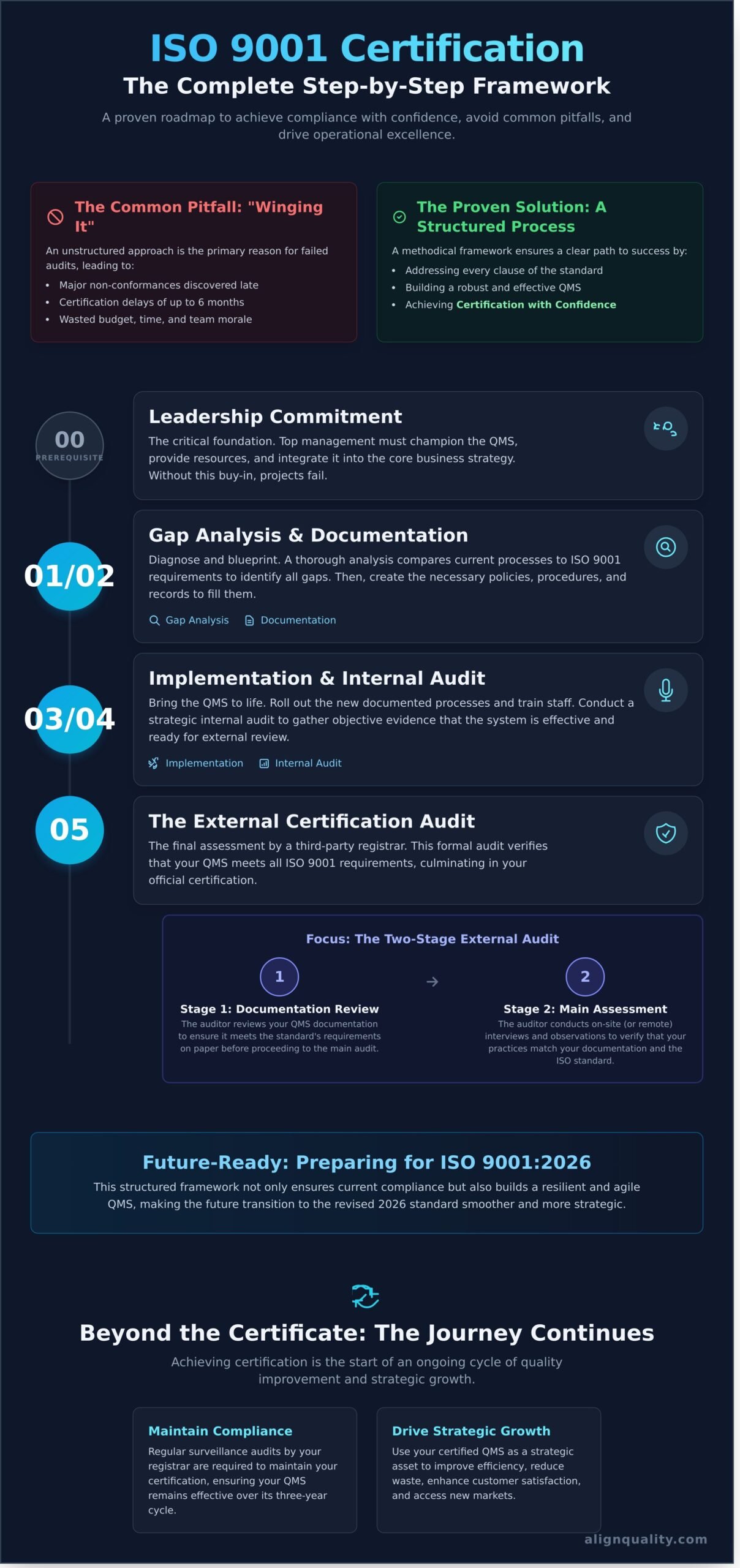
The 5-Stage ISO 9001 Framework
Our proven iso 9001 certification process step-by-step is built on a five-stage framework that eliminates guesswork and ensures comprehensive compliance. This sequence is designed to build upon itself, preventing the costly rework that comes from a disorganized implementation. The stages are:
- Stage 1: Consultation. Defining the scope and objectives of your QMS.
- Stage 2: Gap Analysis. Identifying the specific gaps between your current processes and ISO 9001 requirements.
- Stage 3: Documentation. Creating the necessary policies, procedures, and records to fill the identified gaps.
- Stage 4: Implementation. Rolling out the new processes and training your team.
- Stage 5: Audit. Undergoing the formal certification audit with a third-party registrar.
Following this order is essential. You cannot effectively write documentation without first knowing what gaps exist, nor can you implement a system that hasn’t been documented. For a deeper dive into the standard’s structure, see our complete ISO 9001: The Definitive Guide for Business Leaders.
Securing Leadership Commitment
Before any formal stages begin, there is a critical “Stage 0”: securing top management buy-in. The standard itself emphasizes this in Clause 5.1, “Leadership and commitment.” Without genuine support from the leadership team, any QMS implementation is destined to fail. The key is to frame ISO 9001 not as a cost center, but as a strategic asset that drives efficiency, reduces waste, and unlocks access to new markets that mandate certification.
The Quality Manager may drive the day-to-day project, but the leadership team’s role is to provide resources, remove obstacles, and integrate the QMS into the core business strategy. They champion the “why” behind the process, connecting the principles of the ISO 9000 family of standards to tangible business outcomes like improved customer satisfaction and a stronger bottom line.
Phase 1 & 2: Gap Analysis and the Documentation Framework
Embarking on the ISO 9001 certification journey begins with two foundational stages: understanding your current state and building the structural blueprint for your Quality Management System (QMS). This is not about creating paperwork; it’s about establishing a clear, efficient, and compliant operational framework. Successfully navigating these initial phases sets the trajectory for the entire project, ensuring your efforts are focused and effective.
Think of this as drawing the map before you start driving. A precise map ensures you reach your destination directly, avoiding costly detours and delays. This initial assessment and planning is a critical part of the iso 9001 certification process step-by-step, turning a complex standard into a manageable action plan.
Conducting a Comprehensive Gap Analysis
The first practical step is a Gap Analysis. This is a meticulous diagnostic review that compares your existing processes, procedures, and practices against the official standard. The goal is to systematically identify every “gap” or area of non-conformance. The goal is to systematically compare your operational reality against the formal ISO 9001 requirements. Engaging a certified lead auditor for this task provides an objective, expert perspective that internal teams often cannot replicate, identifying subtle risks that could jeopardize a formal audit. As we anticipate the upcoming ISO 9001:2026 revision, a thorough analysis also helps future-proof your QMS against new requirements. To help your team understand what’s involved, our free resource, The Ultimate ISO 9001 Gap Analysis Checklist Guide, provides a detailed starting point.
Developing a Lean Documentation Structure
Many businesses fear that ISO 9001 certification will bury them in bureaucracy. This is a common myth. The standard has evolved to require “documented information,” not prescriptive piles of paper. This flexible approach allows you to use formats that best suit your business, from digital wikis and video tutorials to traditional documents. The key is control and accessibility, not volume. Your documentation must be tailored to how your business actually operates.
At a minimum, your QMS needs a few core components:
- A Quality Policy: A high-level statement of your organization’s commitment to quality.
- Quality Objectives: Specific, measurable goals that align with your policy.
- The Scope of the QMS: A clear definition of the boundaries of your QMS, detailing which parts of your business it covers.
The most effective QMS is a lean one that your team understands and uses daily. Modern digital tools can drastically reduce the administrative burden of managing this documented information, ensuring version control and easy access. By focusing on a lean structure, you build a system that adds value instead of one that just sits on a shelf. Our experts specialize in designing a QMS that is both compliant and practical, tailoring the documentation to your unique operational workflows.
Phase 3 & 4: System Implementation and the Strategic Internal Audit
With your Quality Management System (QMS) documented, the focus now shifts from planning to execution. This phase is where your policies and procedures come to life, transforming theoretical documents into the daily operational rhythm of your business. Successfully navigating these steps is critical, as it generates the objective evidence required to prove your system is both effective and compliant.
The implementation and internal audit stages of the iso 9001 certification process step-by-step are where you prove your commitment to quality. This isn’t just about paperwork; it’s about embedding a culture of continuous improvement. The process involves five distinct actions:
- Step 1: Train Staff. Your team is the engine of your QMS. Effective training must go beyond simply distributing new documents. It involves explaining the “why” behind each procedure, clarifying new responsibilities, and reinforcing the company’s commitment to quality. This aligns directly with core NIST quality management principles that emphasize the engagement of people at all levels.
- Step 2: Collect Records. An auditor’s mantra is “show me the evidence.” For the next 2-3 months, your organization must diligently operate according to the new QMS, generating records that prove it. This includes everything from completed inspection reports and customer feedback logs to equipment calibration certificates and employee training records.
- Step 3: Conduct a Full Internal Audit. This is your internal “test run” before the main event. A trained internal auditor (or a third-party consultant) will systematically review your entire QMS against the ISO 9001 standard to identify any gaps or non-conformances.
- Step 4: Hold a Management Review Meeting. ISO 9001 requires top management to formally review the QMS’s performance. This meeting uses data from internal audits, customer feedback, and process performance metrics to make strategic decisions about resources and improvements.
- Step 5: Close Non-conformances. Any issues identified during the internal audit must be addressed with corrective actions. This involves not only fixing the immediate problem but also investigating the root cause to prevent it from happening again.
Living the QMS: Implementation Tips
Ensuring employees follow new workflows requires consistent leadership and clear communication. The foundational principle here is simple: “say what you do, and do what you say.” Your documented procedures must accurately reflect your team’s real-world activities. If they don’t, you must either update the documentation or retrain the staff. This phase also involves integrating risk-based thinking into daily operations, encouraging employees to proactively identify potential issues before they impact quality.
The Internal Audit: Your Final Dress Rehearsal
The internal audit is arguably the most critical step before your certification body arrives. It provides a confidential, low-pressure opportunity to discover and correct compliance gaps. Approaching audit findings with a “fix and prevent” mindset is essential. Instead of panicking, view each finding as a valuable opportunity to strengthen your system. Handling these findings requires a structured approach. For a detailed breakdown, see our complete guide to ISO 9001 Nonconformance: A Guide to Findings, Fixes, and Prevention.
Phase 5: The External Certification Audit and the 2026 Shift
This final phase is the culmination of your hard work. An accredited, third-party Certification Body, often called a Registrar, will conduct a formal audit to verify that your Quality Management System (QMS) meets all ISO 9001 requirements. This is not an internal review; it’s an independent assessment that determines whether you earn your certificate. The entire external audit is a methodical part of the iso 9001 certification process step-by-step and is executed in two distinct stages.
- Stage 1 Audit (Documentation Review): This initial stage is a high-level review of your QMS documentation. The auditor verifies that your quality manual, procedures, and policies are in place and appear to meet the standard’s requirements. It’s a readiness check, usually conducted over 1-2 days, to confirm you have a compliant system on paper before the full on-site audit proceeds. Any major gaps identified here must be closed before Stage 2 can be scheduled.
- Stage 2 Audit (Evidence Audit): This is the comprehensive on-site audit where the registrar validates that your QMS is not only documented but also fully implemented and effective. The auditor will tour your facility, observe processes, interview employees, and review records (like training logs, internal audit reports, and corrective actions) to collect objective evidence of conformity.
What to Expect
Beyond the Certificate: Maintaining Compliance and Strategic Growth
Achieving your ISO 9001 certificate is a significant milestone, but it’s the starting line, not the finish line. The true value of the standard is realized in the years that follow. Your focus now shifts from implementation to maintenance, continuous improvement, and leveraging your Quality Management System (QMS) as a powerful tool for strategic growth. This final phase of the iso 9001 certification process step-by-step is where leading organizations create a lasting competitive advantage.
Your certification is valid for three years, but its continuation depends on a structured cycle of audits designed to ensure your QMS remains effective and compliant.
- Surveillance Audits (Year 1 and Year 2): These are annual “health checks” conducted by your certification body. They are less intensive than the initial certification audit, focusing on a sample of your QMS processes, a review of internal audits, management reviews, and progress on corrective actions. The goal is to verify that your system is being actively maintained and is delivering on its objectives.
- Recertification Audit (Year 3): Before your initial certificate expires, you will undergo a full recertification audit. This is a comprehensive review of your entire QMS, similar in scope to your initial Stage 2 audit. A successful recertification renews your certificate for another three-year cycle, confirming your long-term commitment to quality.
Viewing these audits as opportunities rather than obligations is the key to unlocking real ROI. Each audit provides expert, third-party feedback you can use to refine processes, reduce waste, and improve customer satisfaction.
The Role of Continuous Improvement
A static QMS is a failing QMS. To stay ahead, your organization must embrace the principle of continuous improvement, which is built into the ISO 9001 framework through the Plan-Do-Check-Act (PDCA) cycle. This iterative method ensures your system evolves. As technology advances, so do the tools for quality management. Forward-thinking companies are now exploring how to leverage AI for predictive quality analytics and proactive risk management, turning data into a strategic asset. To prepare for the future, it’s vital to understand what’s next. You can learn more in our guide on How AI Will Impact ISO 9001: A Guide to the 2026 Revision.
Choosing Your Long-Term ISO Partner
Maintaining an effective QMS requires dedicated resources and expertise. Some organizations manage this in-house, while others partner with specialists to ensure compliance and drive improvement. Working with a consultant isn’t just for the initial certification. An expert partner provides ongoing assurance. Align Quality’s Certified ISO 9001 Lead Auditors bring multi-industry experience to your surveillance and internal audits, offering insights that go beyond simple compliance checks. We help you use the iso 9001 certification process step-by-step not just to maintain a certificate, but to build a more resilient and profitable business.
Ready to transform your quality management from a requirement into a strategic advantage? Let’s discuss your long-term goals and ensure your quality journey continues with confidence.
Book Your Free ISO 9001 Consultation
Your Path to ISO 9001 Certification Starts Now
The journey to certification isn’t just about passing an audit; it’s about building a resilient quality management system for long-term growth. This guide has shown that success hinges on a structured approach, from a meticulous gap analysis to preparing for the 2026 standard shifts. Navigating the iso 9001 certification process step-by-step is achievable with a clear roadmap and the right partner.
The most critical phase is the first one. Our team of Certified ISO 9001 Lead Auditors has developed a proven 5-Stage Certification Process to streamline this journey for hundreds of clients. It all begins with a comprehensive gap analysis to identify exactly where you stand against the standard’s requirements.
Start with clarity and purpose. As specialists in the ISO 9001:2026 transition, we’re here to help you succeed. Download the Ultimate ISO 9001 Gap Analysis Checklist to get the expert-developed tool you need. Take the first step toward certification with confidence today.
Frequently Asked Questions About the ISO 9001 Certification Process
How long does the ISO 9001 certification process take from start to finish?
The ISO 9001 certification process typically takes between 6 to 12 months to complete. This timeline depends heavily on your organization’s size, the complexity of its processes, and the maturity of its existing quality systems. For a small business with around 25 employees and some established procedures, the journey might take closer to 6 months. A larger organization with 200+ employees and multiple sites may require over a year to fully implement the system and prepare for the audit.
Can a small business get ISO 9001 certified without a dedicated quality department?
Yes, a small business can absolutely achieve ISO 9001 certification without a formal quality department. The standard requires that quality management responsibilities are clearly assigned and fulfilled, but it doesn’t mandate a specific organizational structure. In many small to mid-sized businesses, an owner, general manager, or operations lead effectively serves as the quality management representative, integrating these duties into their existing role. The key is demonstrating commitment and competence, not a job title.
What is the total cost of ISO 9001 certification in 2026?
The total first-year cost for ISO 9001 certification in 2026 typically ranges from $10,000 to $25,000 for a small to mid-sized business. This estimate includes registrar audit fees (often $4,000-$8,000), potential consulting fees for implementation support, and the internal costs of employee time. Costs vary significantly based on the number of employees and physical locations. Annual surveillance audits in subsequent years are less expensive, usually costing 50-60% of the initial certification audit fee.
What is the difference between an ISO registrar and an ISO consultant?
An ISO consultant helps you prepare for certification, while an ISO registrar performs the official audit to grant it. Think of a consultant as your guide; they provide expertise to help you build and implement your Quality Management System (QMS) to meet the standard’s requirements. A registrar, or Certification Body, is the independent and accredited third party that assesses your QMS for compliance. To maintain impartiality, the same company cannot provide both consulting and certification services for your audit.
How often do we need to perform internal audits to maintain certification?
You must conduct a full cycle of internal audits covering all QMS processes at least once per year. While the standard doesn’t set a rigid schedule like “monthly,” a common best practice is to create an annual audit program that addresses different processes quarterly. This approach makes the workload more manageable and supports continuous improvement. High-risk or poor-performing processes should be audited more frequently, perhaps twice a year, to ensure they remain under control.
What happens if we fail our Stage 2 certification audit?
Failing a Stage 2 audit means the registrar has identified nonconformities that you must resolve before a certificate can be issued. The auditor will classify findings as either major or minor. For minor nonconformities, you will typically submit a corrective action plan for the registrar’s approval. For a major nonconformity, the registrar will likely require a follow-up audit, usually within 90 days, to verify that the issue has been effectively corrected before recommending certification.
Is the ISO 9001:2026 revision mandatory for companies already certified under 2015?
Yes, transitioning to the new ISO 9001:2026 standard will be mandatory for all certified companies to maintain their status. Based on previous revisions, the International Organization for Standardization (ISO) will provide a three-year transition period after the new version is officially published. This means companies certified to the 2015 version will likely have until late 2029 to update their QMS, train their teams, and complete a successful transition audit with their registrar.
What are the most common documentation mistakes in the ISO 9001 process?
The two most common documentation mistakes are creating overly complicated procedures and failing to maintain accurate records. Many organizations write lengthy procedures that don’t reflect how work is actually performed, which is a direct path to a nonconformity. Another frequent error is poor version control on documents, leading to employees using outdated information. A successful iso 9001 certification process step-by-step relies on documentation that is simple, accurate, and accessible to the people who use it.