Navigating the world of quality management standards can be confusing, especially when faced with similar terms like ISO 9000 and ISO 9001. This common point of confusion often leads to uncertainty and a fear of pursuing the wrong objective, wasting valuable time and resources. Many business leaders mistakenly believe that pursuing iso 9000 certification is their primary goal, a misunderstanding that can misdirect a company’s entire quality management strategy from the start.
This guide is designed to provide definitive clarity. We will explain the critical distinction between the ISO 9000 family-which provides fundamentals and vocabulary-and the ISO 9001 standard, which outlines the specific requirements for a quality management system. You will learn precisely why ISO 9001 is the only standard in this series that leads to certification. This knowledge will empower you to proceed with confidence, ensuring your organization is on the correct and most efficient path to demonstrating its commitment to quality.
The Core Question: Can You Get ‘ISO 9000 Certification’?
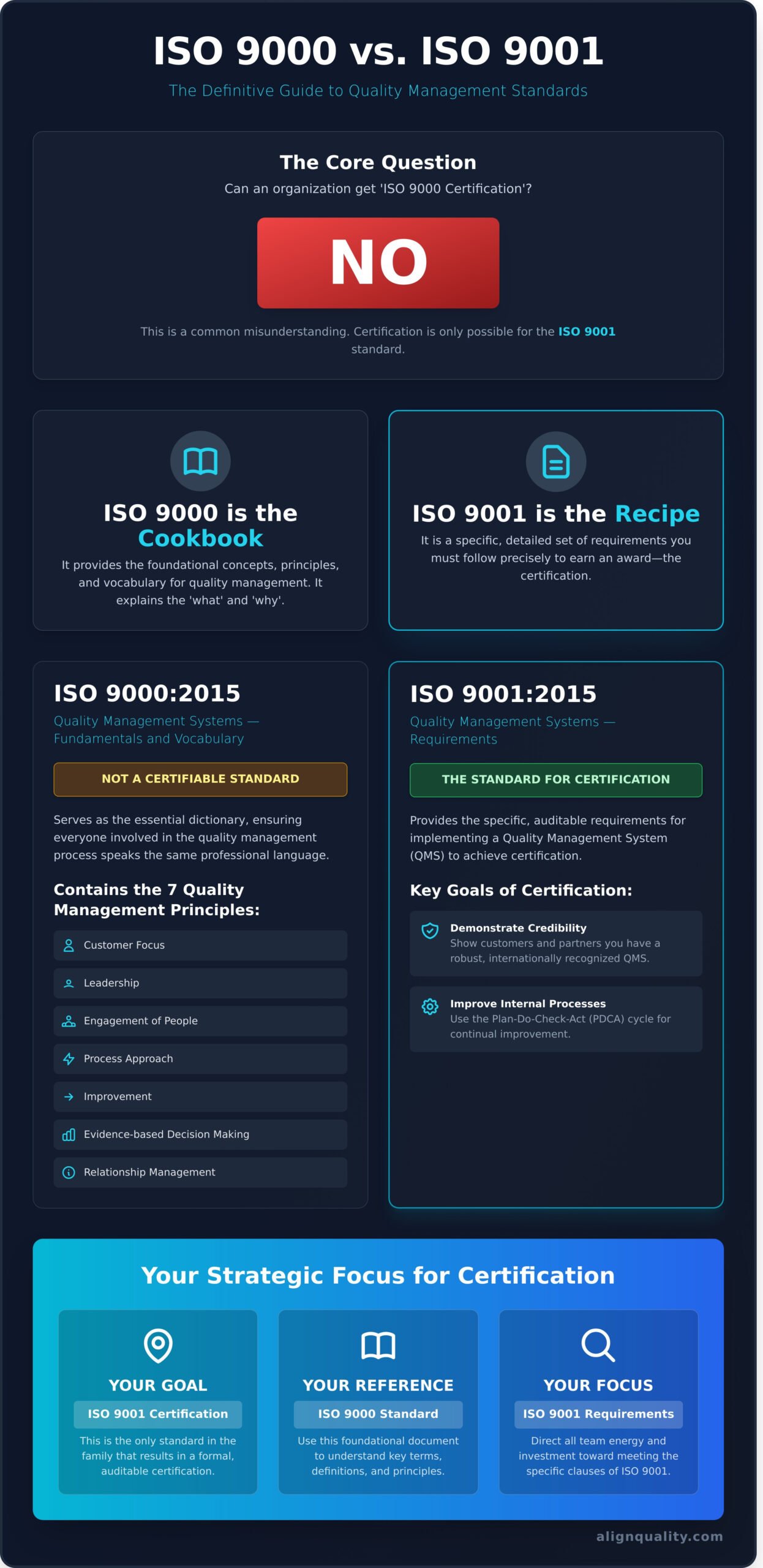
Let’s begin by directly addressing the central point of confusion for many business leaders. The short, unequivocal answer is no, an organization cannot get ‘ISO 9000 certification’. While this term is frequently used in business discussions, it stems from a common misunderstanding of how the standards are structured. If your goal is to have your quality management system (QMS) formally recognized, the standard you must focus on is ISO 9001.
Think of it like this: ISO 9000 is the entire cookbook that defines essential culinary principles, techniques, and vocabulary. ISO 9001, however, is a specific, detailed recipe within that book that you must follow precisely to earn an award. You are judged on your execution of the recipe (ISO 9001), not on your ownership of the cookbook (ISO 9000).
ISO 9000 is the name of a group of quality management standards, often referred to as the ISO 9000 family of standards. This foundational document, specifically titled ISO 9000:2015, outlines the fundamental concepts and defines the vocabulary. It provides the context but does not contain requirements that can be audited for certification. Understanding this distinction is the first critical step on your journey to compliance.
Why the Confusion Exists
The terms ISO 9000 and ISO 9001 are often used interchangeably, largely for historical reasons and as a matter of convenience. Over time, “ISO 9000” became a popular shorthand to refer to the entire process of implementing a QMS and achieving certification. This interchangeability is why the quest for iso 9000 certification has become a common, though technically incorrect, search query. Rest assured, this is a frequent point of confusion, and clarifying it sets you on the correct path to success.
The Simple Answer for Business Leaders
For executives and managers planning for certification, the takeaway is clear and actionable. To streamline your efforts and allocate resources effectively, focus on this simple framework:
- Your Goal: Your organization’s objective is to achieve certification to the ISO 9001 standard. This is the only standard in the family that carries auditable requirements.
- Your Reference: You will use the ISO 9000 standard as a foundational document to understand key terms and principles. It is a guide, not the destination.
- Your Focus: All your team’s energy, planning, and investment should be directed toward implementing a QMS that meets the specific clauses outlined in ISO 9001.
By focusing your strategy on ISO 9001 from the outset, you can confidently navigate the certification process without ambiguity.
What Is ISO 9000? The Foundation and Vocabulary
To understand the ISO 9000 family of standards, you must first start with its foundation: ISO 9000 itself. Formally titled ISO 9000:2015, ‘Quality management systems – Fundamentals and vocabulary’, this document serves as the essential starting point for any organization embarking on its quality management journey. Its primary purpose is to provide the official terms, definitions, and concepts that underpin the entire series.
Think of it as the official dictionary for quality management. It ensures that when an auditor, a consultant, and your internal team discuss a concept like “continual improvement” or “top management,” everyone is speaking the same professional language. This shared understanding is critical for a smooth implementation and audit process. Crucially, ISO 9000 contains no requirements and is not a certifiable standard. A common point of confusion is the idea of an iso 9000 certification, but such a thing does not exist; certification is exclusive to ISO 9001.
The 7 Quality Management Principles
ISO 9000 introduces the core philosophies that give a Quality Management System (QMS) its purpose and direction. These seven quality management principles are the philosophical backbone of the ISO 9001 standard, guiding an organization’s actions and culture toward excellence.
- Customer focus
- Leadership
- Engagement of people
- Process approach
- Improvement
- Evidence-based decision making
- Relationship management
Who Should Read ISO 9000?
While not a mandatory read for every employee, ISO 9000 is an indispensable reference guide for key personnel. This includes quality managers, internal auditors, and business leaders responsible for overseeing the QMS. During implementation, it serves as the authoritative source for clarifying terminology and understanding the intent behind the requirements found in ISO 9001. Using it ensures your team builds its system on a solid and accurate foundation.
What Is ISO 9001? The Standard for Certification
While ISO 9000 provides the foundational principles and vocabulary for quality management, ISO 9001 is the specific, actionable standard that organizations implement. Formally titled ISO 9001:2015, ‘Quality management systems – Requirements’, it is the only standard within the ISO 9000 family of standards against which an organization can be formally audited and certified.
ISO 9001 provides a proven framework for establishing a Quality Management System (QMS). Its purpose is to help organizations consistently provide products and services that meet customer and regulatory requirements, enhance customer satisfaction, and drive continual improvement. It is a globally recognized benchmark for quality and operational excellence.
The Structure of ISO 9001:2015
The standard is organized into 10 clauses that provide a clear structure for a QMS. Key clauses like Clause 4: Context of the Organization, Clause 5: Leadership, and Clause 6: Planning detail the specific requirements a business must meet. This framework is underpinned by the Plan-Do-Check-Act (PDCA) cycle, a methodical process for identifying, managing, and continuously improving business processes.
The Goal of ISO 9001 Certification
Achieving certification is a strategic business decision with tangible benefits. The primary goals are to:
- Demonstrate Credibility: Show customers, partners, and stakeholders that you have a robust, internationally recognized QMS.
- Improve Internal Processes: Use the framework to reduce errors, eliminate waste, and increase operational efficiency across the organization.
- Unlock New Opportunities: Gain access to new markets and win contracts that mandate ISO 9001 certification as a prerequisite.
Certification vs. Compliance
It is crucial to understand the distinction between compliance and certification. An organization can be compliant with ISO 9001 by implementing its requirements internally. However, certification takes this a step further. The journey to a formal iso 9000 certification requires an impartial audit conducted by an accredited, third-party certification body. This external verification provides objective proof of conformity, lending your business unparalleled credibility and formal recognition in the marketplace.
How ISO 9000 and ISO 9001 Work Together
Think of the ISO 9000 family of standards not as separate documents, but as two parts of a cohesive whole. They are designed to be used together to build a robust and effective Quality Management System (QMS). Understanding their relationship is fundamental to a successful certification journey.
The simplest way to view their connection is:
- ISO 9000 defines the ‘what’: It provides the foundational concepts, core principles, and essential vocabulary for quality management.
- ISO 9001 specifies the ‘how’: It translates those concepts into actionable requirements that an organization must meet to achieve certification.
An effective analogy is to think of ISO 9000 as the official rulebook for a sport. It explains the game’s objective, defines key terms like ‘foul’ or ‘goal,’ and outlines the principles of fair play. ISO 9001, in contrast, is the checklist an official uses to confirm a team is eligible to compete-verifying they have the right equipment, the correct number of players, and follow all mandatory procedures. You cannot effectively implement the checklist (ISO 9001) without first understanding the rulebook (ISO 9000).
A Practical Example in Action
Consider the principle of “risk-based thinking.” ISO 9000 defines this as a fundamental concept for achieving an effective QMS. It’s a proactive approach to quality. ISO 9001 then takes this principle and makes it a mandatory, auditable requirement in Clause 6.1, which states that an organization must plan and implement actions to address risks and opportunities. This demonstrates how a core philosophy from ISO 9000 becomes a concrete task for certification.
Do You Need to Buy Both Standards?
While only ISO 9001 is required for the audit, having access to ISO 9000 is highly recommended for a complete understanding. The definitions and principles it contains are crucial for correctly interpreting and implementing the requirements. Many businesses mistakenly begin their journey searching for iso 9000 certification, but quickly learn that a deep knowledge of its principles is the key to achieving ISO 9001 compliance.
Navigating these dense documents can be challenging. Consultants at Align Quality possess deep expertise in both standards, streamlining the entire process. Working with an expert removes ambiguity and ensures your QMS is built on a solid foundation, ready for a successful audit. Let our experts guide you through the standards with confidence.
Your Next Step: Focusing on the ISO 9001 Certification Journey
Understanding the distinction between the ISO 9000 family and the certifiable ISO 9001 standard is the first step. Now, the focus shifts from theory to a practical, value-driven project. While many businesses begin by searching for iso 9000 certification, the path leads directly to implementing ISO 9001. This process is far more than a compliance task; it is a strategic initiative to refine operations, enhance customer satisfaction, and build a framework for continual improvement.
The journey to certification is a methodical one, typically broken down into four key phases: planning, documentation, implementation, and auditing. Each stage builds upon the last, creating a robust Quality Management System (QMS) tailored to your organization.
Starting with a Gap Analysis
The foundational step is a comprehensive Gap Analysis. This assessment meticulously compares your current processes, procedures, and documentation against the specific requirements of the ISO 9001 standard. It effectively identifies the ‘gaps’ between your existing system and what is needed for compliance. The result is not a list of problems, but a clear and actionable roadmap that defines the scope and priorities of your certification project.
Building Your Quality Management System (QMS)
Using the roadmap from your gap analysis, the next phase is to build or refine your QMS. This involves developing the necessary policies, quality objectives, and documented procedures that align with both ISO 9001 requirements and your core business goals. An effective QMS is not an off-the-shelf solution; it must be integrated into your unique operations to drive real-world improvements. Expert guidance at this stage can save significant time and resources.
Partnering for Success
Navigating the complexities of ISO 9001 implementation alone can be daunting. Partnering with an experienced ISO consultant streamlines the entire journey. A consultant provides critical expertise, project management, and objective insights to ensure your QMS is effective and audit-ready. This partnership helps you prepare for the formal certification audit with confidence, knowing that every requirement has been systematically addressed.
Achieving ISO 9001 certification transforms your commitment to quality into a recognized credential. To learn how to navigate this process efficiently, contact our team of certified experts for a consultation.
Navigating Your Certification Journey with Clarity
Understanding the key distinction between ISO 9000 and ISO 9001 is the foundational step toward enhancing your quality management system. To summarize, ISO 9000 provides the essential concepts and vocabulary, while ISO 9001 sets the specific, auditable requirements for certification. This clarifies the common misconception; while many search for iso 9000 certification, the actual standard your organization will implement and be certified against is ISO 9001.
Now that you have this clarity, you can confidently move forward. At Align Quality, our purpose is to make this process seamless and successful. Guided by Certified ISO 9001 Lead Auditors, our Proven 5-Stage Certification Process and extensive Multi-Industry Experience provide a clear and reliable roadmap to achieving your quality objectives.
Start Your ISO 9001 Certification Journey with Confidence. Let us help you achieve the standard of excellence your business deserves.
Frequently Asked Questions About ISO 9000 and ISO 9001
What is the difference between ISO 9000 and the ISO 9000 series?
ISO 9000 is a single standard that defines the fundamental concepts and vocabulary for quality management. It provides the foundation for understanding the system. The ISO 9000 series, or family, is the entire collection of related standards. This includes ISO 9001, which outlines the requirements for certification, and ISO 9004, which provides guidance for sustained success. While you cannot get an ISO 9000 certification, the standard is essential for correctly implementing ISO 9001.
Is ISO 9000 still a valid standard in 2025?
Yes, ISO 9000 remains a current and valid standard. The latest version, ISO 9000:2015, provides the official terms and definitions used throughout the ISO 9000 family. It is not a standard that organizations get certified against, but it is a critical reference document. Understanding its contents is a prerequisite for any organization seeking to properly implement a QMS and achieve a successful audit for ISO 9001 certification, which is sometimes colloquially called ISO 9000 certification.
What are the other main standards in the ISO 9000 family, like ISO 9004?
Beyond ISO 9001, the most significant standard is ISO 9004, which provides guidance for achieving sustained success. While ISO 9001 sets the certifiable requirements for a quality management system (QMS), ISO 9004 helps organizations move beyond compliance to improve overall performance and long-term viability. Another key document is ISO 19011, which offers guidelines on auditing management systems, a crucial component of the maintenance and continual improvement process for any certified organization.
How often is the ISO 9001 standard updated?
The International Organization for Standardization (ISO) reviews its standards at least every five years to ensure they remain relevant. However, major revisions to ISO 9001 have historically occurred every seven to eight years, as seen with the updates in 2008 and 2015. When a new version is released, certified organizations are given a three-year transition period to update their QMS and undergo a new audit to meet the revised requirements and maintain their certification status.
What is the difference between ISO certification and accreditation?
This distinction is crucial. Certification is the process where a third-party organization, known as a Certification Body, audits a company to verify that its management system complies with a standard like ISO 9001. Accreditation is the formal process of verifying the Certification Body itself. A national Accreditation Body evaluates and recognizes that the Certification Body is competent and impartial, ensuring the integrity and value of the entire certification process.
Can a small business get ISO 9001 certified?
Absolutely. The ISO 9001 standard is intentionally designed to be scalable and applicable to organizations of any size, from a sole proprietorship to a multinational corporation. The requirements can be tailored to the specific context and complexity of a small business. Achieving certification helps small businesses improve efficiency, build customer trust, and often qualifies them to work with larger clients who mandate a certified quality management system within their supply chain.