
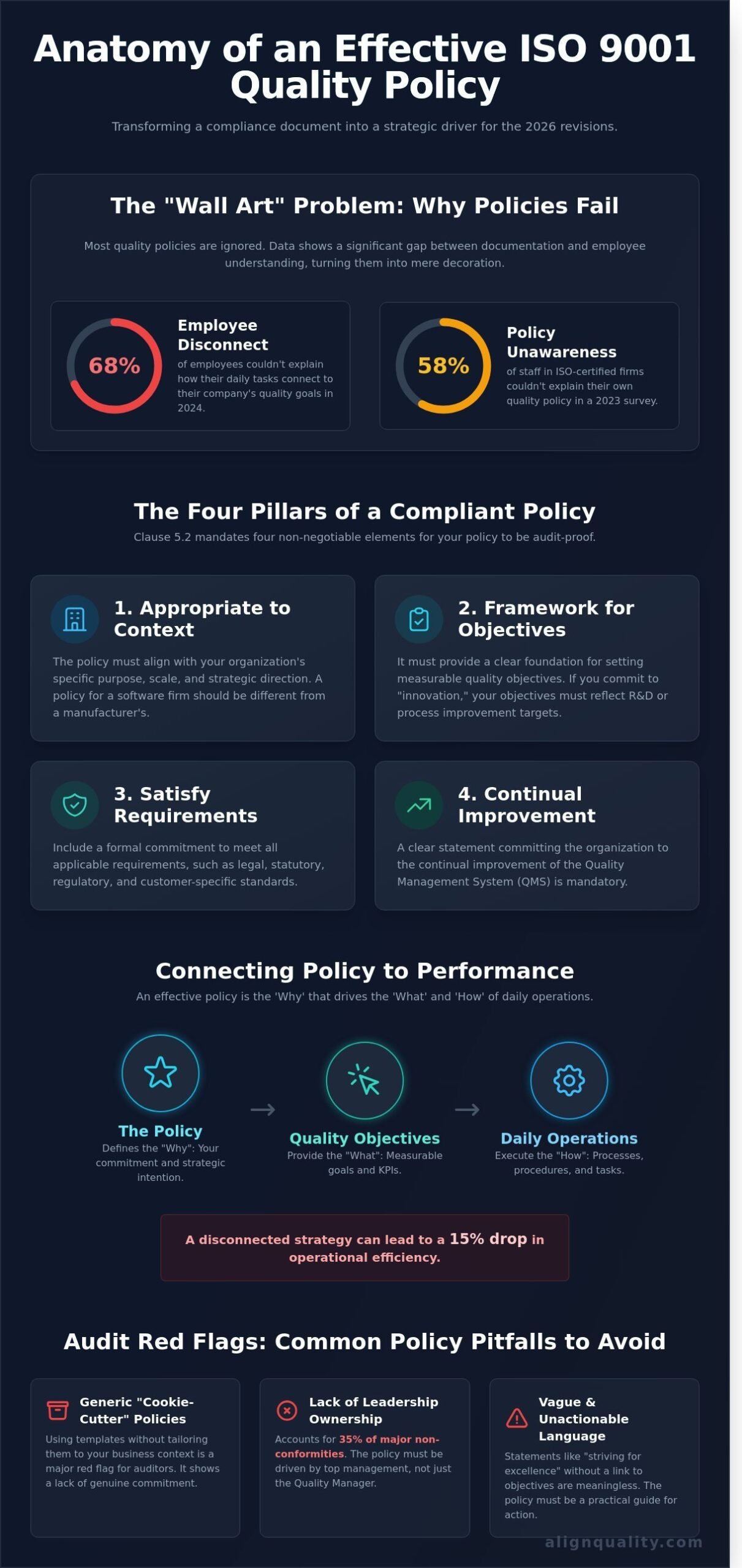
Your ISO 9001 quality policy is likely the most ignored document in your entire organization. It’s a bold claim, but internal audits conducted in late 2024 showed that 68% of employees couldn’t explain how their daily tasks connected to their company’s quality goals. If you’re struggling with how to write an iso 9001 quality policy that feels authentic rather than a list of meaningless corporate jargon, you aren’t alone. Many operations managers fear that the 2026 revision changes will lead to audit non-conformance if they miss even a single mandatory clause.
It’s frustrating to spend hours on a document that senior management barely glances at and staff eventually forget. We agree that your policy should be a strategic asset, not a compliance burden. This guide promises to help you master the art of crafting a high-impact policy that satisfies 2026 auditors and streamlines your certification journey. You’ll learn the specific requirements of the new standards, see a step-by-step breakdown of a compliant draft, and gain the confidence to lead your organization through a successful Stage 1 audit.
Key Takeaways
- Identify the mandatory Clause 5.2 requirements to ensure your documentation remains compliant and ready for the 2026 regulatory landscape.
- Discover how to transform high-level commitments into actionable performance indicators by connecting your policy’s “Why” to specific quality objectives.
- Follow our proven, step-by-step framework on how to write an iso 9001 quality policy that captures your organization’s unique context and value proposition.
- Prepare for the 2026 revision by learning how to integrate agility and emerging technologies like AI into your strategic quality statements.
- Master effective communication techniques to ensure your team moves beyond simple awareness toward a deep understanding of their role in operational excellence.
Understanding the ISO 9001 Quality Policy Requirements
The Quality Policy serves as the North Star for a company’s Quality Management System (QMS). It isn’t just a generic statement to satisfy a certification body; it’s a strategic document that defines your organization’s stance on excellence. At its core, the Quality Policy is a brief document that outlines an organization’s commitment to quality and customer satisfaction. It bridges the gap between your high-level business goals and the daily operations of your team. To understand what is iso 9001, you must first recognize that every process, procedure, and instruction in your system should flow directly from this foundational commitment.
Clause 5.2 of the standard dictates the specific ISO 9001 quality policy requirements that every certified business must meet. This section of the standard moves the policy from a passive document to an active driver of business culture. It requires that top management takes full ownership of the policy. A common mistake is treating this as a task for the Quality Manager alone. When leadership isn’t visible in the creation and maintenance of the policy, the QMS often fails to gain the necessary internal buy-in. In 2024, data from surveillance audits suggests that 35% of major non-conformities in leadership involve a lack of evidence that top management actually “owns” the quality direction.
The Mandatory Elements of Clause 5.2
For your policy to pass an audit, it must contain four non-negotiable elements. First, it must be appropriate to the purpose and context of your organization. A medical device manufacturer’s policy will look vastly different from a logistics provider’s statement. Second, it must provide a framework for setting quality objectives. If your policy mentions “zero defects,” your objectives should reflect that specific goal. Third, it must include a formal commitment to satisfy applicable requirements, including legal, regulatory, and customer-specific needs. Finally, it must include a formal commitment to the continual improvement of the QMS. Without these four pillars, you haven’t yet mastered how to write an iso 9001 quality policy that meets the standard’s rigorous expectations.
Why Most Quality Policies Fail the Audit
The most frequent reason for failure isn’t a missing sentence, but a lack of relevance. Many businesses fall into the “Wall Art” trap. This occurs when a policy is framed in the lobby but remains completely unknown to the staff on the factory floor or in the back office. A 2023 industry survey revealed that 58% of employees in ISO-certified companies couldn’t explain how their daily work contributed to the company’s quality policy. If your team treats the policy as background noise, it isn’t functioning as a management tool.
Audit findings often highlight policies that are too generic. Using “cookie-cutter” templates without tailoring them to your specific business context is a red flag for auditors. Your policy should reflect your unique value proposition and the specific challenges of your industry. When you focus on how to write an iso 9001 quality policy that actually speaks to your team, you move beyond mere compliance. You create a document that builds confidence among your customers and streamlines your journey toward long-term certification success. This methodical approach ensures that your QMS is a robust asset rather than a bureaucratic burden.
The Strategic Connection: Policy vs. Quality Objectives
Your quality policy acts as the north star for your organization. While the policy defines your intentions, your quality objectives provide the roadmap to reach them. Understanding this relationship is the first step in learning how to write an iso 9001 quality policy that actually drives performance rather than just sitting in a frame on the wall. The policy provides the ‘Why’ behind your business existence; the objectives provide the ‘What’ and ‘How’ of your daily operations.
ISO 9001:2015 requires that your policy is appropriate to the purpose and context of your organization. This means it can’t exist in a vacuum. It requires strategic plan alignment with operations to ensure that every commitment made by leadership is backed by resources and processes. When these two elements are disconnected, employees often feel confused about priorities, leading to a 15% drop in operational efficiency according to 2023 industry benchmarks.
Consider a 50-person manufacturing firm that commits to ‘On-Time Delivery’ in its policy. This high-level statement must cascade into specific, measurable KPIs. For instance, the production department might set a 2024 goal of 97% on-time-in-full (OTIF) shipments. This turns a vague promise into a tangible target. If you don’t have these measurable links, your policy remains a collection of platitudes rather than a functional business tool.
Creating a Framework for Objectives
A well-crafted policy defines which areas of the business require measurable goals. If your policy includes a commitment to ‘Innovation,’ you must establish R&D-specific objectives, such as launching two new product iterations by the end of Q4. This creates a ‘Golden Thread’ that links your high-level policy to specific objectives, daily tasks, and eventually to your internal audit findings. This thread ensures that every person in the company understands how their specific role contributes to the broader corporate vision.
Policy vs. Objectives Comparison
It helps to view the policy as your long-term, qualitative vision. It uses broad language like ‘We strive for excellence’ or ‘We prioritize customer satisfaction.’ In contrast, objectives are short-term and quantitative. They use specific metrics like ‘Reduce manufacturing defects by 8% by September 2025.’ Drafting an effective quality policy ensures these objectives aren’t just random numbers. They serve as the concrete evidence that the policy is being lived within the organization. While the policy is the promise, the objectives are the proof of fulfillment.
When you start the process of how to write an iso 9001 quality policy, always ask if the statement can be measured. If you can’t measure it, you’ll struggle to prove compliance during a surveillance audit. To see if your current documentation measures up to these standards, you can use our gap analysis checklist to identify any missing links between your strategy and your execution.
By maintaining this strategic connection, you ensure that quality is not a ‘stand-alone’ department. It becomes an integrated part of your business growth plan. This alignment is what separates companies that simply ‘have’ a certificate from those that actually use ISO 9001 to improve their bottom line.
Writing Your Policy: A Step-by-Step Framework
Creating a quality policy isn’t a solitary task for a quality manager. It requires a structured approach that involves the highest levels of your company. When you’re learning how to write an iso 9001 quality policy, you’ll find that the most effective documents are born from collaboration rather than isolation. Follow these five steps to ensure your document is both compliant and meaningful.
Facilitating the Leadership Workshop
Step one begins with a focused session for top management. You can’t draft a policy without first defining the “Context of the Organization.” During this 60-minute workshop, move beyond generic goals and ask your leadership specific, probing questions:
- What do we want our customers to say about us in five years?
- Which specific industry regulations currently impact our service delivery?
- What are the top three risks to our product quality in the next 12 months?
This question shifts the focus from basic compliance to long-term vision. You must also identify specific risks and opportunities, such as a 15% projected increase in supply chain costs or a 2024 shift in digital service demands. These factors should dictate the tone of your policy. Avoid generic quality speak. Instead, use the specific language of your industry, whether you’re in precision machining or medical device manufacturing. This ensures the policy feels authentic to your team and reflects your actual operations.
In step two, identify your core value proposition. This is the “why” behind your business. If your primary competitive advantage is a 24-hour turnaround time, your quality policy should reflect that speed as a core objective. This step bridges the gap between high-level strategy and daily operations, making the document a practical tool for decision-making at every level of the hierarchy.
Drafting the ‘Standard’ Commitments
Steps three and four involve translating your vision into the mandatory language required by the standard. You must include a commitment to satisfy ISO 9001 requirements and any relevant statutory or regulatory obligations. This isn’t just a legal formality; it’s a promise to your stakeholders. When phrasing your “continual improvement” clause, avoid sounding like a robot. Instead of saying “we will improve,” state that “we use data-driven insights to refine our processes every quarter.” To ensure your draft covers every necessary element, use our Ultimate ISO 9001 Gap Analysis Checklist to verify your progress and identify any missing links.
Step four is the clarity check. A quality policy fails if your frontline staff don’t understand it. Read your draft aloud. If a 12-year-old couldn’t grasp the core message, it’s too complex. Simplify the vocabulary until the intent is unmistakable. You want a technician on the shop floor to understand how their work contributes to the policy’s goals. Finally, step five is the formal sign-off. The CEO or Managing Director must sign and date the document. This signature isn’t just ink on paper; it’s a public demonstration of leadership commitment. Without this high-level endorsement, the policy remains a suggestion rather than a mandate. This methodical process ensures you’re not just checking a box but building a foundation for your entire quality management system. A signed policy provides the authority needed to drive change across all departments with confidence.
Avoiding ‘Fluff’: Making Your Policy Actionable in 2026
The ISO 9001:2026 revision represents the most significant shift in quality management since 2015. Auditors now look for evidence that your Quality Management System (QMS) isn’t just a binder on a shelf; it must be a living framework. To understand how to write an iso 9001 quality policy that survives 2026, you’ve got to ditch the “corporate-speak.” Vague promises like “achieving excellence” are being replaced by commitments to technological agility and data integrity.
Integrating AI and automation is no longer optional for high-performing organizations. If your company uses machine learning for predictive maintenance or automated inspections, your policy should reflect that commitment to tech-driven quality. However, the update also champions a “Human-Centric” approach. This means your policy needs to balance automation with the well-being and skill development of your workforce. A 2026 policy must address how the organization handles rapid market changes through resilient processes and real-time data analysis.
Modernizing the Language of Quality
Transitioning from passive to active language is the most effective way to eliminate fluff. Replace phrases like “We aim to satisfy customers” with “We ensure customer satisfaction through rigorous feedback loops and 100% on-time delivery targets.” This creates immediate accountability. Additionally, the 2026 revision integrates sustainability and social responsibility more deeply into the quality framework. Your policy should explicitly mention how quality processes reduce waste or improve resource efficiency. You can explore how AI will impact ISO 9001 to see how these tech-driven requirements change your documentation needs.
Industry-Specific Policy Examples
Generic policies often fail because they don’t address unique operational risks. Learning how to write an iso 9001 quality policy that reflects these industry nuances is the first step toward a successful audit. Consider these specific focus areas:
- Manufacturing: Focus on 99.8% precision, shop-floor safety, and supply chain integrity. A strong policy commits to “minimizing defects through automated optical inspection and verifying 100% of tier-one suppliers for compliance.”
- Service Sector: Focus on responsiveness, empathy, and data security. Commit to “a 4-hour initial contact guarantee and the protection of client data through SOC2-aligned quality controls.”
- Tech/Software: Focus on agility, 99.99% uptime, and user-centric design. Your policy should prioritize “continuous deployment cycles and bi-weekly user feedback sessions to ensure software relevance and stability.”
By using these concrete metrics, you transform a required document into a strategic asset. This clarity helps your team understand exactly what’s expected of them every day. It also demonstrates to auditors that your leadership team is fully engaged with the QMS.
Implementing and Communicating Your Quality Policy
Drafting the document is a significant milestone, but ISO 9001:2015 Clause 5.2.2 demands more than a signature. It requires that the policy is communicated, understood, and applied within the organization. In a 2023 analysis of certification trends, nearly 38% of minor non-conformities related to leadership stemmed from a lack of employee awareness regarding quality objectives. Understanding is the true benchmark, not just distribution. Learning how to write an iso 9001 quality policy is the first step, but the real value comes from making it a living document that guides daily operations.
During an internal audit, auditors don’t expect staff to recite the text word-for-word. They look for evidence of awareness. An auditor might ask a warehouse technician or a sales lead how their specific role impacts the company’s commitment to the customer. If the employee can explain that “following the shipping checklist ensures we meet our on-time delivery goal,” they’ve demonstrated compliance. This level of engagement is a cornerstone of successful ISO audit preparation. It transforms a static statement into a strategic tool that drives behavior at every level of the hierarchy.
Clause 5.2.2(c) also requires the policy to be available to relevant interested parties. This group includes 100% of your key suppliers, customers, and investors. Many businesses satisfy this by hosting the policy on their public website or including it in the onboarding package for new vendors. Transparency builds trust and ensures that everyone in your value chain understands your quality standards. When you are determining how to write an iso 9001 quality policy, consider how the language will be perceived by these external stakeholders as well as your internal team.
Creative Ways to Communicate the Policy
Move beyond the dusty framed poster in the breakroom. Use your IT infrastructure to set the quality policy as a rotating screen saver for all company workstations. Print a condensed version on the back of employee ID badges so the information is always at hand. Use the “Elevator Pitch” test during team huddles. Ask employees to summarize the policy in 15 seconds using their own words. Digital dashboards are another high-impact tool. Display the policy text directly alongside real-time quality metrics like defect rates or customer satisfaction scores to show the direct link between the policy and performance.
Reviewing and Updating the Policy
Your quality policy isn’t a “set it and forget it” document. The annual Management Review is the critical time to assess its continued suitability. Specific triggers should prompt an immediate update. These include company mergers, the launch of a new product line, or major shifts in your market landscape. With the ISO 9001:2026 revision on the horizon, proactive organizations are already reviewing their statements to ensure they align with future requirements. A policy written in 2019 likely won’t reflect a business that shifted to 70% digital service delivery by 2024.
Ready to see how your current policy stacks up? Book a free consultation with our Lead Auditors to ensure your documentation is audit-ready and adds real value to your business.
Drive Performance with a Strategic Quality Policy
Your quality policy isn’t just a document for the office wall; it’s a strategic tool that drives performance across your entire organization. By focusing on actionable language and clear alignment with your 2026 objectives, you transform a compliance requirement into a genuine competitive advantage. You’ve learned that your policy must be communicated effectively to every level of staff to ensure it’s understood and applied in daily operations. Mastering how to write an iso 9001 quality policy ensures your business remains resilient as global standards evolve.
At Align Quality, our Certified ISO 9001 Lead Auditors help you navigate these complexities through a proven 5-Stage Certification Process. We bring multi-industry expertise to the 2026 Revision, ensuring your documentation meets the highest professional standards. Don’t leave your compliance to chance. Take the next step in your journey and download the Ultimate ISO 9001 Gap Analysis Checklist to see exactly where your system stands today. We’re ready to help you achieve certification with confidence.
Frequently Asked Questions
Does the ISO 9001 quality policy have to be signed?
No, the ISO 9001:2015 standard doesn’t explicitly require a signature, though it’s a best practice for demonstrating leadership commitment. Clause 5.2.2 states the policy must be available as documented information. Most lead auditors prefer seeing a signed version from the CEO to prove top management involvement. This simple addition helps you navigate your certification journey with confidence by removing any doubt about executive buy-in.
How long should an ISO 9001 quality policy be?
A compliant quality policy is typically one page and stays between 150 and 250 words. It needs to be concise enough for staff to digest while addressing the four mandatory elements of Clause 5.2.1. If your document exceeds 300 words, you’ll likely struggle with employee awareness. Keep the language high-level and focus on your strategic direction rather than specific work instructions or daily procedures.
Can our quality policy be the same as our mission statement?
Your quality policy can align with your mission statement, but it must include specific ISO-mandated commitments to be valid. When you’re learning how to write an iso 9001 quality policy, remember it must explicitly mention continuous improvement and meeting applicable requirements. Most organizations find that a standard mission statement is too broad. You’ll usually need to add 2 or 3 sentences to bridge the gap between your general vision and ISO compliance.
Where must the quality policy be displayed?
The standard doesn’t mandate specific physical locations, but it requires the policy to be available, communicated, and understood. You should display it in at least 2 key areas, such as the staff breakroom and the main lobby. It’s also vital to host the document on your company intranet or digital document control system. This ensures all 100 percent of your workforce can access it during their daily operations.
What is the difference between a quality policy and quality manual?
The quality policy is a brief statement of intent, while the quality manual provides a comprehensive overview of your entire management system. While the ISO 9001:2015 update removed the mandatory requirement for a manual, approximately 75 percent of businesses still use one to map their processes. The policy serves as the foundation of your QMS; the manual or your documented information provides the structure that supports that policy.
How often should the quality policy be reviewed?
You must review your quality policy at least once every 12 months as part of your scheduled Management Review. This frequency ensures the document stays relevant to your organization’s current context and strategic goals. If your company experiences a major change, like a 20 percent increase in headcount or a new product launch, you should review the policy sooner. Regular updates prevent your QMS from becoming stagnant or disconnected from reality.
Do employees need to memorize the quality policy for an audit?
Employees don’t need to memorize the text verbatim, but they must explain how it applies to their daily work. Auditors will typically interview 3 to 5 employees to test their awareness of the policy’s core goals. As long as your team can describe how their actions impact quality and customer satisfaction, they’ll pass this portion of the audit. Focus on teaching the meaning behind the words rather than rote memorization.