What if the biggest obstacle to your company’s 2026 growth isn’t a lack of talent, but an outdated view of quality as a cost center rather than a profit driver? You likely recognize that a robust Quality Management System (QMS) is the backbone of operational excellence; however, your leadership team might still see it as a bureaucratic hurdle. Learning how to convince management for iso 9001 requires shifting the conversation from simple compliance to long-term competitive advantage.
We agree that it’s frustrating to see critical quality initiatives stalled by a lack of executive buy-in or budget constraints. You’re ready to lead the journey, but you need the board to sign off on the investment. This article promises to arm you with the specific financial logic and strategic arguments needed to transform ISO 9001 from a “nice-to-have” into a business imperative. We will walk through the exact roadmap for building a 2026 business case that aligns with executive goals, mitigates risk, and secures the commitment you need to move forward with confidence.
Key Takeaways
- Learn how the ISO 9001:2026 revision transforms quality management from a bureaucratic burden into a strategic framework for navigating AI risks and supply chain volatility.
- Shift the executive conversation from the cost of certification to the “cost of non-quality” by identifying where your business is losing revenue through rework and lost contracts.
- Discover a proven 5-step roadmap on how to convince management for iso 9001 by aligning quality objectives with the organization’s 2026 strategic goals.
- Master the use of a Gap Analysis to provide leadership with clear, data-driven evidence of operational leaks and the financial logic for immediate action.
- Understand how a structured 5-stage implementation journey and expert Lead Auditors remove uncertainty and ensure a successful, stress-free certification process.
Why Management Hesitates: Debunking the ‘Paperwork’ Myth
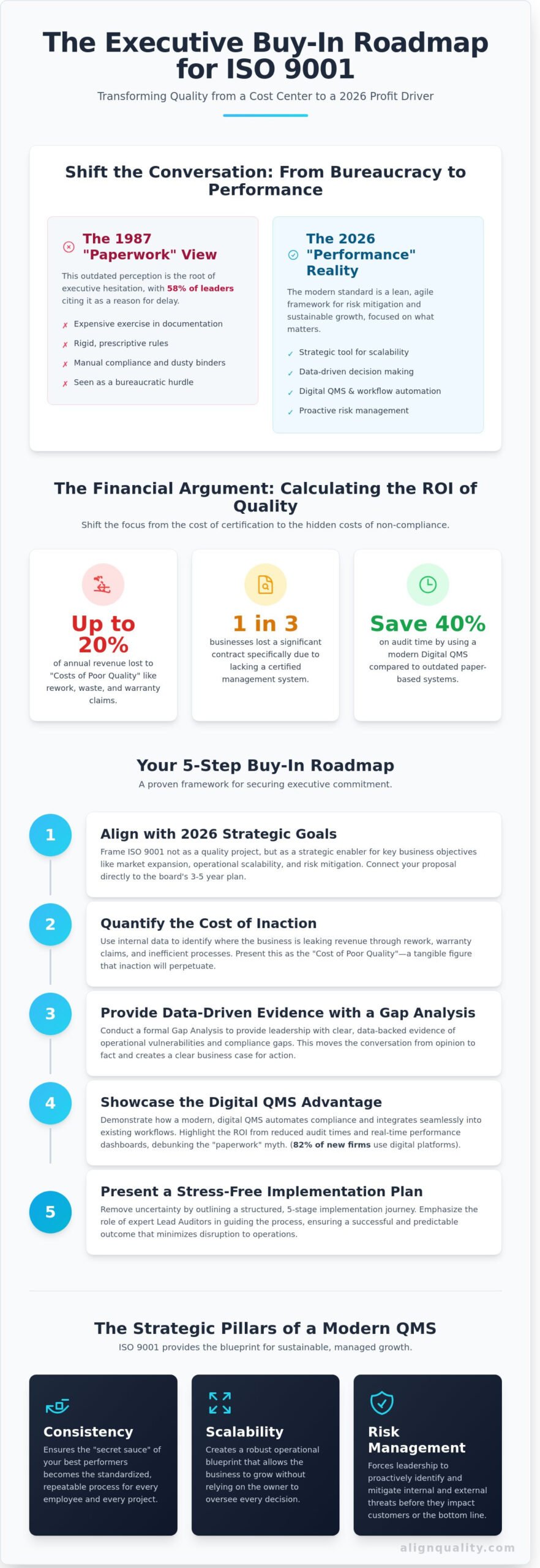
Most executives view ISO 9001 as an expensive exercise in generating unnecessary paperwork. This perception is rooted in the 1987 version of the standard, which focused heavily on rigid, prescriptive documentation. By 2024, industry surveys indicated that 58% of leadership teams still cite “excessive bureaucracy” as their primary reason for delaying certification. To move forward, you must demonstrate that the 2026 revision is a lean framework for operational excellence, not a collection of dusty binders. Understanding how to convince management for iso 9001 starts with shifting the conversation from “compliance” to “performance.”
Management often argues that the company is “already good” because it is currently profitable. However, hidden process gaps often cost mid-sized firms up to 20% of their annual revenue through “costs of poor quality” like rework, warranty claims, and inefficient resource allocation. In 2025, data showed that 1 in 3 businesses lost a significant contract specifically because they lacked a certified management system. ISO 9001 identifies these invisible leaks. It moves the organization away from the old mandate of “documenting everything” toward a modern strategy of “documenting what matters” to ensure consistency and profit.
The True Definition of ISO 9001 for Modern Leaders
Modern leaders need to see ISO 9001 as a strategic tool for scalability and risk mitigation rather than a hurdle to clear. ISO 9001 is a risk-based management system designed to align organizational objectives with consistent, high-quality output. It provides a structured way to manage the complex variables of a growing business. While the 1987 mindset was obsessed with manual compliance, the 2026 performance mindset prioritizes data-driven decision making and value creation within the broader ISO 9000 family of standards.
- Consistency: It ensures that the “secret sauce” of your best performers becomes the standard for every employee.
- Scalability: It creates a repeatable blueprint that allows the business to grow without the owner needing to oversee every decision.
- Risk Management: It forces the leadership team to identify external and internal threats before they impact the bottom line.
Addressing the Fear of Bureaucracy
A modern Quality Management System (QMS) actually eliminates redundant tasks rather than creating them. By 2025, over 82% of newly certified firms will use digital platforms to automate their compliance requirements, replacing manual logs with real-time dashboards. This digital transformation ensures that ISO requirements integrate directly into existing workflows. When you explain how to convince management for iso 9001, focus on how a digital QMS reduces the time spent on audits by up to 40% compared to paper-based systems.
The goal is to streamline your operations so that quality becomes an invisible part of the daily routine. If you need to clarify the basics for your team, our guide on what is iso 9001 breaks down the standard into plain English. Modern certification is about agility; it gives management the confidence to delegate authority because they know the system is designed to catch errors before they reach the customer. It’s about working smarter, not harder, to achieve sustainable growth.
The Strategic Lever: ISO 9001:2026 and Future Compliance
The upcoming ISO 9001:2026 revision represents the most significant shift in quality management since the 2015 update. For leaders asking how to convince management for iso 9001, the argument shouldn’t be about just “getting a certificate.” It’s about securing the company’s future against a backdrop of rapid technological change and supply chain instability. Waiting until the 2026 deadline to begin alignment creates a bottleneck that stresses internal resources and risks compliance gaps. Proactive adoption transforms quality from a back-office function into a high-performance business improvement framework that protects your bottom line.
Early adoption provides a 24-month head start over competitors who remain tethered to outdated protocols. By implementing these standards now, you’re building a foundation that handles supply chain shocks and shifting regulatory requirements with precision. This isn’t just a minor edit to a document; it’s a strategic recalibration. Organizations that integrated the previous version early saw a 15% higher retention rate during the 2018 transition period compared to those who rushed at the last minute. The “wait and see” approach is a calculated risk that rarely pays off in a tightening global market.
AI and Emerging Technologies in the 2026 Standard
The 2026 revision specifically addresses how businesses manage automated workflows and algorithmic decision-making. AI isn’t just a trend; it’s a data integrity challenge that requires strict version control and validation. You can learn more about how ai will impact iso 9001 to see how the new standard treats machine-led quality checks. This ensures that as you automate, your quality doesn’t suffer from “black box” errors. Integrating AI within a certified QMS framework proves to stakeholders that your innovation is grounded in reliable, repeatable processes.
Future-Proofing Your Market Position
Market leaders don’t wait for mandates; they set the pace. Top-tier global firms are already drafting procurement contracts that require vendors to demonstrate alignment with the latest international standards. Beyond traditional quality, the 2026 update bridges the gap between operational excellence and ESG (Environmental, Social, and Governance) reporting. This is a massive selling point when considering how to convince management for iso 9001, as 90% of S&P 500 companies now publish formal ESG disclosures. If you’re looking for the technical roadmap, our iso 9001:2026 update news provides the necessary details to stay ahead of the curve.
The risks of delaying the transition are quantifiable and severe. During the last major revision cycle, roughly 40% of organizations waited until the final six months to migrate. This led to a massive shortage of available auditors and a 25% spike in certification costs due to emergency “rush” fees. By acting now, you avoid the panic and ensure your team has the time to actually improve processes rather than just rushing to meet a deadline. Consider these concrete benefits of early 2026 alignment:
- Reduced Transition Costs: Spreading the implementation over 18 months is 30% more cost-effective than a three-month “crunch” period.
- Supply Chain Resilience: New requirements for contingency planning help mitigate the $184 billion annual loss businesses face globally from supply disruptions.
- Investor Confidence: Demonstrating a forward-looking compliance strategy improves your risk profile for stakeholders and potential buyers.
- Operational Clarity: Moving away from legacy systems reduces “process debt” and speeds up employee onboarding by an average of 20%.
To see exactly where your current system stands before presenting to the board, you might find it helpful to review our Ultimate ISO 9001 Gap Analysis Checklist to quantify your current standing. Treating quality as a strategic asset rather than a checkbox is the hallmark of a resilient business. As global markets continue to fluctuate, the companies that survive are those that built their house on a foundation of standardized, data-driven excellence.
The Financial Argument: Calculating the ROI of Quality
Management often views certification as a sunk cost. To shift this perspective, you must pivot the discussion from the price of the audit to the Cost of Non-Quality (CONQ). CONQ represents the tangible financial drain caused by inefficient processes and product failures. When you’re determining how to convince management for iso 9001, presenting a balance sheet of these avoidable losses is your most persuasive tactic.
Concrete examples of CONQ include high scrap rates, repetitive rework, and the catastrophic loss of major contracts due to quality lapses. Industry data suggests that the cost of poor quality can range from 15% to 40% of a company’s total revenue. By implementing a formal Quality Management System (QMS), you’re not just buying a certificate; you’re plugging those leaks. ASQ explains ISO 9001 benefits as a framework that directly addresses these costs by improving process consistency and meeting customer requirements more effectively.
Direct Savings: Waste Reduction and Efficiency
Standardized processes lead to immediate labor hour savings. When every employee follows a uniform procedure, you eliminate the time wasted on “figuring it out” or correcting mistakes. A 2022 case study of a mid-sized engineering firm showed a 15% reduction in operational errors within the first year of implementation. This efficiency stems from a clear governance and policy structure. It speeds up decision-making because the “right way” to handle a situation is already documented. It’s about removing the reliance on tribal knowledge and replacing it with a scalable, repeatable system.
Indirect Gains: Market Access and Customer Retention
ISO 9001 is often a non-negotiable prerequisite for winning government tenders and enterprise-level contracts. Without it, your sales team is effectively locked out of a significant portion of potential high-value opportunities. Beyond new business, certification significantly impacts Customer Lifetime Value (CLV). A certified QMS ensures a predictable customer experience, which reduces churn and increases referral rates. Understanding what it means to be iso 9001 certified helps management see that quality is a growth engine, not a bureaucratic hurdle.
The financial benefits extend to your overhead. ISO 9001 reduces legal liabilities by providing a documented trail of due diligence. Many insurance providers recognize this risk reduction and offer lowered premiums for certified organizations. In some sectors, businesses have reported up to a 10% reduction in professional liability costs. This makes the ROI calculation clear. You aren’t just spending money on an audit; you’re investing in a more profitable, lower-risk business model. This data-driven approach is exactly how to convince management for iso 9001 while positioning yourself as a strategic leader.
Your Buy-In Roadmap: 5 Steps to Convince Management
Securing executive approval for a Quality Management System (QMS) requires a shift in perspective. You aren’t just asking for a certificate; you’re proposing a tool for operational excellence. Understanding how to convince management for iso 9001 requires moving beyond technical jargon and focusing on the bottom line. This structured roadmap provides the exact framework needed when you’re determining how to convince management for iso 9001 approval.
Step 1: Conduct a Gap Analysis to expose financial leaks. Start by quantifying the cost of poor quality. Research by the American Society for Quality suggests that quality-related costs can consume 15% to 20% of sales revenue in organizations without standardized processes. Use a ultimate iso 9001 gap analysis checklist to identify exactly where your business is losing money through rework, scrap, or lost man-hours. Presenting these “leaks” as data points makes the need for ISO 9001 undeniable.
Step 2: Align ISO goals with the 2026 strategic plan. Management cares about the future trajectory of the company. If your board has a five-year vision or a specific 2026 strategic plan, show how ISO 9001 acts as the engine to reach those goals. Position the upcoming ISO 9001:2026 revision as a competitive advantage that will keep the company ahead of market shifts and regulatory changes.
Step 3: Identify a ‘Pain Point’ Pilot. Choose one specific executive headache, such as a high rate of customer returns or a 12% lag in shipping times, and explain how ISO principles will solve it within 90 days. By fixing a visible, high-stakes problem first, you build the internal credibility necessary to roll out the full system. This small win proves that the framework delivers tangible results.
Step 4: Present the ‘Journey’ to reduce anxiety. The prospect of a full-scale audit can be intimidating for leadership. Break the process into manageable stages. Use a how to get iso 9001 certification guide to show that this is a logical, phased progression rather than an overnight disruption. Visualizing the timeline helps the board see the certification as a controlled project with a clear ROI.
Step 5: Leverage external expertise. Guaranteeing audit success is the best way to remove the “risk” of failure from the conversation. Mention how partnering with Certified Lead Auditors ensures the system is tailored to your specific industry needs. This expertise prevents the “trial and error” approach that often leads to budget overruns and project fatigue.
The Power of the Initial Gap Analysis
A thorough gap analysis provides the “proof of need” that data-driven managers demand. Instead of anecdotal evidence, you provide a factual baseline of current performance. Use your findings to create a “Risk vs. Opportunity” matrix. This visual tool shows the board the specific risks of maintaining the status quo versus the growth opportunities unlocked by a certified QMS. It transforms a technical requirement into a strategic asset.
Framing the Pitch: Operations vs. Strategy
Stop talking about “clauses” and start talking about “workflows.” Executive teams don’t need to know the details of Clause 7.1.5; they need to know how standardized measurement reduces equipment downtime. Present ISO 9001 as a “Quality framework” that supports the company’s long-term vision. When you frame the QMS as a foundation for scaling the business, it ceases to be a cost center and becomes a strategic investment.
Ready to build your business case with hard data? Download our ultimate ISO 9001 gap analysis checklist to identify your organization’s improvement opportunities today.
Partnering for Confidence: The Align Quality Advantage
Deciding how to convince management for iso 9001 often comes down to one specific factor: certainty. Executives rarely reject the concept of quality; they reject the perceived chaos of a disorganized, expensive implementation. Align Quality serves as the professional antidote to this stress. We replace the “one-size-fits-all” bureaucracy trap with lean, tailored solutions that mirror your actual operations rather than forcing you into a rigid box. By leveraging our Certified ISO 9001 Lead Auditors, your organization gains access to proven certification success without the trial-and-error approach that typically drains internal resources and morale.
Our 5-Stage ISO 9001 Process
Our methodology transforms a complex regulatory hurdle into a logical sequence of manageable milestones. We guide your team through five distinct phases: Consultation, Gap Analysis, Implementation, Internal Audit, and Certification. This structured approach provides the transparency leadership demands, allowing them to track progress in real-time. To eliminate financial anxiety, we operate on a Fixed Fee model. This “no-surprise” pricing ensures that your project budget remains intact, preventing the 15% to 25% cost overruns often seen in unguided implementations. You can explore the technical requirements of the final stages in our iso audit guide to see exactly how we prepare your team for the big day.
During the Consultation and Gap Analysis phases, we identify exactly where your current systems meet the standard and where they fall short. This prevents your staff from wasting 100+ hours “fixing” processes that already work. We focus on the high-impact areas that drive ROI. When you explain how to convince management for iso 9001, highlighting this efficiency is vital. It shows that you aren’t just asking for a budget; you’re proposing a streamlined project with a defined start and end point.
The Value of an External Guide
Attempting certification alone often leads to expensive “major nonconformances” that delay market entry and damage credibility. Industry data shows that companies using expert consultants reach certification 40% faster than those relying solely on internal teams. We act as your specialized resource, preventing the common pitfalls that lead to audit failures and wasted registration fees. When you weigh the costs of iso consultancy vs in-house teams, the ROI becomes clear through reduced labor hours and guaranteed compliance. We handle the technical heavy lifting so your managers can stay focused on their daily operations.
ISO 9001 is more than a certificate on the wall; it’s a strategic journey to achieving your business goals with confidence. By partnering with Align Quality, you’re not just buying a manual. You’re securing a future of streamlined operations and verified excellence. We help you turn your quality vision into a corporate reality that pays dividends for years to come. Book a free consultation today to build your custom business case and start your journey toward proven success with a partner who understands the high stakes of your industry.
Secure Your Strategic Advantage for 2026
Moving from a perceived paperwork burden to a strategic growth engine is the secret to winning executive support. By focusing on the upcoming ISO 9001:2026 revision and the measurable ROI of quality, you transform a compliance task into a competitive edge. You now have a structured 5-step roadmap to remove the guesswork from your pitch. It’s time to stop treating quality as a cost center and start presenting it as a tool for operational excellence.
Mastering how to convince management for iso 9001 requires more than just enthusiasm; it demands concrete data and a clear path forward. Align Quality supports this journey with a proven 5-stage process and a team of Certified ISO 9001 Lead Auditors who bring multi-industry experience to your organization. We specialize in turning complex standards into actionable business results. You don’t have to navigate these requirements alone when expert guidance is available to streamline every phase of your certification.
Take the first step toward a successful board meeting today. Download the Ultimate ISO 9001 Gap Analysis Checklist to build your business case.
Your path to international recognition is clear and achievable with the right preparation.
Frequently Asked Questions
Is ISO 9001 certification worth the investment for a small business?
Yes, ISO 9001 provides a measurable return on investment for small businesses by reducing operational waste and opening new market opportunities. Data from ISO surveys indicates that 75% of certified companies improved their internal processes and customer satisfaction levels. For a small team, this means less rework and clearer roles. You can start by using our Ultimate ISO 9001 Gap Analysis Checklist to identify specific areas where efficiency gains will offset the initial certification costs.
How long does it typically take to convince management and start the process?
The process of how to convince management for iso 9001 typically takes between 3 and 6 months of consistent internal communication. This timeframe allows you to build a business case based on data like a 15% reduction in scrap or access to new 2025 tender requirements. Once leadership signs off, the implementation phase usually begins within 30 days. Preparation is the key to shortening this initial buy-in period and starting your journey with confidence.
Can we achieve ISO 9001 without hiring an external consultant?
Yes, your internal team can achieve certification if they can dedicate 10 to 15 hours per week to the project. Many organizations successfully use self-guided tools and templates to navigate the requirements without outside help. We recommend starting with our Ultimate ISO 9001 Gap Analysis Checklist to see if your internal team can manage the workload. If the gap analysis shows a compliance score below 60%, a consultant might be a more efficient choice.
What are the most common objections management has regarding ISO 9001?
Management usually objects to the perceived high cost, the 6 to 12 month timeline, and the fear of creating a “paperwork monster.” To address these, show them that 80% of the required documentation likely already exists in your current workflows. Explain that modern quality management systems focus on digital efficiency rather than physical binders. Presenting a clear 5-stage roadmap helps alleviate their anxiety about the complexity of the certification journey.
How does the ISO 9001:2026 revision change the business case for certification?
The ISO 9001:2026 revision strengthens the business case by aligning quality management with modern risks like supply chain volatility and emerging technologies. This update ensures your management system remains a strategic tool rather than a static certificate on the wall. By preparing for these changes now, you demonstrate to leadership that the company is future-proofing its operations. This proactive approach makes the certification a more compelling investment for long-term growth and resilience.
What happens if we fail our first ISO 9001 certification audit?
You don’t actually “fail” a certification audit; instead, the auditor identifies non-conformities that you must address within a 90-day window. Statistics show that roughly 30% of companies receive at least one major non-conformity during their initial stage 2 audit. As long as you provide a corrective action plan that satisfies the registrar, your certification journey continues. This process is designed to ensure your system is robust and effective before the final certificate is issued.