
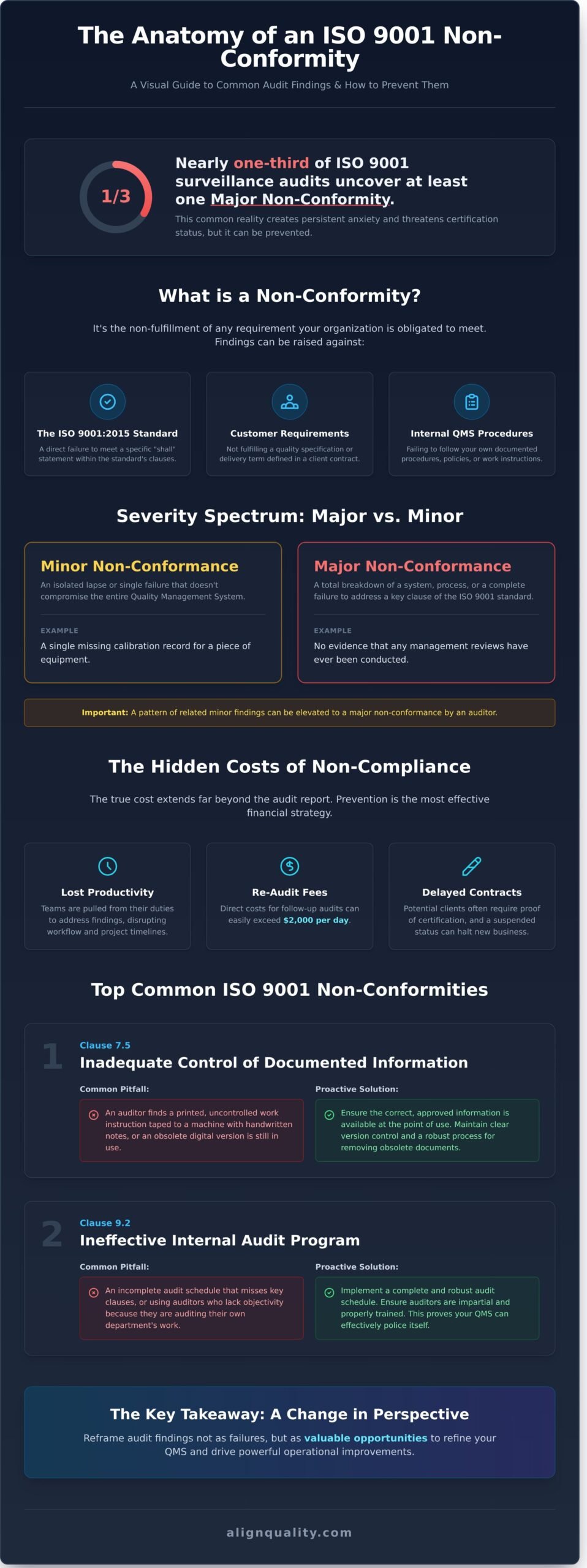
Industry analysis reveals that nearly one-third of ISO 9001 surveillance audits uncover at least one major non-conformity, often in the same recurring areas. It’s a frustrating reality for any quality manager. You and your team invest significant time and resources into maintaining your Quality Management System, yet the fear of an unexpected audit finding can create persistent anxiety and threaten your certification status.
This guide is designed to replace that uncertainty with confidence. We will demystify the audit process by detailing the most common ISO 9001 non-conformities that auditors consistently identify, from inadequate management reviews to incomplete corrective action records. You’ll gain a clear, expert-led roadmap to not only fix these potential issues before they arise but also to build a more resilient QMS that is fully prepared for your 2026 audit and beyond.
Key Takeaways
- Reframe audit findings not as failures, but as valuable opportunities to refine your quality management system and drive operational improvements.
- Proactively address the most common ISO 9001 non-conformities, such as issues with documented information (Clause 7.5) and internal audits (Clause 9.2), before they are flagged.
- Understand the critical difference between a “correction” (fixing a symptom) and a “corrective action” (eliminating the root cause) to ensure long-term compliance.
- Implement a strategic gap analysis to identify and resolve potential non-conformities, transforming your audit preparation from a scramble into a systematic process.
Understanding ISO 9001 Non-Conformity: Definitions and Impact
An ISO 9001 non-conformity is, in its simplest terms, the non-fulfillment of a requirement. This isn’t limited to just the clauses of the standard. A finding can be raised against any requirement your organization is obligated to meet, including:
- The ISO 9001:2015 Standard: A direct failure to meet a specific “shall” statement within the standard.
- Customer Requirements: Not fulfilling a quality specification or delivery term defined in a client contract.
- Internal QMS Requirements: Failing to follow your own documented procedures, policies, or work instructions.
Receiving a non-conformity can feel like a setback, but the most successful organizations reframe this perspective. An audit finding is not a business failure; it’s a valuable opportunity for operational refinement. It provides objective evidence of a gap in your system, guiding you toward a more robust and effective Quality Management System (QMS). These gaps are closed using a structured approach known as corrective and preventive action (CAPA), a process that turns a problem into a permanent improvement. Whether identified during an internal audit or a high-stakes external certification audit, each finding directly impacts your certification status and, by extension, your brand’s reputation for quality.
Major vs. Minor Non-Conformities
Auditors classify findings into two main categories based on their severity and impact on the QMS. A Major Non-Conformance signifies a total breakdown of a system or process, or a complete failure to address a key clause of the ISO 9001 standard. An example would be having no evidence that any management reviews have ever been conducted. A Minor Non-Conformance is typically an isolated lapse that doesn’t compromise the entire QMS, like a single missing calibration record. It’s crucial to understand that a pattern of related minor findings across several departments can be elevated to a major non-conformance by an auditor.
The Real Cost of Non-Compliance
The true cost of non-compliance extends far beyond the audit report. While some businesses only see the immediate task of fixing the issue, the hidden financial drain includes lost productivity as teams are pulled from their duties, direct re-audit fees that can exceed $2,000 per day, and delayed contracts from potential clients who require proof of certification. The most effective strategy is prevention. Proactive internal ISO auditing allows you to catch the most common iso 9001 non-conformities early, when they are easier and less costly to fix. A “paper-only” QMS, one that exists in documents but not in practice, will not survive the scrutiny of a modern lead auditor. They are trained to find the disconnect between what your manual says and what your team actually does.
The 5 Most Common ISO 9001 Non-Conformities Found in Audits
While every organization’s Quality Management System (QMS) is unique, external audits reveal consistent patterns of failure. Understanding these pitfalls is the first step toward building a resilient system that passes scrutiny with confidence. Based on analysis of thousands of audit reports, we’ve identified the five clauses that most frequently result in a finding. Addressing these areas proactively will significantly improve your certification outcome.
Here are the top five common ISO 9001 non-conformities and how to avoid them:
-
Clause 7.5: Inadequate Control of Documented Information
This is the most frequent finding. An auditor walks onto your production floor and finds a printed, uncontrolled work instruction taped to a machine with handwritten notes on it. Or, they check your digital document management system and discover that version 3 of a procedure is in use, while version 4 was approved two months ago. These failures demonstrate a breakdown in control. The core issue is ensuring that the correct, approved information is available at the point of use. This includes having clear version history, approval records, and a process for removing obsolete documents. For a deeper dive into structuring your QMS documentation, explore our ISO 9001 definitive guide for best practices. -
Clause 9.2: An Ineffective Internal Audit Program
Auditors often review your internal audit program first. Why? It’s the best indicator of your QMS’s health and your commitment to continual improvement. Common failures include an incomplete schedule that misses key clauses of the standard, or using auditors who lack objectivity because they are auditing their own department’s work. A finding here suggests the organization isn’t capable of policing itself. A robust internal audit program must be planned, cover the full scope of the QMS over time, and use impartial auditors to ensure the integrity of the findings. -
Clause 8.5: Gaps in Production and Service Provision Control
This clause covers the “how” of your operations. A non-conformity often arises from a disconnect between the documented procedure and the actual work being performed. For example, the manual specifies a three-step quality check, but employees consistently perform only two. Another critical failure is the use of uncalibrated or improperly maintained monitoring and measurement equipment. If you can’t prove your scale, caliper, or sensor is accurate, you can’t prove your product meets specifications. This violates the foundational principles of quality control detailed by leading organizations like the American Society for Quality (ASQ). -
Clause 7.2: Missing Competence and Training Records
Your QMS is only as effective as the people who run it. ISO 9001 requires you to determine the necessary competence for roles affecting quality and ensure those people are competent through education, training, or experience. An auditor will ask for proof. A non-conformity is issued when you cannot provide a training record for a new machine operator, a valid certification for a specialized welder, or even a basic job description outlining the required skills. This “retained documented information” must be readily available to prove your team is qualified. -
Clause 10.2: Failure to Close Corrective Actions
Finding a problem is acceptable; failing to fix it is not. One of the most damaging common ISO 9001 non-conformities an auditor can find is a corrective action from a previous audit that remains open and unresolved. This signals that the QMS is not functioning as a tool for improvement. An effective corrective action process involves not just a quick fix, but a thorough root cause analysis, implementation of a permanent solution, and verification that the solution worked. Leaving these actions open guarantees a repeat finding and raises serious questions about management’s commitment to the standard.
Root Causes: Why Non-Conformities Occur in Modern Businesses
Identifying a non-conformity is only the first step. To build a resilient Quality Management System (QMS), you must understand the systemic issues that allow them to develop. These aren’t isolated mistakes; they are symptoms of deeper operational challenges. The most common ISO 9001 non-conformities almost always trace back to one of four foundational weaknesses: a disengaged leadership, reactive risk management, overly complex systems, or a culture of last-minute “audit panic.”
Addressing these root causes is the only sustainable way to prepare for an audit and drive genuine business improvement. Let’s break down each of these critical areas.
Leadership and the Culture of Quality
When top management views the QMS as a certificate on the wall rather than a strategic asset, the entire system falters. An auditor can detect this cultural gap almost immediately. For example, if senior leaders are consistently absent from management review meetings, it signals that quality isn’t a core business priority. This disengagement creates a ripple effect, leading to under-resourced departments and unmotivated teams. As we look toward the future, leadership’s role is only growing. For expert guidance on getting your management team aligned, review the latest ISO 9001:2026 update news and see why their active participation is more critical than ever.
Risk Management and 2026 Transition Gaps
A static “set it and forget it” approach to risk management is a direct path to an audit fail. Many businesses fail to update their risk assessments to address emerging threats like the operational impact of AI integration or the supply chain volatility we’ve seen since 2020. An auditor often starts with the Risk Register because it tells a clear story. If it hasn’t been updated in 18 months, it proves that risk-based thinking isn’t embedded in your operations. In fact, a failure to properly document risks and opportunities is one of the most common causes of nonconformance found during certification audits. The upcoming ISO 9001:2026 revision further intensifies this by shifting the focus from simply identifying risks to demonstrating proactive and adaptive risk mitigation strategies.
Beyond leadership and risk, two other internal factors frequently contribute to the list of common ISO 9001 non-conformities:
- Complexity Creep: Over time, a QMS can become bloated with convoluted procedures and excessive documentation. When processes are too difficult for employees to follow in their daily work, they will inevitably find workarounds. This creates a dangerous gap between what the documentation says and what actually happens on the floor. A simple, streamlined QMS is always more effective than a complex one nobody uses.
- The “Audit Panic” Syndrome: The frantic, last-minute rush to “clean up” records before an auditor arrives often creates more problems than it solves. This scramble leads to hastily written documents, mismatched version numbers, and procedural changes that haven’t been properly communicated or approved. Auditors are trained to spot these inconsistencies, which serve as clear evidence that the QMS is not a living system used for day-to-day management.
Corrective Action: Turning Findings into Continuous Improvement
Receiving a non-conformity during an audit isn’t a failure; it’s a critical data point for improvement. ISO 9001 Clause 10.2 provides the framework for this process, requiring organizations to react to non-conformities, evaluate the need for action to eliminate their causes, and implement effective changes. A key distinction auditors look for is the difference between a Correction and a Corrective Action. A correction is the immediate fix, like correcting a mislabeled product. A corrective action is the systemic change that prevents the mislabeling from ever happening again, such as updating a work instruction and retraining staff.
Your Non-Conformance Report (NCR) is the primary evidence of your response. To satisfy an auditor, it must be more than a simple apology. It needs to clearly document the finding, a thorough investigation into its root cause, a detailed plan for corrective action, and assigned responsibilities. This document demonstrates that you don’t just fix problems; you improve the system itself.
Mastering Root Cause Analysis (RCA)
A superficial investigation leads to recurring problems. To truly address common iso 9001 non-conformities, you must dig deeper using structured methods like the “5 Whys” or an Ishikawa (Fishbone) Diagram. These tools push your team past the obvious symptoms to uncover the underlying process flaws. Citing “human error” as a root cause is a significant red flag for any experienced auditor. They view it not as a cause, but as a symptom of a system that allows for error. The real root cause is the flawed process, inadequate training, or unclear documentation that set the individual up for failure.
The Corrective Action Loop
A robust corrective action process follows a clear, four-stage loop that ensures nothing is missed. This methodical approach is essential for demonstrating control and driving genuine improvement.
- Step 1: Containment. Immediately stop the problem from getting worse. This could mean quarantining a bad batch of products or taking a non-compliant document out of circulation.
- Step 2: Investigation. Conduct your Root Cause Analysis to understand the systemic “why” behind the issue.
- Step 3: Action Plan. Develop and implement a plan to eliminate the root cause. This is the “corrective action” itself.
- Step 4: Verification. This is the most frequently missed step. You must gather evidence to prove your action plan worked and that the non-conformity is unlikely to recur. Follow-up audits often focus here, as data shows that ineffective verification is a leading cause of repeat findings.
Effectively managing this entire process from start to finish is crucial. For detailed templates and examples, consult our complete guide to findings and fixes, which provides the tools you need to build a compliant and effective corrective action system.
Preventing Non-Conformities: Your Roadmap to a Clean Audit
Understanding the causes of audit failures is only half the battle. The most successful organizations shift their focus from reacting to findings to proactively preventing them. A clean audit result isn’t a matter of chance; it’s the direct outcome of a deliberate, systematic strategy. This approach transforms your Quality Management System (QMS) from a source of annual stress into a powerful tool for continuous business improvement.
The foundation of this strategy is a mindset shift. Instead of treating the audit as a once-a-year event that requires a frantic scramble to prepare, adopt a “continuous audit” mentality. This means integrating quality checks, internal reviews, and process verification into your daily and weekly operations. When your team lives and breathes the QMS every day, the certification audit becomes a simple validation of the excellent work you’re already doing. This approach also requires training employees to speak confidently with auditors. They don’t need to be ISO 9001 experts, but they must understand their specific roles, procedures, and how their work contributes to overall quality. A well-prepared team is a confident team.
The Role of the Gap Analysis
A gap analysis is the single most effective tool for identifying potential non-conformities before your auditor does. Organizations that perform a comprehensive gap analysis report up to a 75% reduction in major findings during their Stage 2 audit. This structured review mirrors the certification audit, meticulously assessing your QMS against each clause of the standard. Once identified, findings should be prioritized based on risk. A missing training record is a lower priority than a systemic failure to conduct management reviews. To start your journey, download The Ultimate ISO 9001 Gap Analysis Checklist and begin your internal review.
Partnering for Certification Success
Internal teams, while knowledgeable about their own operations, often have “blind spots.” They are so accustomed to “the way we do things” that they can miss subtle deviations from the standard that an external expert will spot immediately. Leveraging a professional consultant provides an objective, experienced eye to identify these hidden risks. Our proven 5-stage certification process is designed to eliminate audit anxiety by systematically identifying and closing these gaps, ensuring you are fully prepared. This methodical journey is how we help leaders achieve ISO 9001 with confidence and avoid the pitfalls of common iso 9001 non-conformities.
Ultimately, preventing common iso 9001 non-conformities requires a proactive and structured plan. By embracing continuous improvement, conducting a thorough gap analysis, and leveraging expert guidance, you can transform your audit from a test you hope to pass into a confirmation of your commitment to quality.
Your Path to a Flawless 2026 Audit
Understanding the root causes behind the most common iso 9001 non-conformities is the first critical step. It’s not just about fixing a single issue; it’s about strengthening your entire Quality Management System. A systematic corrective action process transforms every audit finding from a point of failure into a catalyst for genuine, measurable improvement.
Preparing for your audit doesn’t have to be a source of anxiety. Our team of Certified ISO 9001 Lead Auditors leverages a proven 5-Stage Certification Process and multi-industry expertise to make your compliance journey predictable and successful. Take the first definitive step to identify potential gaps before your auditor does. Download the Ultimate ISO 9001 Gap Analysis Checklist and approach your next audit with confidence.
Frequently Asked Questions
What happens if we get a major non-conformity during our certification audit?
You cannot be certified until a major non-conformity is fully resolved. The certification body will require you to investigate the root cause, implement a corrective action, and provide objective evidence that the fix is effective. This often requires a follow-up audit, either on-site or remote, specifically to verify the correction. Your certification is put on hold until the auditor formally closes the finding, which can delay the process by 30 to 90 days.
How many minor non-conformities are allowed before we fail an ISO 9001 audit?
There isn’t a strict numerical limit for minor non-conformities that equals an automatic failure. However, if an auditor identifies a large number, typically more than 10-15, they may determine that these individual issues point to a systemic failure of the quality management system. This pattern can lead them to raise a major non-conformity, which would prevent certification. The focus is on the overall health of your system, not just a raw count of these common ISO 9001 non-conformities.
Can we be ISO 9001 certified if we have open corrective actions?
Yes, you can be certified with open corrective actions for minor non-conformities, but not for major ones. For minor findings, you must submit an acceptable corrective action plan to your auditor, usually within 60 days of the audit. Certification can then be granted. The auditor will verify the effective implementation of those actions during your first surveillance audit, which typically occurs within 12 months. A major non-conformity must be closed before a certificate is issued.
How long do we have to fix a non-conformity after the audit ends?
The typical deadline to address non-conformities is between 60 and 90 days from the last day of the audit. For a major non-conformity, you must provide evidence of a complete and effective correction within this period. For minor non-conformities, you are only required to submit a satisfactory corrective action *plan* within this timeframe. The actual implementation of that plan is then checked at your next scheduled surveillance audit.
What is the most common reason for a major non-conformity in 2026?
Anticipating the focus of the ISO 9001:2026 revision, the most common reason for a major non-conformity will likely be an inadequate integration of risk and opportunity management. Auditors will expect to see risk-based thinking embedded throughout core processes, not just documented in a standalone register. A failure to demonstrate how risks related to supply chain resilience, climate impact, and digital security are managed will be a primary trigger for major findings.
Do we need to hire a consultant to fix our audit findings?
No, hiring a consultant to fix audit findings is not a requirement. Your internal team can absolutely perform the root cause analysis and implement the necessary corrective actions. However, if your team is short on time or unfamiliar with the process, an experienced consultant can streamline the journey. They can ensure your response fully satisfies the auditor’s requirements and addresses the systemic issue, preventing a recurrence of the finding in future audits.