
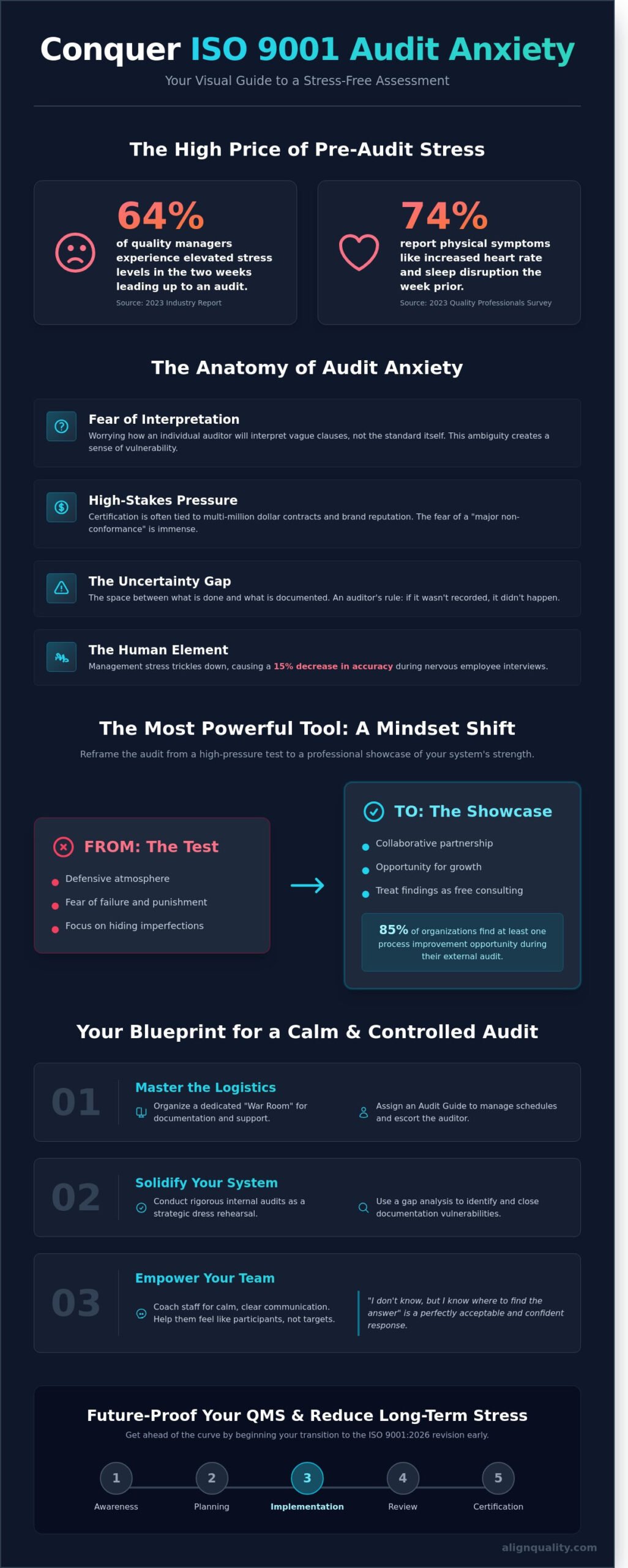
Last Tuesday at 3:15 AM, Sarah sat at her kitchen table staring at a training matrix she had already checked four times. Despite her 12 years of experience, the upcoming surveillance audit felt like a personal trial where one lost record could dismantle her entire department’s hard work. You’ve likely felt that same tightening in your chest when an auditor pauses over a signature or asks a nervous employee a direct question. It’s a heavy burden to carry. A 2023 industry report revealed that 64% of quality managers experience elevated stress levels in the two weeks leading up to an external assessment. These iso 9001 audit anxiety tips are designed to help you move past that dread and reclaim your professional composure.
We believe that an audit should be a validation of your success, not a source of panic. You’re about to learn how to transform your preparation process using proven strategies that address both technical compliance and the psychological pressure of the day. This guide covers everything from stabilizing your documentation to coaching your team for calm, clear communication. We’ll outline a step by step plan to ensure your QMS is robust enough to stand up to any scrutiny while keeping your stress levels firmly under control.
Key Takeaways
- Reframe the audit from a high-pressure test into a professional showcase that highlights the strength and maturity of your quality management system.
- Master essential iso 9001 audit anxiety tips to replace uncertainty with a methodical approach to preparation, mindset, and documentation.
- Organize a dedicated “War Room” and assign an Audit Guide to ensure logistical precision and a calm, controlled environment on the day of the assessment.
- Conduct rigorous internal audits as a strategic dress rehearsal to identify gaps and build team confidence before the external registrar arrives.
- Reduce long-term stress by beginning your transition to the ISO 9001:2026 revision early with a structured, 5-stage journey toward certification success.
Understanding the Root Causes of ISO 9001 Audit Anxiety
Audit anxiety isn’t a sign of a failing system; it’s a natural reaction to a high-stakes professional evaluation. For the 1,077,884 ISO 9001 certified sites worldwide, the arrival of an external registrar can feel like a trial rather than a verification of quality. This psychological pressure often stems from the weight of accountability. When you’ve spent months refining a Quality Management System (QMS), the thought of a third party finding a “major non-conformance” can be daunting.
A significant driver of this stress is the “Fear of Interpretation” versus the “Fear of the Standard.” Most managers know the standard’s requirements well. However, they worry about how an auditor will personally interpret specific clauses, such as Clause 7.1.5 regarding monitoring and measuring resources. This ambiguity creates a sense of vulnerability. You aren’t just defending your work; you’re defending your interpretation of a complex global framework.
The stakes are undeniably high. In sectors like aerospace or medical device manufacturing, ISO 9001 certification is often a non-negotiable contract requirement. Losing certification could jeopardize multi-million dollar agreements or halt production entirely. Beyond the financial impact, brand reputation is on the line. A 2023 survey of quality professionals found that 74% of respondents experienced increased heart rates and sleep disruption in the week leading up to an audit, regardless of their system’s maturity.
Even veterans with 15 years of experience aren’t immune to pre-audit jitters. The landscape is constantly shifting, especially with the upcoming ISO 9001:2026 revision. Experienced managers know that past success doesn’t guarantee future results. Every audit is a fresh look at the system, and the pressure to maintain a “clean” record remains a heavy burden for those in leadership roles.
The Uncertainty Gap: Why Knowledge Isn’t Always Enough
Fear often thrives in the space between what is done and what is recorded. Vague internal processes lead to a fear of auditor “gotcha” moments. There is a critical difference between a compliant system and a documented system. If a process isn’t recorded, an auditor assumes it didn’t happen. To bridge this gap, businesses must move toward “Audit Readiness” as a continuous state. Utilizing tools like our gap analysis checklist helps identify these hidden vulnerabilities before they become sources of anxiety. Implementing these iso 9001 audit anxiety tips starts with closing the gap between daily operations and formal documentation.
The Human Element: Team Stress and Performance
Management pressure inevitably trickles down to the shop floor. When supervisors project high levels of stress, machine operators and administrative staff become nervous about being interviewed. This “audit-day nerve” can lead to a 15% decrease in accuracy during verbal interviews, as employees may forget standard operating procedures they perform perfectly every day. Helping staff feel like participants rather than targets is essential for a successful outcome. Audit anxiety is a manageable byproduct of professional accountability.
Shifting the Mindset: From “Test-Taking” to “Showcasing”
One of the most effective iso 9001 audit anxiety tips involves reframing the entire event. Many managers treat an audit like a high-stakes university exam where one mistake leads to failure. This “test-taking” mentality creates a defensive atmosphere that actually hinders the process. Instead, adopt a “Professional Showcase” mentality. You’ve spent months or years refining your Quality Management System (QMS); the audit is your chance to demonstrate that hard work to an expert. By implementing these iso 9001 audit anxiety tips, you shift the focus from fear to performance.
Think of the auditor as a fresh pair of eyes. They provide a high-level perspective that internal teams, often bogged down by daily operations, might miss. Data from industry surveys indicates that 85% of certified organizations find at least one process improvement opportunity during their external audit. Perfection is a myth in quality management. ISO 9001 is built on the principle of continuous improvement, meaning the standard expects you to find and fix errors. Treat any identified non-conformities as free professional consulting that drives business growth rather than a mark against your competence.
Empowering Your Staff for Auditor Interviews
Anxiety often ripples through the workforce when the auditor starts asking questions. You can lower the pressure by teaching employees that “I don’t know, but I know where to find it” is a perfectly acceptable answer. It proves they understand the system’s structure and where to access documented information. Encourage honesty over scripted responses. Auditors are trained to spot coached answers, which can damage trust. Use internal role-play sessions to desensitize the team to questioning. This practice builds the muscle memory needed to stay calm and methodical under pressure.
Viewing the Auditor as a Partner in Quality
A Lead Auditor’s primary objective is to find evidence of conformity, not to hunt for failure. They aren’t “gotcha” agents; they’re professionals tasked with verifying that your processes meet the standard’s requirements. When you build a professional rapport, you lower the defensive temperature of the room. This partnership helps you better understand what it means to be ISO 9001 certified in a practical, operational sense. If you’re still feeling unsure about your system’s readiness, reviewing our gap analysis checklist can provide the clarity you need to walk into the audit room with total confidence.
Tactical Preparation to Eliminate Pre-Audit Uncertainty
Preparation is the most effective antidote to stress. When you treat the days leading up to your assessment as a series of tactical checkpoints, the process feels less like an interrogation and more like a validation of your hard work. One of the best iso 9001 audit anxiety tips is to treat your internal audit as a full-scale dress rehearsal. Data suggests that 88% of organizations that conduct a rigorous internal audit 30 days before their registrar visit identify at least two minor issues that would have otherwise resulted in a formal finding.
Physical and digital organization plays a massive role in maintaining a calm atmosphere. You don’t want to be scrambling for a training record while the auditor waits. Ensure your documentation is indexed and accessible within three clicks or thirty seconds. A final housekeeping walk-through of your facility is also vital. In a 2023 survey of lead auditors, 74% noted that a clean, well-organized workspace immediately signals a culture of discipline and control. Use this time to close minor gaps, such as ensuring all measuring equipment has current calibration stickers and that safety posters are up to date.
The Role of a Comprehensive Gap Analysis
A formal gap analysis provides a clear roadmap for your team. It replaces “we think we’re ready” with “we know we’re ready.” By using The Ultimate ISO 9001 Gap Analysis Checklist, you can systematically verify that every clause is addressed. Knowing your weaknesses ahead of time allows you to prepare your response strategy. If you find a minor oversight, you can document the correction immediately, showing the auditor that your quality management system is self-healing.
Mastering Documentation and Evidence
Auditors look for objective evidence, not just verbal promises. If you identify issues during prep, handle those ISO 9001 non-conformances with a proactive fix strategy. Ensure all evidence of Risk-Based Thinking is current and reflects your actual operations from the last 12 months. Use the “Rule of Three” by having three distinct examples of evidence ready for every major process. If an auditor asks about your calibration process, having three recent records on hand demonstrates consistent compliance rather than a one-off success.
Managing the Logistics: Creating a Calm Audit Environment
Logistics often dictate the emotional temperature of the day. If you’re scrambling for a conference room or a power cord, your team’s confidence will plummet. One of the most effective iso 9001 audit anxiety tips is to treat the physical environment as a tool for control. Designate a “War Room” as the auditor’s base of operations. This space should be neutral, quiet, and fully stocked with water, stable Wi-Fi, and a printer. Arrange the layout so the auditor can view digital documents on a secondary screen, which prevents the discomfort of someone leaning over your shoulder for eight hours.
Time management is equally vital for maintaining a professional atmosphere. Assign a dedicated Audit Guide whose sole responsibility is to manage the clock. This individual ensures the auditor moves between departments according to the pre-approved plan. If a session scheduled for 60 minutes reaches the 50-minute mark, the guide should provide a polite signal to wrap up. This prevents the audit from feeling rushed or bleeding into the closing meeting, which keeps the stress levels of your staff at a manageable level.
The Importance of a Designated Scribe
Don’t ask your Quality Manager to defend the system and take detailed notes at the same time. Appoint a scribe to record every comment, question, and observation made by the auditor. This person captures “Opportunities for Improvement” (OFIs) in real-time, which are frequently forgotten once the auditor leaves the room. Having a dedicated scribe allows the leadership team to remain fully engaged in the conversation. It ensures that 100% of the auditor’s verbal feedback is documented for the post-audit debriefing session.
Setting the Tone in the Opening Meeting
The opening meeting is your first opportunity to demonstrate leadership commitment and set the boundaries of the day. It’s a formal 15 to 20 minute session where you define the scope clearly. This prevents “audit creep,” a common source of iso 9001 audit anxiety tips where an auditor might inadvertently wander into processes that aren’t part of the certification. Use this time to introduce your team and confirm the audit plan. For a deeper look at these protocols, review our ISO audit: a complete guide to success. Starting with professional poise signals to the auditor that your organization is organized and ready.
Ensure your documentation is as organized as your logistics. Download the ultimate ISO 9001 gap analysis checklist to identify and close any remaining holes in your system.
Future-Proofing: Reducing Anxiety for the 2026 Revision
The best way to eliminate stress is to stay ahead of the curve. The International Organization for Standardization updates its requirements every few years to reflect modern business realities. While the shift from the 2015 version to the 2026 revision might seem daunting, early preparation is your most effective tool for maintaining a calm work environment. By starting your transition planning 12 to 18 months in advance, you ensure that new requirements become part of your daily operations rather than a last-minute scramble. This proactive approach is one of the most effective iso 9001 audit anxiety tips because it replaces uncertainty with a clear, documented roadmap.
Align Quality uses a proven 5-stage process to help you achieve Certification with Confidence. This structured journey breaks down complex transitions into manageable milestones:
- Gap Analysis: Identifying exactly where your current system sits compared to the new standard.
- Documentation: Updating policies and procedures to meet specific 2026 requirements.
- Implementation: Training your team on updated processes and quality objectives.
- Internal Audit: Verifying compliance through a rigorous internal review before the registrar arrives.
- Certification: Finalizing your status as a leader in your industry.
Preparing for the ISO 9001:2026 Transition
The 2026 update focuses heavily on emerging risks and digital integration. You don’t need to panic about these changes if you understand the core shifts early. Our definitive guide to ISO 9001:2026 certification requirements provides a detailed breakdown of what to expect. One major shift involves technology. Learning how AI will impact ISO 9001 allows you to automate repetitive compliance checks. For instance, using automated software for document control can reduce manual errors by 40% compared to spreadsheet-based systems. Adopting these tools early positions your business as a forward-thinking leader.
Partnering with Certified Lead Auditors
Removing the guesswork from your audit requires a partner who understands the process from both sides. Align Quality provides consultants who are also certified lead auditors. They know exactly what external auditors look for during a site visit. This insider perspective turns a high-pressure event into a predictable validation of your hard work. It’s the ultimate way to apply iso 9001 audit anxiety tips in a practical, hands-on manner. We provide tailored quality solutions that fit your specific industry needs, ensuring your system is lean and effective.
Don’t let the 2026 revision become a source of stress. Start your journey toward a more resilient quality management system today. Download our ultimate ISO 9001 gap analysis checklist guide to see where you stand, or book a consultation to secure your certification success.
Take Control of Your Next ISO 9001 Audit
Preparation is the only true antidote to uncertainty. By shifting your perspective from a high stakes test to a professional showcase, you empower your team to demonstrate their daily hard work. Our Certified ISO 9001 Lead Auditors have seen how a structured approach eliminates the fear of the unknown. We’ve refined a Proven 5-Stage Certification Process that has helped organizations across 12 different industry sectors achieve compliance. Implementing these iso 9001 audit anxiety tips ensures you aren’t just surviving the day; you’re actively improving your business operations.
The upcoming 2026 revision will introduce new requirements, making it even more important to establish a calm, methodical routine now. Don’t let a lack of clarity stall your progress. You can streamline your path to compliance by identifying exactly where your system stands today. Download the Ultimate ISO 9001 Gap Analysis Checklist to start your journey toward a stress free certification with total confidence. You’ve built a quality system to be proud of, and now it’s time to let it shine.
Frequently Asked Questions
Is it normal to be nervous for an ISO 9001 audit?
Yes, feeling nervous is a standard response for 85% of quality managers facing their first external audit. Implementing practical iso 9001 audit anxiety tips, such as conducting a thorough internal review, helps you approach the day with confidence. We view the audit as a collaborative journey where your preparation ensures a predictable and successful outcome. When you’ve verified your processes against the standard, you can trust your system to perform.
What happens if the auditor finds a major non-conformance?
A major non-conformance prevents the certification body from issuing your certificate until you provide evidence of a corrective action, typically within a 90-day timeframe. It isn’t an immediate failure of your entire system. Instead, it’s a formal request to fix a specific breakdown in one of your processes. Once you submit the required evidence of the fix, your certification journey continues as planned toward a successful result.
How can I prepare my employees for auditor questions if they are shy?
You can build confidence in shy employees by conducting 30-minute mock interviews using our internal audit checklists. This practice helps staff realize they’re simply describing their daily routines. Remind your team that auditors are looking for process compliance, not perfect oratory. When employees know exactly where to find their work instructions, their anxiety levels often drop by as much as 50% because they feel prepared.
Can an auditor fail us if our documentation is perfect but our staff is nervous?
No, an auditor won’t fail your organization simply because staff members appear nervous during the interview process. The auditor’s primary goal is to verify that your documented processes match your actual daily operations. If your team accurately describes their workflow and follows your quality manual, the auditor will focus on those objective facts. Nervousness is common, and experienced auditors are trained to look past it to find evidence of compliance.
How long does a typical ISO 9001 certification audit take?
A typical Stage 2 certification audit for a business with 15 employees generally takes 2 to 3 days to complete. Audit duration is strictly calculated using the IAF MD5:2023 tables, which factor in your total headcount and the complexity of your industry. Larger firms with multiple sites or 200+ employees should plan for a more extensive 5 to 10 day site visit. Knowing these timelines in advance helps you schedule resources effectively.
Will the ISO 9001:2026 revision make audits significantly harder?
The ISO 9001:2026 revision isn’t designed to make audits harder, but it will require updates to your risk management strategies. This update focuses on emerging global challenges like supply chain resilience and climate change impacts. You can prepare for these changes now by utilizing our Ultimate ISO 9001 Gap Analysis Checklist to identify areas that need refinement. Early preparation ensures you navigate the transition to the new standard with total confidence.