
For many quality managers, the words "climate change" appearing in an ISO 9001 update can cause immediate anxiety. You might be wondering if your Quality Management System (QMS) now needs to become an environmental report or if you’ll face a non-conformance for not having a carbon reduction plan.
The good news is that the ISO 9001 climate change amendment isn’t an environmental mandate. It’s a strategic update designed to bolster your organization’s resilience. It reframes climate change as a business risk and opportunity, asking a simple question: How might climate-related issues affect your ability to consistently deliver quality products and services?
This guide will demystify the amendment, providing a clear, step-by-step process to update your QMS, address auditor expectations, and ensure you pass your next audit with confidence.
Key Takeaways
- It’s a Risk Assessment, Not an Environmental Mandate: The amendment requires you to consider if climate change is a relevant issue for your QMS, focusing on its potential impact on your operations, not your impact on the environment.
- Clauses 4.1 and 4.2 Are Affected: The changes are small text additions to Clause 4.1 (Context of the Organization) and Clause 4.2 (Interested Parties), making climate change a mandatory consideration.
- Documentation is Crucial: Even if you determine climate change is not a relevant issue for your business, you must document the analysis and justification for that decision to satisfy an auditor.
- This Is a Bridge to ISO 9001:2026: This amendment is a precursor to the more significant changes expected in the upcoming ISO 9001:2026 revision, which will likely integrate sustainability and ESG concepts more deeply.
What Is the ISO 9001 Climate Change Amendment?
The ISO 9001 Climate Change Amendment, officially known as ISO 9001:2015/Amd 1:2024, is a mandatory update to the standard that requires all certified organizations to consider the effects of climate change within their QMS.
- Origin: The amendment stems from the London Declaration, ISO’s commitment to support global climate action through its standards. It’s not just for ISO 9001; similar changes have been rolled out across more than 30 other management system standards.
- The Core Shift: Previously, considering climate-related risks was good practice. Now, it is a mandatory requirement. Your organization must determine if climate change is a relevant issue that could impact your ability to achieve the intended outcomes of your QMS.
- Why it Matters: This is not an optional update. As of its publication in February 2024, the amendment is active. Auditors are already being trained to look for evidence that organizations have addressed these new requirements.
The London Declaration and Quality Standards
In 2021, ISO made a public pledge known as the London Declaration, committing to embed key climate considerations into all new and existing standards. The goal is to ensure that organizations using ISO standards are actively thinking about how climate change could affect their business.
By adding this to ISO 9001, the International Organization for Standardization is positioning quality management as a central pillar of organizational resilience. The logic is simple: you cannot consistently provide quality products and services if your operations are vulnerable to climate-related disruptions.
Effective Dates and Audit Expectations
The climate change amendment is effective immediately. During your next surveillance or recertification audit, your auditor will expect to see that you have considered its implications.
So, what happens if an auditor finds no mention of climate change in your QMS? Initially, it may be raised as an Observation or an Opportunity for Improvement (OFI). However, as awareness grows, it is increasingly likely to result in a minor non-conformance.
At its core, the amendment is a mandatory, risk-based addition to the context of your organization. You must be able to show an auditor that you’ve had the conversation and documented your conclusion.
Understanding the Changes to Clauses 4.1 and 4.2
The amendment introduces two small but significant additions to the standard. These changes work together to ensure that climate change is considered from both an internal/external perspective and from the viewpoint of your key stakeholders.
The key is to understand the difference between your organization’s ‘environmental impact’ (the focus of ISO 14001) and ‘climate change relevance’ for ISO 9001. The amendment is concerned with the latter: how climate change could affect you, not how you affect the climate.
Clause 4.1: Understanding the Organization and Its Context
Clause 4.1 requires you to determine external and internal issues relevant to your purpose and that affect your ability to achieve the intended results of your QMS.
The amendment adds the following statement:
"The organization shall determine whether climate change is a relevant issue."
This forces you to formally assess whether climate-related factors could disrupt your business.
- Examples of External Issues:
- Supply Chain Disruption: Extreme weather events (floods, wildfires, droughts) delaying or destroying shipments of raw materials.
- Regulatory Shifts: New carbon taxes or energy efficiency regulations that increase operational costs.
- Market Changes: Shifting customer preferences toward more resilient or sustainable suppliers.
- Examples of Internal Issues:
- Resource Availability: Water scarcity impacting manufacturing processes or energy grid instability affecting operations.
- Facility Resilience: The need for upgraded HVAC systems to cope with extreme heat or reinforced infrastructure to withstand storms.
- Employee Welfare: Ensuring staff can safely commute and work during extreme weather events.
Clause 4.2: Understanding the Needs and Expectations of Interested Parties
Clause 4.2 requires you to determine the relevant interested parties and their requirements.
The amendment adds the following note:
"NOTE: Relevant interested parties can have requirements related to climate change."
This prompts you to think about which of your stakeholders might have expectations regarding your climate resilience.
- Customers: May include clauses in contracts requiring you to have a business continuity plan that accounts for climate risks.
- Insurers: May adjust premiums based on your facility’s vulnerability to climate-related events like flooding or wildfires.
- Regulators: May impose new reporting or operational requirements related to climate adaptation.
- Investors: Are increasingly focused on Environmental, Social, and Governance (ESG) criteria and may require evidence of climate risk management.
You should document these expectations within your existing stakeholder analysis or matrix.
Is Climate Change Relevant to Your Business? A Practical Analysis
For many businesses, especially those in service or software industries, the initial reaction is, "This doesn’t apply to us." However, the standard requires you to prove it. The key is to conduct and document a "Relevance Test."
This process connects directly to the core of the standard: the ISO 9001:2015 risk-based thinking model. You are simply applying that same logic to a new, specific category of risk.
Crucially, concluding that climate change is not a relevant issue is a valid outcome. But you cannot simply ignore the clause. You must have documented evidence showing that you performed an analysis and reached a logical conclusion. This prevents your QMS from being accused of "greenwashing" while still meeting the auditor’s expectations.
Relevance for Manufacturing and Logistics
For companies dealing with physical products and supply chains, the relevance is often clear.
- Supply Chain Vulnerability: Are your key suppliers located in regions prone to hurricanes, floods, or droughts? A single weather event could halt your production line.
- Energy Costs and Transition Risks: How would a carbon tax or a sharp rise in electricity costs affect your overhead? Are you dependent on a power grid that is vulnerable to extreme weather?
- Product Durability: Will your products perform as expected in hotter, wetter, or more extreme environmental conditions? This can impact warranty claims and customer satisfaction.
Relevance for Service and Software Sectors
Even if you don’t have a factory, climate change can be a highly relevant issue.
- Data Center Resilience: Where is your data hosted? If your cloud provider’s data centers are in a location at risk of flooding, wildfires, or power outages, your service availability is at risk.
- Employee Safety and Availability: Can your team work effectively during a severe heatwave? Do they have reliable power and internet at home if extreme weather prevents them from commuting?
- Client Expectations: Are you bidding on contracts for government agencies or large corporations? Many now include sustainability and climate resilience questions in their RFPs. Your answer could be a competitive differentiator.
Example: Relevance Statement for a Software Company
Subject: Determination of Climate Change Relevance per ISO 9001:2015/Amd 1:2024
Date: October 26, 2024
Analysis: As part of our Management Review and update to our Context of the Organization (Ref: QMS-DOC-01), we have assessed the relevance of climate change to our QMS.
Conclusion: Climate change is determined to be a relevant external issue.
Justification:
- Interested Party Requirement (Clause 4.2): Our key enterprise clients and government contracts (e.g., RFP-2024-5) increasingly require evidence of business continuity planning that addresses climate-related disruptions.
- External Issue (Clause 4.1): Our service delivery is dependent on the uptime of our cloud hosting provider (AWS us-east-1). While AWS has robust redundancy, regional climate events like hurricanes or grid failures pose a low but high-impact risk to our service level agreements (SLAs).
Action: This risk has been added to our Risk and Opportunities Register (Ref: QMS-REG-04) with mitigating actions, including reviewing our SLA with AWS and confirming our data backup and failover procedures.
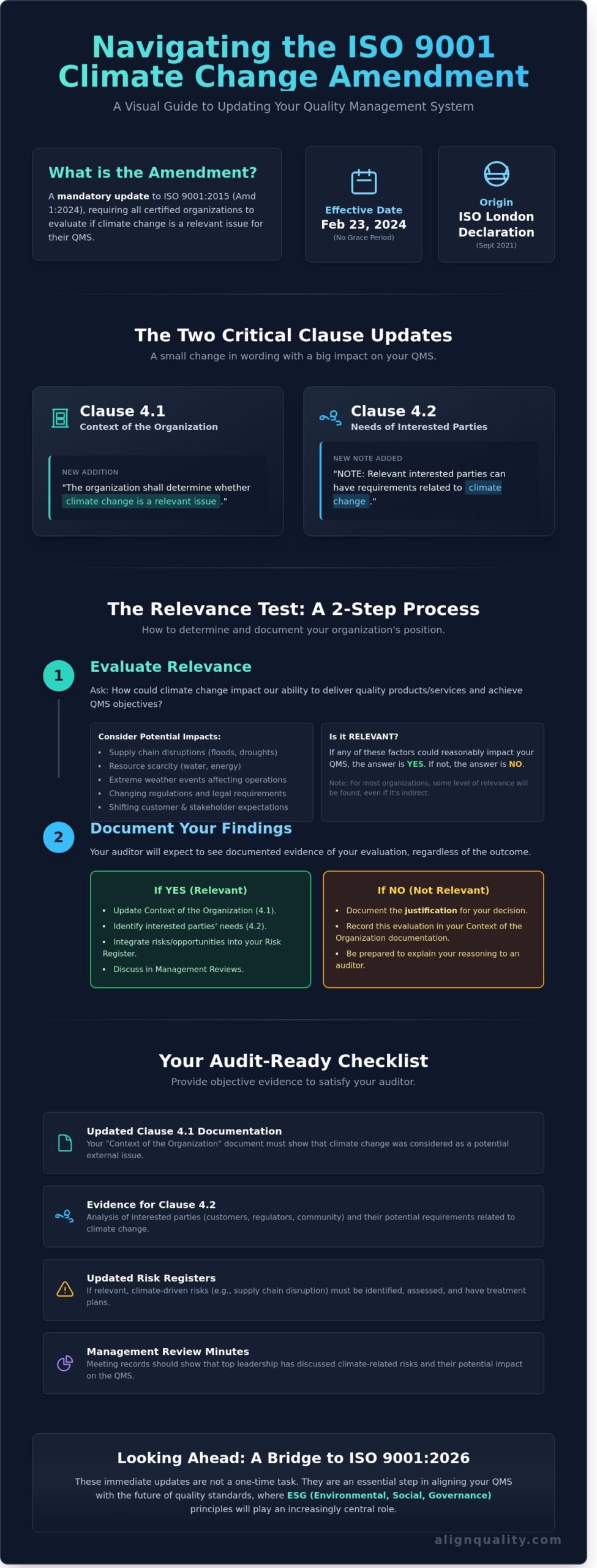
How to Update Your QMS for the Climate Change Amendment
Integrating this amendment doesn’t require a complete overhaul of your system. It’s a targeted update that can be accomplished in four clear steps. These steps can be integrated into your normal QMS maintenance activities and are foundational to how to get ISO 9001 certification and maintain it over time.
Step 1: Conduct a Targeted Gap Analysis
Before changing any documents, understand where you stand. Focus your analysis specifically on Clause 4.
- Review your "Context of the Organization" and "Interested Parties" documents. Is there any mention of environmental or climate-related issues?
- Interview department heads. Ask your operations manager about supply chain vulnerabilities or your sales team about customer questions on sustainability.
- You can use a structured approach to ensure nothing is missed. Using our ultimate ISO 9001 gap analysis checklist can help you pinpoint exactly where climate considerations need to be added.
Step 2: Update Your ‘Context of the Organization’ Document
This is where you will formally document your decision.
- Write a "Relevance Statement": Based on your analysis, add a clear statement (like the software company example above) that declares whether climate change is relevant and why.
- Update SWOT/PESTLE Analysis: If you use tools like a SWOT (Strengths, Weaknesses, Opportunities, Threats) or PESTLE (Political, Economic, Social, Technological, Legal, Environmental) analysis, add climate-related factors. For example, "More frequent heatwaves" could be a Threat, while "Growing demand for green products" could be an Opportunity.
- Document in Management Review: Ensure the discussion and decision are recorded in the minutes of your next Management Review meeting. This provides a clear audit trail.
Step 3: Review and Refresh Your Risk and Opportunities Register
If you determine that climate change is a relevant issue, the next logical step is to update your risk register.
- Add specific risks (e.g., "Supply chain disruption due to flooding at Supplier X’s facility").
- Evaluate the risk level and identify controls or mitigation strategies (e.g., "Qualify a second supplier in a different geographic region").
- Consider any opportunities that arise, such as developing more durable products or marketing your climate resilience to new customers.
Step 4: Communicate Changes to Key Personnel
Ensure that relevant team members, especially those who interact with customers or manage key processes, are aware of the updated risk assessment. They need to understand the "why" behind any new procedures or controls.
Preparing for the ISO 9001:2026 Revision and Beyond
The climate change amendment is more than just a minor tweak; it’s a signal of the future direction of quality management. It serves as a deliberate bridge to the upcoming ISO 9001:2026 revision, which is expected to place a greater emphasis on organizational resilience, sustainability, and ESG factors.
By taking a proactive and thoughtful approach to this amendment now, you are not just ensuring compliance for your next audit—you are building a more robust and future-proof QMS that will be better prepared for the changes to come.
The Future of Risk and Sustainability
The world of business is changing. Issues that were once considered "non-financial," like climate risk and social responsibility, are now understood to have a direct impact on long-term viability. Future versions of ISO 9001 will likely continue this trend, expanding on these initial climate requirements.
Forward-thinking organizations are already exploring the intersection of AI and ISO 9001 compliance, using technology to better monitor and predict supply chain and operational risks, including those related to climate.
Getting Audit-Ready with Align Quality
Navigating changes to ISO standards can be daunting, but you don’t have to do it alone. Our team of certified lead auditors specializes in helping businesses integrate new requirements seamlessly, ensuring your QMS is not only compliant but also adds real value to your organization. We can help you conduct a thorough analysis, update your documentation, and face your next audit with complete confidence.
To see where your QMS stands against this new amendment and other ISO 9001 requirements, a great next step is to perform a detailed self-assessment.
Download the Ultimate ISO 9001 Gap Analysis Checklist & Guide
Frequently Asked Questions (FAQ)
Is the ISO 9001 climate change amendment a new version of the standard?
No, it is not a new version. It is an amendment, designated as ISO 9001:2015/Amd 1:2024. The base standard is still ISO 9001:2015, and this amendment simply adds two new sentences to the existing text.
Do I need to get a new ISO 9001 certificate because of this amendment?
No. Your existing ISO 9001:2015 certificate remains valid. You simply need to demonstrate during your regular surveillance audits that you have incorporated the requirements of the amendment into your QMS.
What happens if I decide climate change is not relevant to my business?
This is a perfectly acceptable outcome. However, you must be able to show an auditor the evidence of your analysis. You need a documented record (e.g., in your Context of the Organization document or Management Review minutes) that explains how you reached that conclusion. Simply ignoring the requirement is not an option.
Does this amendment require me to reduce my carbon footprint?
No, not directly. ISO 9001 is focused on quality management. This amendment requires you to assess the risk of climate change to your organization’s ability to provide quality products/services. It is not about measuring or reducing your environmental impact, which is the focus of a standard like ISO 14001 (Environmental Management).
How does this amendment relate to ISO 14001?
This amendment borrows a concept from the world of environmental management but applies it through a quality and risk lens. ISO 14001 is about managing your environmental impact. The ISO 9001 amendment is about managing climate change’s potential impact on your business operations and quality objectives. The two are complementary but distinct.