
What if the very documentation you’re avoiding is actually the secret to doubling your enterprise contract win rate? For many software firms, the thought of iso 9001 certification for tech companies feels like a handbrake on innovation. You’ve likely spent years perfecting a lean, Agile culture and don’t want to bury it under a mountain of rigid paperwork. It’s frustrating when a promising $500,000 deal stalls because a procurement officer demands a level of process maturity you haven’t yet formalized.
We understand that you need a system that supports speed rather than hindering it. This guide provides a clear roadmap to leverage the ISO 9001:2026 standards to scale your operations and integrate AI ethically. You’ll discover how to map quality requirements to your current Scrum cycles and prepare for the 2026 transition with total certainty. We’ll explore the exact steps to build a framework that satisfies auditors and impresses global enterprise clients.
Key Takeaways
- Understand how iso 9001 certification for tech companies acts as a modern business operating system to help you scale and win high-value enterprise contracts with confidence.
- Discover how to align ISO requirements with Agile and DevOps workflows by standardizing your underlying processes without sacrificing speed or creative output.
- Identify the core components of a tech-centric Quality Management System, including how to mitigate “key person risk” through robust organizational knowledge management.
- Follow a structured 5-stage journey to certification, starting with a strategic gap analysis to formalize your existing unwritten tech processes and culture.
- Future-proof your operations for the ISO 9001:2026 revision by integrating ethical AI governance and digitalization into your long-term quality strategy.
Why ISO 9001 Certification is a Growth Lever for Tech Companies
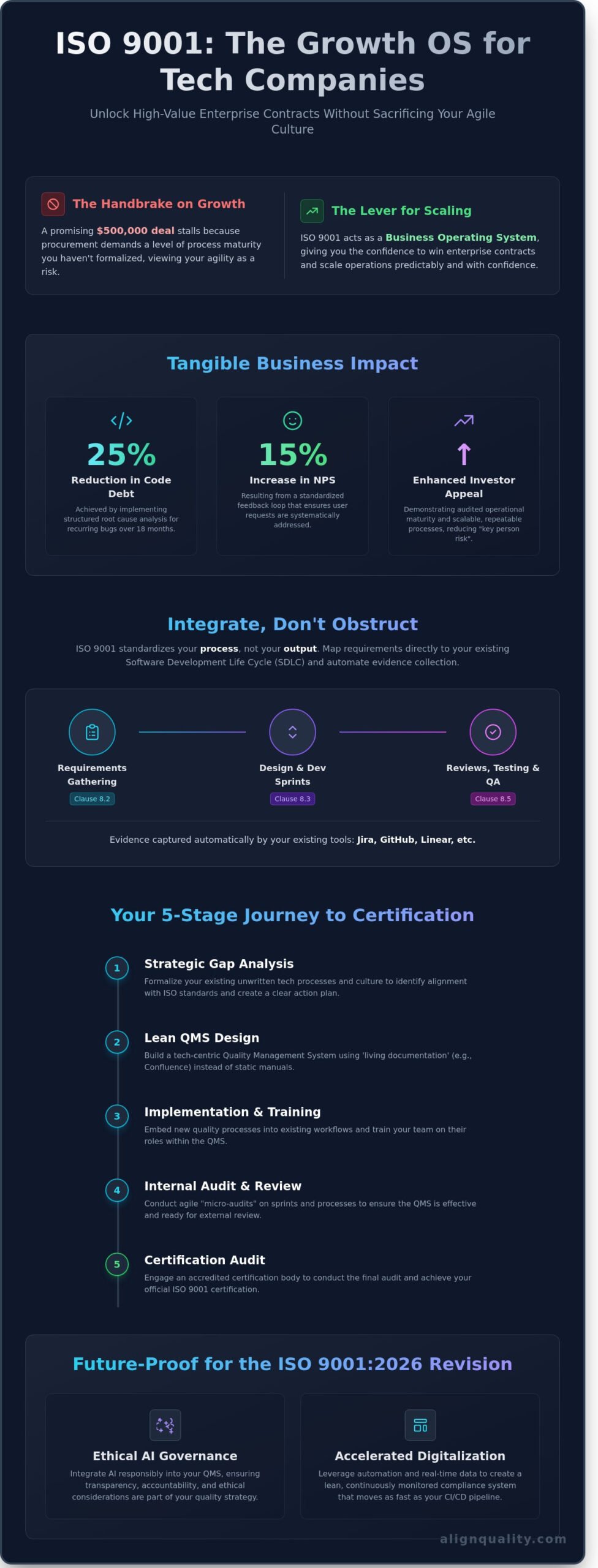
ISO 9001 certification for tech companies isn’t about rigid factory protocols or outdated paperwork. It’s a strategic framework for consistent service delivery and proactive risk management. For a SaaS provider or an AI startup, this standard functions as a business operating system that ensures every deployment meets customer expectations. While the ISO 9000 family of standards originated in manufacturing, the 2015 revision shifted the focus toward leadership and risk-based thinking. This makes it highly compatible with modern software development life cycles.
Achieving certification removes significant friction during enterprise procurement. Large-scale buyers often require SOC2 or ISO 27001; while ISO 9001 provides the foundational quality management layer, utilizing professional ISO 27001 implementation services ensures these security audits are faster and more predictable. It establishes a “Quality with Confidence” mindset. This allows leadership to focus on innovation while the system handles operational consistency, ensuring that the journey toward scale is documented and repeatable.
ISO 9001 Benefits for Software Companies
- Reduction in Code Debt: By implementing structured root cause analysis, teams identify why specific bugs recur. This systematic approach can reduce technical debt by up to 25% over an 18-month period.
- Improved Customer Retention: Standardizing the feedback loop ensures user requests and complaints don’t fall through the cracks. Companies often see a 15% increase in Net Promoter Scores (NPS) after aligning their support processes with ISO standards.
- Investor Appeal: Audited operational maturity proves to investors that the company is a reliable investment. It demonstrates that the business relies on scalable, repeatable processes rather than the intuition of a few key individuals.
Scaling Operations Without Losing Agility
Rapid team expansion often leads to “quality drift” where new hires don’t follow the original vision. ISO 9001 provides the guardrails necessary for growth. It facilitates the transition from founder-led quality, which relies on a single person’s intuition, to system-led quality, where the process drives the outcome. This structure allows a 50-person team to operate with the same precision as a 5-person core group. To understand how this fits into your broader strategy, consult ISO 9001: The Definitive Guide for Modern Businesses to see how these standards adapt to agile environments.
Adapting ISO 9001 to Agile, DevOps, and CI/CD Environments
Many software leaders worry that formal standards will stifle their engineering velocity. This is a common myth. ISO 9001 standardizes your process, not your output. It doesn’t dictate a rigid waterfall approach; instead, it provides a framework for the requirements for a quality management system (QMS) that can be fully integrated into modern workflows. For high-growth firms, iso 9001 certification for tech companies is about proving that your rapid releases are the result of a controlled, repeatable system rather than luck.
Mapping Clause 8 (Operations) to the Software Development Life Cycle (SDLC) is the most efficient way to achieve compliance. Requirements gathering aligns with Clause 8.2, while your design and development sprints satisfy Clause 8.3. You don’t need manual logs to prove these steps happened. Automated tools like Jira, GitHub, or Linear naturally capture the evidence of peer reviews, approvals, and testing. Internal audits should mirror this speed. Rather than a massive annual event, conduct “micro-audits” on individual sprints to ensure your QMS remains healthy without stalling your roadmap.
Continuous Improvement in a CI/CD Pipeline
In a DevOps environment, “Corrective Action” isn’t a bureaucratic chore. It’s the natural outcome of a post-mortem or sprint retrospective. When a deployment fails, your team already analyzes the root cause and implements a fix. ISO 9001 simply requires you to document this loop. You can satisfy ISO control requirements by automating quality gates within your pipeline. These gates prevent code from reaching production unless it passes specific security and performance benchmarks. By 2026, automated testing suites will function as the primary verifiable quality control, providing real-time compliance data without manual intervention.
Lean Documentation for Tech Teams
The days of static PDF manuals are over. Living documents in Confluence, Notion, or internal wikis are far superior for maintaining a modern QMS. These platforms allow for real-time updates and collaborative editing, ensuring your processes match your actual daily operations. Version control serves as a built-in ISO compliance feature; every change to your documentation or code is timestamped and attributed to a user. This transparency is exactly what an auditor looks for during the certification journey.
If you’re unsure where your current tech stack meets the standard, our gap analysis checklist can help you identify specific overlaps between your existing tools and the requirements for iso 9001 certification for tech companies. Using your existing tools for compliance ensures that your team stays focused on building great products while we help you manage the certification process with confidence.
Building a Quality Management System for Tech that Actually Works
A successful Quality Management System (QMS) isn’t a stack of dusty binders or a collection of static PDFs. For software firms, it’s a living framework that streamlines development and deployment. Achieving iso 9001 certification for tech companies requires focusing on three pillars: risk management, robust design controls, and technical support. You’ll need to move past generic templates and build a system that reflects your actual sprint cycles and deployment pipelines.
One critical area often overlooked is Clause 7.1.6, which covers Organizational Knowledge. In the tech sector, key person risk is a major threat to stability. If your lead architect leaves tomorrow, does your QMS ensure their knowledge stays behind? By documenting tribal knowledge in a centralized wiki or Confluence, you protect your intellectual property. This approach aligns with the globally recognized standard for Quality Management Systems, ensuring your operations remain stable during personnel shifts and rapid scaling.
You’ll get better buy-in from developers if you don’t force them into separate, clunky QMS software. Instead, integrate your quality checks directly into Jira, GitHub, or Azure DevOps. When a pull request requires a peer review, that’s a quality control in action. Use our gap analysis checklist to see how your current dev tools already meet ISO requirements. This integration ensures that iso 9001 certification for tech companies feels like a natural extension of the workflow rather than an administrative burden.
Risk-Based Thinking in Software and Data
Tech risks aren’t about physical hazards; they’re about data integrity and system availability. You should integrate ISO 9001 risk assessments with your existing cybersecurity frameworks to cover uptime risks. For example, a cloud infrastructure provider might mitigate risk by using multi-region failovers. In a 2024 analysis of SaaS providers, companies using structured risk mitigation saw an 85% reduction in unplanned downtime compared to those using ad-hoc fixes.
Measuring What Matters: Tech KPIs for ISO
Don’t track metrics just for the auditor. Use data your team already relies on to drive performance. Focus on these three areas:
- Bug Density: Aim for a specific target, such as fewer than 0.5 defects per 1,000 lines of code.
- Uptime: Measure against a 99.99% Service Level Agreement (SLA).
- Net Promoter Score (NPS): Track customer satisfaction to meet Clause 9.1.2 requirements.
During a management review, present these as trend lines rather than static numbers. This proves that your QMS is a tool for continuous improvement. “In a modern QMS, data is the pulse that proves your processes are healthy and your customers are satisfied.”
The 5-Stage Journey to ISO 9001 Certification for Startups
Achieving iso 9001 certification for tech companies isn’t about slowing down your release cycle with red tape. It’s a strategic move to ensure your scaling efforts don’t break your core service delivery. We break this down into a structured, five-stage journey that aligns with modern development cycles.
- Stage 1: The Gap Analysis. We identify where your “unwritten” tech processes fall short of the standard. Roughly 70% of tech startups rely on tribal knowledge that isn’t documented, creating significant risks during periods of rapid growth.
- Stage 2: QMS Design. We tailor the Quality Management System to your specific tech stack. Your QMS should live where your work happens, whether that’s in Jira, GitHub, or Notion. We ensure the standard fits your culture, not the other way around.
- Stage 3: Implementation. This is where the team begins working under the new framework. We recommend running your first full sprint or development cycle under the QMS to identify practical friction points.
- Stage 4: Internal Audit. Think of this as a pre-production environment. We use a Lead Auditor to find “bugs” in your process before the official registrar arrives. This step typically uncovers 80% of potential non-conformances.
- Stage 5: Certification Audit. This is the final verification. A third-party registrar reviews your evidence and grants official status, confirming your systems meet global standards.
Starting with a Tech-Focused Gap Analysis
Generic checklists often fail tech companies because they focus on physical manufacturing rather than digital assets. A tech-focused analysis looks at version control, deployment pipelines, and bug tracking. We focus on identifying “low-hanging fruit,” such as formalizing your existing code review process. This provides quick compliance wins without disrupting your engineers. For a detailed roadmap, see our guide on How to Get ISO 9001 Certification: A Step-by-Step Guide.
Preparing for the External Audit with Confidence
The external audit is often the most stressful part of iso 9001 certification for tech companies. We coach your engineering team to speak confidently about their workflows. Auditors don’t want to see “perfect” folders; they want to see how you handle a failed deployment or a security patch. Organizing digital evidence in a central repository ensures a smooth remote or hybrid audit. You can learn more about this in our ISO Audit: A Complete Guide to Preparation and Success.
Ready to see where your current processes stand against the standard? Start your journey today and download our gap analysis checklist to identify your path to certification.
Future-Proofing for the ISO 9001:2026 Tech Revision
The ISO 9001:2026 revision represents the most significant shift in quality management since 2015. This update moves away from static documentation toward a framework built for a digital-first economy. For leaders pursuing iso 9001 certification for tech companies, these changes aren’t just administrative hurdles; they’re a roadmap for managing the complexities of modern software and hardware lifecycles. The 2026 standard prioritizes digitalization and ethical governance, ensuring your Quality Management System (QMS) addresses the risks inherent in automated environments.
Tech companies are uniquely positioned to lead this transition. While traditional industries may struggle with digital transformation, your firm likely already uses the agile methodologies and data-driven workflows the new standard encourages. Adopting these requirements early provides a level of confidence that resonates with global partners. It proves your organization isn’t just following rules but is actively shaping the future of industry standards.
AI Integration and Ethical Quality Management
The 2026 framework introduces specific requirements for verifying AI-generated code and automated outputs. Under these new guidelines, algorithmic bias is categorized as a quality non-conformance. Tech firms must demonstrate how they validate machine learning models to ensure consistent, unbiased results. You can find detailed strategies for this in our guide on How AI Will Impact ISO 9001: A Guide to the 2026 Revision. Proactively addressing these ethical quality standards builds trust with the 92 percent of B2B buyers who now prioritize vendor transparency and data ethics.
As companies integrate more advanced AI, understanding the core technologies becomes essential for compliance and innovation. For instance, firms specializing in intelligent automation, such as IntellifyAi, are at the forefront of developing and implementing the very systems these new standards aim to govern.
Transitioning Your QMS Smoothly
The transition period from the 2015 version to the 2026 standard typically spans three years. However, high-growth firms shouldn’t wait for the deadline to start the update process. Align Quality simplifies this journey by helping you map your existing digital workflows to the new requirements. We focus on streamlining your documentation so it supports, rather than hinders, your development speed. By integrating these updates now, you ensure your iso 9001 certification for tech companies remains a powerful tool for scaling and market entry.
Ready to secure your company’s future and stay ahead of regulatory changes? Use our ultimate ISO 9001 gap analysis checklist to evaluate your current processes and begin your journey toward the 2026 standard with confidence.
Secure Your Competitive Edge with the 2026 Standard
Successfully navigating iso 9001 certification for tech companies requires moving beyond static documentation. It’s about integrating quality management directly into your Agile sprints and DevOps pipelines. By preparing for the ISO 9001:2026 revision now, you ensure your software or AI firm stays ahead of shifting global requirements. Our Certified ISO 9001 Lead Auditors specialize in high-growth tech environments, applying a Proven 5-Stage Certification Process that’s designed to be lean and scalable. We don’t believe in adding unnecessary friction to your development cycles. Instead, we help you build a system that attracts enterprise clients and stabilizes your delivery. You can achieve full compliance while maintaining the speed that defines your brand. Our expert-led approach removes the guesswork, giving your team the clarity they need to excel during audits. It’s time to transform your quality processes into a reliable engine for long-term growth.
Ready to see where you stand? Download the Ultimate ISO 9001 Gap Analysis Checklist and begin your journey with confidence. You’ve got the innovation; let’s give it the framework it deserves.
Frequently Asked Questions
Is ISO 9001 relevant for a software-as-a-service (SaaS) company?
ISO 9001 certification for tech companies is highly relevant for SaaS providers because it standardizes software delivery and support cycles. In 2023, 42% of SaaS firms adopted the standard to satisfy enterprise procurement requirements and shorten sales cycles. It ensures your team manages service level agreements (SLAs) and bug resolution with the same rigor as a physical manufacturing line.
How long does it typically take for a tech startup to get ISO 9001 certified?
A tech startup can expect the journey to take between 4 and 9 months from start to finish. A typical 20-person team usually completes our 5-stage process in about 6 months if they have basic documentation in place. You can significantly accelerate this timeline by using our Ultimate ISO 9001 Gap Analysis Checklist to identify your existing compliance strengths early.
Can we maintain our Agile workflow while being ISO 9001 compliant?
You can absolutely maintain an Agile workflow while meeting all ISO 9001 requirements. The standard doesn’t mandate a rigid Waterfall approach; it simply requires that you define and follow a consistent process. Modern auditors accept Jira tickets, sprint reviews, and Confluence pages as valid evidence of quality control. The upcoming ISO 9001:2026 update further emphasizes this flexibility for digital-first environments.
What is the difference between ISO 9001 and ISO 27001 for tech companies?
ISO 9001 focuses on general quality management and customer satisfaction, while ISO 27001 specifically targets information security. Think of 9001 as the foundation for how your business operates and 27001 as the specialized vault for your data. Statistics show that 65% of tech firms pursue both certifications to provide a complete picture of reliability. ISO 9001 certification for tech companies provides the operational framework that supports security goals.
How much does ISO 9001 certification cost for a small tech firm?
Small tech firms should budget between $8,000 and $15,000 for their initial certification journey. This total includes registrar audit fees, which typically start at $3,000 for a single-site organization, plus the cost of internal resource allocation. Using a structured gap analysis checklist can reduce your reliance on expensive external consultants by 30%, keeping your total investment manageable.
What are the specific requirements for AI companies in the ISO 9001:2026 update?
The ISO 9001:2026 update introduces new requirements for managing algorithmic risk and data integrity. AI companies must now demonstrate how they monitor for bias and ensure the quality of the datasets used to train their models. Clause 4 of the revised standard requires these firms to explicitly document how automated decision-making impacts their ability to meet customer requirements and quality objectives.
Do we need a full-time Quality Manager to maintain our certification?
You don’t need a full-time Quality Manager if your company has fewer than 50 employees. Currently, 70% of small tech firms successfully manage their QMS by appointing an existing Operations or DevOps lead as the Quality Representative. The key is having a methodical person who can coordinate the annual surveillance audits and ensure the team follows the established 5-stage process.
What happens if we fail our first ISO 9001 audit?
You don’t actually “fail” an audit in the traditional sense; instead, the auditor issues “Non-Conformance” (NC) reports. Data shows that 15% of first-time audits result in at least one Major Non-Conformance that requires attention. You’ll have exactly 90 days to implement corrective actions and provide evidence to the auditor. Once they verify these corrections, they’ll issue your certificate with full confidence in your system.