
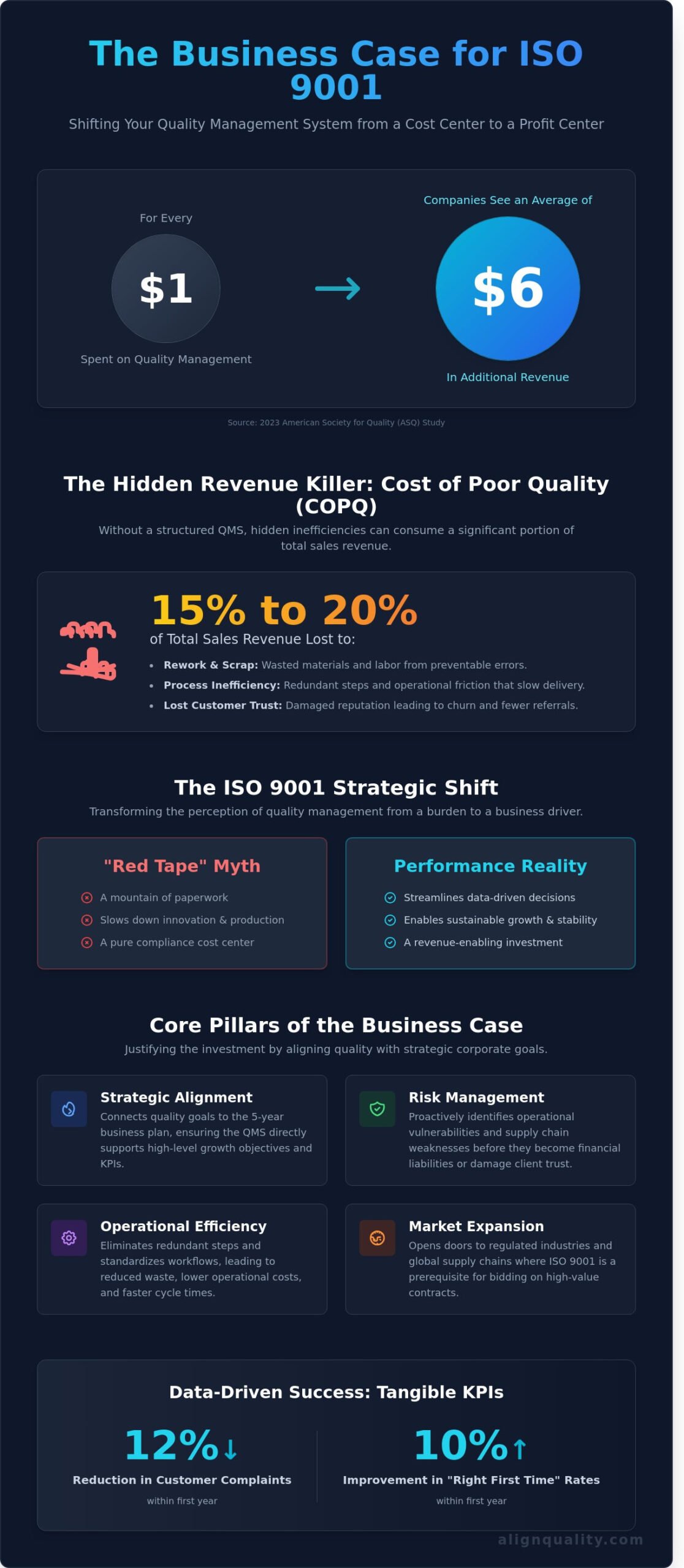
What if your quality management system was actually a profit center rather than a line-item expense? You likely know that ISO 9001 is the gold standard for excellence, but it’s frustrating when leadership views it as a mountain of paperwork that slows down production. In reality, a 2023 study by the American Society for Quality (ASQ) found that for every $1 spent on quality management, companies see an average of $6 in additional revenue. Building a compelling business case for iso 9001 certification requires shifting the conversation from compliance costs to these measurable bottom-line gains.
To underscore this commitment to execution, you can also explore Complex Project Management options to demonstrate that the implementation will be managed with the same professional rigor as any other critical business initiative.
It’s time to stop defending the budget and start presenting a strategic investment. This guide provides the data-driven framework you need to prove the ROI of ISO 9001 to your board with confidence, specifically focusing on 2026 market demands. You’ll learn how to calculate cost savings, forecast revenue growth, and align your quality goals with the upcoming ISO 9001:2026 revision. We will walk through the exact steps to secure executive buy-in and turn your certification journey into a clear competitive advantage.
Key Takeaways
- Understand how to build a compelling business case for iso 9001 certification that shifts your QMS from a compliance burden into a performance-driven strategic asset.
- Discover the three strategic pillars that justify your investment, including how to leverage certification to win high-value tenders and improve operational resilience.
- Learn how to quantify the “Cost of Poor Quality” (COPQ) by identifying hidden expenses like scrap and rework to prove a clear return on investment.
- Master the two-step process for presenting your case to the board by aligning quality objectives with your company’s three-year strategic growth plan.
- Identify why partnering with the right expert auditor is critical to avoiding value-draining templates and ensuring your QMS delivers genuine business value.
What Is the Business Case for ISO 9001 Certification?
A business case for ISO 9001 certification is far more than a request for budget. It’s a strategic document that justifies the investment in a Quality Management System (QMS) by linking operational improvements directly to financial outcomes. In the past, many firms viewed certification as a badge to collect. That perspective is changing rapidly. As we approach the ISO 9001:2026 transition, the focus is shifting from simple compliance to a performance-driven model. This evolution means your QMS must do more than pass an audit; it must actively drive your company’s growth and stability.
For modern firms, “good enough” quality is often a hidden revenue killer. Research indicates that the cost of poor quality, including rework, scrap, and lost customer trust, can consume 15% to 20% of a company’s total sales revenue. This is why ISO 9001 helps leaders gain the operational clarity needed to identify these leaks. By providing a structured framework within the broader ISO 9000 family of standards, the certification process forces an organization to scrutinize its workflows and eliminate waste. You aren’t just buying a certificate; you’re investing in a methodology that ensures your business remains scalable and resilient.
The Core Purpose of the Business Case
The primary goal is to align your quality objectives with high-level corporate strategy. If the board wants to expand into international markets, the business case should demonstrate how ISO 9001 removes trade barriers. It’s about securing executive buy-in by speaking the language of the C-suite: risk mitigation and resource allocation. You must establish clear KPIs to measure the success of the certification journey. These might include a 12% reduction in customer complaints or a 10% improvement in “Right First Time” production rates within the first year of implementation. This data-driven approach transforms a technical project into a business priority.
Why Management Often Resists (And How to Pivot)
Resistance usually stems from the “red tape” myth. Many executives fear that a QMS will bury their teams in paperwork and slow down innovation. You can pivot this conversation by presenting data on process efficiency. Instead of more paperwork, ISO 9001 streamlines decision-making by standardizing how data is collected and analyzed. Move away from “cost center” language. Don’t talk about what the audit costs; talk about how the system acts as a revenue enabler by reducing operational friction. Using a clear understanding of what it means to be ISO 9001 certified allows you to define your market authority. It proves to prospective clients that your business is a steady, dependable partner capable of delivering consistent results. This trust is a powerful competitive advantage that directly impacts your win rate on high-value contracts.
- Strategic Alignment: Connects quality goals to the 5-year business plan.
- Risk Management: Identifies vulnerabilities before they become financial liabilities.
- Operational Efficiency: Eliminates redundant steps in the production or service cycle.
- Market Expansion: Opens doors to regulated industries and global supply chains.
Building a business case for ISO 9001 certification requires a methodical look at your current state versus your desired future. It’s a journey that, when managed with confidence, replaces organizational chaos with a structured path to excellence. By documenting these benefits early, you ensure that the entire leadership team is committed to the long-term success of the Quality Management System.
Three Strategic Pillars of the ISO 9001 Business Case
Building a compelling business case for iso 9001 certification requires moving beyond the idea of simply “getting a badge.” It’s about demonstrating how a formal system creates a foundation for sustainable scale. Executive leaders often view compliance as a cost center, yet data from global industry surveys shows that over 1.2 million sites worldwide maintain this standard to secure their market position. By focusing on three strategic pillars, you can prove that certification is a high-return investment that stabilizes operations and drives top-line growth. This structured approach helps stakeholders see the journey as a path toward professional excellence rather than an administrative burden.
Pillar 1: Revenue Growth and Market Expansion
Certification acts as a global passport for your products and services. It’s often a mandatory requirement for Tier 1 supply chains and government tenders, where the absence of a certificate leads to immediate disqualification. A 2023 survey of certified firms indicated that 75% of respondents gained new customers because they could prove adherence to recognized quality management standards. Beyond winning new business, the framework significantly impacts customer retention. When processes are consistent, the customer experience becomes predictable, reducing the churn that often erodes the profits of uncertified competitors.
Pillar 2: Efficiency and Cost Reduction
Operational resilience stems from the radical reduction of process variability. A lean ISO implementation removes redundant steps and clarifies ownership across the organization. For instance, documented workflows can cut employee onboarding time by 30% because new hires have a clear, audited roadmap to follow from day one. Internal audits function as a diagnostic tool, uncovering “hidden” bottlenecks that cost the average mid-sized firm up to 15% in wasted productivity annually. By standardizing these workflows, you aren’t just checking boxes; you’re reclaiming lost hours and reducing the material waste associated with avoidable errors.
Pillar 3: AI Readiness and Data Integrity
The upcoming ISO 9001:2026 revision will place a heavy focus on technology, risk, and data-driven decision-making. A structured Quality Management System (QMS) is a non-negotiable prerequisite for effective AI implementation. You can’t automate chaos; you need clean, structured data and consistent processes first. Understanding how AI will impact ISO 9001 helps strengthen your business case for iso 9001 certification by ensuring your data integrity is ready for automated systems. This future-proofing protects the brand from the reputational damage of AI hallucinations or logic errors caused by poor underlying data quality.
Meticulous record-keeping and risk-based thinking protect the organization from the high costs of recalls and litigation. These systems ensure that small deviations are caught before they reach the client, preserving your brand’s integrity in a competitive market. If you’re ready to see how your current processes align with these strategic goals, our gap analysis checklist provides a clear starting point for your certification journey.
Calculating the ROI: Certification Cost vs. Cost of Poor Quality
Building a successful business case for iso 9001 certification requires a shift in perspective. You must stop viewing quality as a cost center and start seeing it as a profit driver. Many organizations operate with a “Cost of Poor Quality” (COPQ) that averages 15% to 20% of their total sales revenue. These are hidden leaks in your bottom line. By formalizing your management system, you don’t just “get a badge”; you install a framework to plug those leaks and reclaim lost margin. You can approach this investment with confidence when you balance the initial outlays against the long-term operational gains.
Analyzing the Costs of Certification
Your budget must account for three primary pillars of expenditure. First, consider the choice between consultancy vs. in-house development. While an in-house approach seems cheaper, it often consumes 30% more time due to the learning curve. Professional consultants streamline the journey and often reduce the time to certification by four to six months. Second, you must budget for registrar fees and surveillance audits across the full 3-year cycle. Finally, estimate your internal resource allocation. A typical mid-sized firm might spend 300 to 500 man-hours on QMS development and staff training. These are upfront investments that set the stage for systemic efficiency.
Quantifying the Benefits of Quality
The financial rewards of a robust QMS are measurable and significant. According to the American Society for Quality, the benefits of ISO 9001 include a standardized approach to reducing scrap and rework. If your current rework rate is 5%, cutting that to 2% through better process control can save a manufacturing plant $50,000 or more annually. Other tangible benefits include:
- Reduced Complaint Costs: Administrative costs for handling a single customer complaint often range from $200 to $600. Reducing complaint volume by 25% provides immediate savings.
- Insurance Premium Reductions: Some providers offer 5% to 10% discounts on professional liability insurance for companies that demonstrate rigorous risk management.
- Increased Throughput: Better process flow allows you to increase capacity by 15% without adding new headcount, effectively lowering your cost per unit.
By focusing on these metrics, your business case for iso 9001 certification becomes a data-driven argument that resonates with executive leadership. It moves the conversation from “what does this cost?” to “what are we losing by not doing this?”
Projecting ROI and Finding Quick Wins
Most organizations see a full return on their ISO 9001 investment within 14 to 18 months. To accelerate this timeline, start with a comprehensive gap analysis. This diagnostic tool identifies immediate “quick win” savings by highlighting redundant steps in your current workflows. For example, eliminating a double-entry data requirement can save five hours of administrative work per week. These small victories build momentum and prove the value of the system before the final audit even takes place. This methodical approach ensures your quality journey is both sustainable and highly profitable.
How to Present the Business Case to Your Board
Presenting to a board of directors requires a shift from operational details to strategic outcomes. You aren’t just selling a certificate; you’re proposing a framework for sustainable growth. To build a compelling business case for iso 9001 certification, you must speak the language of risk, ROI, and market positioning. Follow these four steps to secure executive buy-in and project confidence.
Step 1: Link quality to the 3-year strategic plan. Boards focus on the long-term vision. If your company aims to increase annual revenue by 20% by 2027, explain how ISO 9001 provides the scalable infrastructure to handle that volume without increasing defects. Quality is the engine of scale. Connect the standard’s requirements directly to existing KPIs like customer retention rates or operational margin targets to show alignment.
Step 2: Present a competitive analysis. Data indicates that 71% of procurement officers in the manufacturing and service sectors prioritize certified suppliers. Identify three direct rivals who already hold the certification. If your competitors use their ISO status to win contracts you’re currently losing, the board needs to see that gap. This isn’t about keeping up; it’s about removing a barrier to entry for high-value RFPs.
Step 3: Detail the implementation roadmap. Boards dislike open-ended projects. Present a clear, time-bound strategy using a proven 5-stage process. By breaking the journey into Gap Analysis, System Development, Implementation, Internal Audit, and Certification, you demonstrate a methodical approach. This structure reduces the perceived chaos of a new initiative and builds trust in your project management capabilities.
Step 4: Use a ‘Risk vs. Reward’ matrix. Visualize the cost of doing nothing. Research from the American Society for Quality indicates that the cost of poor quality can reach 15% to 20% of total sales revenue. Compare this against the one-time investment of certification. When the board sees that staying the course costs $450,000 in annual waste while certification costs a fraction of that, the decision becomes a financial necessity.
Structuring the Executive Summary
Your summary must lead with the bottom line first. Start with the projected 12% reduction in operational waste or the access to the $2.5 billion government contract market. Keep technical jargon out of the primary presentation slides. Crucially, highlight the ISO 9001:2026 transition as an urgent deadline. Delaying today means rushing toward a mandatory update later, which increases both cost and risk for the organization.
Handling Common Executive Objections
When directors say they’re too busy, remind them that ISO 9001 is a tool to create time by standardizing processes and reducing fire-fighting. If they cite high costs, reframe the business case for iso 9001 certification as a capital investment in business infrastructure. For the objection that “we already do this,” emphasize that internal excellence is invisible to the market without third-party validation. External audits provide the trust your sales team needs to close deals faster.
Ready to evaluate your current standing before meeting the board? Download our Ultimate ISO 9001 Gap Analysis Checklist to identify exactly where your systems need alignment.
Partnering for Success: Why the Right Consultant Matters
The strength of your business case for iso 9001 certification often hinges on the implementation strategy you choose. Many organizations fall into the trap of purchasing “cookie-cutter” ISO templates. These generic document kits frequently add 40% more administrative weight to a company without providing any functional value. Instead of streamlining operations, these rigid templates force your team to adapt to a system that doesn’t fit your specific culture or industry requirements. This creates “compliance debt,” where the cost of maintaining the system eventually outweighs the benefits of the certification itself.
Expert consultants and auditors prevent this by identifying critical gaps that internal teams often miss due to operational blindness. While your staff is focused on daily output, a professional eye spots the 15% to 20% of process inefficiencies that lead to non-conformities during a final audit. By addressing these early, you ensure that your quality management system (QMS) is a lean, high-performing asset rather than a filing cabinet full of unused procedures. Professional guidance can reduce your time to certification by up to 50%, moving the timeline from a typical 12-month struggle to a structured 6-month journey.
Success isn’t just about passing the initial audit; it’s about sustaining those gains. Ensuring long-term success requires comprehensive audit preparation that builds a culture of continuous improvement. When your team understands the “why” behind every requirement, the system becomes self-sustaining and drives the ROI promised in your initial business case.
The Align Quality Advantage
Align Quality leverages certified lead auditors to provide a “no-surprises” certification journey. We don’t use generic manuals. Instead, we deliver tailored solutions that fit your specific industry and organizational culture. Our experts have guided over 200 companies through successful transitions, ensuring every process adds measurable value. We stand by our “With Confidence” signature promise, which means we stay with you until you achieve your goals. This methodical approach removes the anxiety from the process and replaces it with a structured path to excellence.
Next Steps: Starting Your Journey
Your path toward a more efficient organization starts with a clear understanding of where you stand today. We recommend booking a free consultation to evaluate your current state and identify the most direct route to compliance. To get a head start, you can download the Ultimate ISO 9001 Gap Analysis Checklist to see exactly which areas of your business require attention. With the ISO 9001:2026 revision on the horizon, now is the time to act. Setting your target certification date for 2026 ensures your business remains competitive and compliant as global standards evolve. Don’t leave your certification to chance; start building your framework for success today.
Secure Your Competitive Advantage for 2026
Building a compelling business case for iso 9001 certification requires looking far beyond the certificate on the wall. It’s about capturing the 15% to 20% of revenue that many organizations lose to the cost of poor quality and operational friction. You’ve identified how strategic pillars and data-driven ROI calculations transform a compliance task into a powerful engine for growth. As the 2026 revision approaches, the window to align your quality management system with future global standards is closing. Early adopters will find themselves better positioned to win high-value contracts and streamline internal workflows.
Align Quality supports your goals through our team of Certified ISO 9001 Lead Auditors and a proven 5-Stage Implementation Process. We ensure your organization is 2026 revision ready while removing the complexity from the certification journey. You don’t have to navigate these technical requirements alone. Our methodical approach provides the clarity your board demands and the results your operations team needs.
Ready to prove the value of ISO 9001? Download our Ultimate ISO 9001 Gap Analysis Checklist and start your journey with confidence. You have the roadmap for success; now it’s time to take the first step toward a more resilient business.
Frequently Asked Questions
Is ISO 9001 certification worth it for small businesses in 2026?
Yes, ISO 9001 remains a vital investment because 85% of certified small businesses report significant improvements in operational efficiency. As we approach 2026, the standard’s focus on digital transformation helps smaller teams automate repetitive documentation. It’s a foundational element of a business case for iso 9001 certification because it allows small firms to compete for contracts that were previously reserved for larger corporations.
How long does it typically take to see a return on investment from ISO 9001?
Most organizations realize a full return on investment within 12 to 18 months after receiving their certificate. You’ll likely see initial gains from a 15% reduction in waste and rework costs during the first year of implementation. Long-term value grows as standardized processes reduce the time leadership spends on “firefighting” by up to 25%, allowing for better strategic focus.
What are the hidden costs of ISO 9001 certification I should include in my business case?
You must account for internal staff hours and potential infrastructure upgrades alongside the visible registrar fees. Internal resource allocation typically represents 60% of the total implementation cost. Don’t forget to budget between $2,000 and $5,000 for specialized team training or document control software. These investments ensure your team can maintain the system confidently without relying on expensive outside help indefinitely.
Can ISO 9001 certification actually help us win more government contracts?
ISO 9001 is a mandatory prerequisite for approximately 75% of federal and state manufacturing and service tenders. Procurement officers use this certification as a primary filter to eliminate high-risk vendors before the bidding process even begins. Holding a valid certificate can increase your bid “win rate” by 20% because it provides third-party verification of your quality management capabilities.
How does the 2026 ISO 9001 revision change the business case for certification?
The 2026 revision strengthens the business case for iso 9001 certification by introducing specific requirements for supply chain resilience and technological integration. It moves the focus from basic compliance toward organizational agility in volatile markets. Early adopters of the 2026 framework can expect a 10% improvement in risk mitigation compared to businesses sticking to older, less flexible quality models.
What happens if we fail our first ISO 9001 certification audit?
You won’t “fail” in the traditional sense; instead, the auditor will identify “non-conformances” that you must address. Data shows that 30% of companies receive at least one minor non-conformance during their initial stage two audit. You’re typically granted a 90-day window to implement corrective actions. Once these are verified, your certification is issued without you having to restart the entire journey.
How do I calculate the ‘Cost of Poor Quality’ for my business case?
Calculate your Cost of Poor Quality (COPQ) by totaling the expenses related to scrap, rework, warranty claims, and administrative errors. For many uncertified firms, COPQ consumes between 15% and 20% of total annual sales revenue. By identifying these specific numbers, you can show stakeholders how a 5% reduction in errors will add thousands of dollars directly to the company’s bottom line.
Do we need a full-time Quality Manager to maintain ISO 9001?
No, businesses with fewer than 50 employees successfully maintain the standard by distributing responsibilities among existing staff. You can manage the system effectively by dedicating roughly 10 hours per month to internal audits and management reviews. This approach allows you to achieve compliance without the $80,000 average annual salary required for a dedicated quality executive.