You’ve successfully passed your initial audit and earned your certificate-a significant achievement for any organization. But as the initial celebration subsides, a common question emerges: What comes next? The path to maintaining iso 9001 certifications can seem just as daunting as achieving it, filled with uncertainty about upcoming surveillance audits and the fear of potential non-conformities that could jeopardize your hard-won status.
This guide is designed to remove that uncertainty and empower your team for the journey ahead. We will demystify the complete three-year certification lifecycle, from the purpose of annual surveillance audits to the requirements for your final recertification. You will gain a clear, practical roadmap for maintaining your quality standard, preparing for each stage effectively, and managing your Quality Management System with confidence. By the end, you will be fully equipped to sustain compliance and drive continuous improvement within your organization.
Beyond the Certificate: Understanding the 3-Year ISO 9001 Certification Cycle
Earning your certificate is a significant achievement, but it marks the start of a continuous improvement journey, not the final destination. The validity of iso 9001 certifications operates on a standard three-year cycle, a structured framework designed to ensure your Quality Management System (QMS) remains effective and evolves with your business. This approach, rooted in the principles of the ISO 9000 family of standards, involves several key audits to maintain your good standing. Understanding this cycle is the first step to confidently managing your compliance long-term.
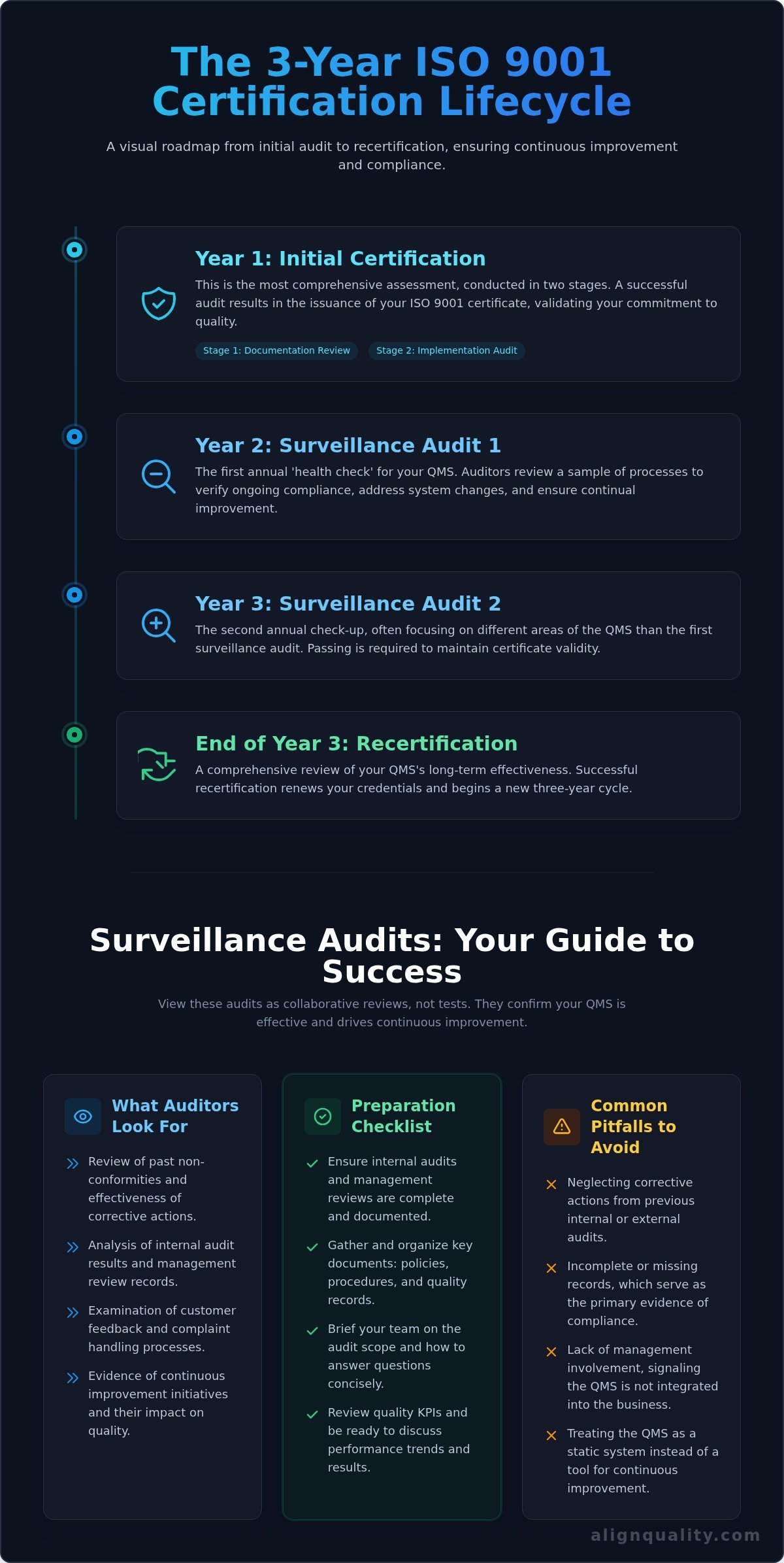
The entire process can be visualized as a clear, methodical timeline:
The 3-Year Certification Journey
- Year 1: Initial Certification
Comprehensive Stage 1 & Stage 2 audits to verify QMS design and implementation. Certificate is issued. - Year 2: Surveillance Audit 1
First annual ‘health check’ to confirm ongoing compliance and improvement. - Year 3: Surveillance Audit 2
Second annual ‘health check’ focusing on different areas of the QMS. - End of Year 3: Recertification Audit
Full system review to demonstrate long-term effectiveness. A new 3-year cycle begins.
Year 1: The Initial Certification Audit
This is the most comprehensive assessment in the cycle, conducted in two parts. Stage 1 verifies your QMS documentation meets the standard’s requirements, while Stage 2 confirms your processes are fully implemented and effective. The goal is to establish a baseline verification of your system’s design and operational control. Successful completion results in the issuance of your initial ISO 9001 certificate, validating your commitment to quality.
Years 2 & 3: Annual Surveillance Audits
Think of surveillance audits as mandatory annual ‘health checks’ for your QMS. Conducted in the first and second year after certification, these audits are less intensive than the initial assessment. Auditors review a sample of your processes to verify ongoing compliance, address any system changes, and ensure you are driving continual improvement. Maintaining your certificate’s validity is contingent on successfully passing these regular reviews.
End of Year 3: The Recertification Audit
Before your certificate expires, you will undergo a recertification audit. This comprehensive review is more detailed than a surveillance audit but typically less so than the initial Stage 2. It focuses on the overall long-term effectiveness of your QMS, performance trends, and improvement efforts over the entire three-year period. A successful recertification audit renews your credentials and begins a new three-year cycle of maintaining excellence.
Surveillance Audits Explained: How to Prepare for a Successful Review
For many business leaders, the term “surveillance audit” can trigger unnecessary anxiety. It is crucial to view these audits not as a test to be passed, but as a collaborative review designed to ensure your Quality Management System (QMS) remains effective. The primary objective is twofold: to confirm your system is being maintained according to the ISO 9001:2015 standard and to verify that it is driving continuous improvement. Unlike the initial certification audit, the auditor will not review your entire system. Instead, they will examine a representative sample of processes, records, and departments to gauge ongoing compliance and performance. These routine checks are a critical component of maintaining all iso 9001 certifications.
What Auditors Look For During Surveillance Visits
An auditor’s visit is focused and methodical. They seek objective evidence that your QMS is a living, breathing part of your organization. Key areas of focus typically include:
- Review of past non-conformities and the effectiveness of the corrective actions implemented.
- Analysis of internal audit results and records from management review meetings to ensure proactive self-assessment.
- Examination of customer feedback and complaint handling processes to verify customer focus.
- Evidence of continuous improvement initiatives and data showing their impact on quality objectives.
Your Pre-Audit Preparation Checklist
A methodical approach to preparation is the key to navigating your audit and maintaining your iso 9001 certifications with confidence. A streamlined preparation process ensures your team is ready and all necessary evidence is accessible, often supported by an integrated information governance system like C1Risk that unifies compliance and risk management.
- Ensure all scheduled internal audits and management reviews are complete, with action items documented and tracked.
- Gather and organize key documentation: updated policies, process procedures, work instructions, and quality records.
- Brief your team on the audit scope, likely areas of focus, and how to answer questions clearly and concisely.
- Review key performance indicators (KPIs) related to your quality objectives, and be prepared to discuss trends and results.
Common Pitfalls to Avoid
Even well-managed systems can face challenges during an audit. Awareness of common pitfalls allows you to address potential gaps proactively and demonstrate a robust commitment to quality.
- Neglecting corrective actions from previous audits. Failing to close out non-conformities is a significant red flag.
- Incomplete or missing records. Documentation is the primary evidence of compliance and operational control.
- Lack of management involvement. Auditors need to see that leadership is actively engaged in the QMS.
- Treating the QMS as a static system. The goal is continuous improvement, not just maintaining a set of documents.
Handling Non-Conformities: Turning Audit Findings into Opportunities
Receiving a non-conformity during a surveillance audit is not a failure; it is a critical component of the continuous improvement cycle. In the context of the ISO 9000 family of standards, a non-conformity is simply the failure to meet a specified requirement, whether from the standard itself, your own Quality Management System (QMS), or a regulatory body. Viewing these findings as data points allows your organization to strengthen its processes, mitigate risks, and enhance overall quality, thereby protecting the value of your iso 9001 certifications.
Major vs. Minor Non-Conformities
Auditors classify findings into two distinct categories, each with different implications for your certification status. Understanding the difference is key to prioritizing your response.
- Minor Non-Conformity: This typically represents an isolated lapse or a single observed failure to follow a procedure. While not a systemic issue, it still requires a formal corrective action plan to address the deviation and prevent it from becoming a larger problem.
- Major Non-Conformity: This indicates a systemic failure in your QMS or a finding that poses a significant risk to product or service quality. A major non-conformity can jeopardize your certification, often requiring immediate, robust action and a follow-up audit to verify resolution.
The Corrective Action Process (CAPA)
A structured and documented Corrective and Preventive Action (CAPA) process is essential for effectively closing out any non-conformity. This methodical approach ensures you not only fix the immediate problem but also prevent it from happening again.
- Step 1: Contain the Issue. Take immediate action to control the effects of the non-conformity. This might involve quarantining a product, stopping a process, or communicating with an affected client.
- Step 2: Conduct Root Cause Analysis (RCA). Move beyond the symptoms to identify the fundamental reason the non-conformity occurred. Techniques like the “5 Whys” or a fishbone diagram are invaluable for digging deep.
- Step 3: Develop a Corrective Action Plan. Create a detailed plan that directly addresses the root cause. Assign clear responsibilities, set realistic deadlines, and define the resources needed for implementation.
- Step 4: Verify Effectiveness. After implementation, you must gather evidence to prove the corrective action was effective and has successfully prevented recurrence. This verification is what the auditor will review.
How a Consultant Streamlines This Process
Navigating the CAPA process under the pressure of an audit finding can be challenging. An experienced ISO consultant provides the objective expertise needed to respond efficiently and effectively. They offer expert guidance in conducting a thorough root cause analysis, help develop robust corrective action plans that satisfy auditors, and provide an impartial review to ensure your response is compliant and complete. This support ensures your corrective actions are not just accepted but truly improve your QMS. Navigate audit findings with confidence. Contact our experts.
Accreditation vs. Certification: What’s the Difference and Why It Matters
In the world of quality management, the terms ‘certification’ and ‘accreditation’ are frequently confused. While they sound similar, understanding their distinct roles is fundamental to the value and credibility of your management system. This distinction ensures the entire system of standards operates with integrity.
To clarify, consider an educational analogy. Your company is like a student seeking a degree. A university-the Certification Body-evaluates your work and awards the degree (your certificate). A national board of education-the Accreditation Body-audits the university to ensure its programs are legitimate and its degrees are meaningful. One process validates the student, while the other validates the institution.
Certification: For Your Organization
Certification is the process your organization undergoes. A third-party auditor from a Certification Body assesses your Quality Management System (QMS) against the specific requirements of the ISO 9001 standard. The primary goal is to verify and formally recognize your compliance.
- It is an audit performed on your company by a Certification Body (or Registrar).
- The outcome is a certificate stating your QMS meets the ISO 9001 standard.
- This certificate demonstrates your commitment to quality and consistency to customers, suppliers, and stakeholders.
Accreditation: For the Certification Body
Accreditation operates one level higher in the hierarchy of conformity. It is the formal process of verifying that a Certification Body is competent, impartial, and operates ethically according to international standards. This is performed by an authoritative, non-profit Accreditation Body.
- It is an assessment performed on the Certification Body by an Accreditation Body (e.g., UKAS in the UK, ANAB in the US).
- It ensures auditors are qualified and follow established, impartial rules.
- This gives you confidence that your certificate is credible and will be recognized globally.
Ultimately, choosing an accredited Certification Body is crucial. It ensures the integrity of your entire certification process. The credibility of reputable iso 9001 certifications hinges on this system of oversight. An accredited certificate carries weight, satisfying tender requirements and opening doors to new markets. Making the right choice is a foundational step in your compliance journey, ensuring your achievement is recognized with confidence.
Transform Your ISO 9001 Certification into a Lasting Asset
Achieving your initial certification is a significant milestone, but the true value of the standard is realized through diligent maintenance and renewal. As we’ve explored, this is a continuous journey, not a destination. Successfully navigating the three-year cycle, preparing for surveillance audits, and using non-conformities as opportunities for growth are all critical to transforming your quality management system from a static certificate into a dynamic tool for improvement.
Maintaining successful iso 9001 certifications requires a proactive and strategic approach. At Align Quality, our team of Certified ISO 9001 Lead Auditors leverages a proven 5-Stage process, refined through multi-industry experience, to provide tailored solutions. We help you move beyond simple compliance to achieve genuine operational excellence and unlock the full potential of your quality management system.
Ready to streamline your certification maintenance with confidence? Book a free consultation to discuss your ISO 9001 maintenance strategy and let our experts help you turn compliance into a true competitive advantage.
Frequently Asked Questions
How much do ISO 9001 surveillance audits typically cost?
The cost of an ISO 9001 surveillance audit generally ranges from $1,500 to $5,000 annually. This price is determined by factors such as your company’s size, the number of locations, and the complexity of your operations. Certification bodies calculate the required number of audit days based on these variables, which directly influences the final fee. For an accurate estimate, it is best to request a detailed quote directly from your accredited certification body.
What happens if my company fails a surveillance audit?
Failing a surveillance audit does not result in immediate certificate withdrawal. Instead, the auditor will raise non-conformities (major or minor). Your organization will be given a specific timeframe, typically 30 to 90 days, to implement effective corrective actions and provide evidence of resolution. Addressing these findings promptly is critical, as failure to resolve a major non-conformity within the designated period can lead to the suspension of your certification until compliance is demonstrated.
Can we change our certification body mid-cycle?
Yes, it is possible to change your certification body during the three-year certification cycle through a process known as a transfer audit. Your new chosen body will conduct a review of your existing Quality Management System, current certificate, and past audit reports to ensure a smooth transition. Companies may pursue a transfer for various reasons, including better customer service, competitive pricing, or to partner with a body that has more expertise in their specific industry.
What is the difference between an internal audit and a surveillance audit?
An internal audit is a self-assessment performed by your own organization or a consultant on your behalf. Its purpose is to proactively review your processes, ensure they comply with the standard, and identify opportunities for improvement. In contrast, a surveillance audit is conducted by your external, accredited certification body. This audit is a formal verification that your system remains compliant and is a mandatory requirement for maintaining your ISO 9001 certifications.
How long does an ISO 9001 certificate remain valid?
An ISO 9001 certificate is valid for a three-year period. However, this validity is conditional upon successfully passing mandatory surveillance audits, which are typically conducted annually in the first and second years of the cycle. These audits confirm your ongoing compliance with the standard. At the conclusion of the three years, your organization must undergo a full recertification audit to renew your certificate for the next cycle, ensuring continuous adherence to quality standards.