
The upcoming revision to the ISO 9001 standard is on the horizon, bringing with it a familiar sense of uncertainty. If you are wondering where to begin or feeling concerned about meeting the new requirements, you are not alone. The key to a seamless and successful transition lies in proactive preparation, and the most critical first step is a thorough iso 9001 2026 gap analysis. Overlooking a single change could jeopardize your certification, but the process of identifying every gap can feel complex and overwhelming.
This definitive guide is designed to eliminate that complexity and empower your team. We will walk you through a clear, methodical process to evaluate your current Quality Management System (QMS) against the upcoming standard. You will learn how to pinpoint crucial gaps, understand the most significant changes, and build a practical action plan. Prepare to navigate your transition journey with clarity and achieve compliance with confidence, ensuring your organization is fully prepared for a successful audit.
Key Takeaways
- Understand why a gap analysis is the essential first step for a successful and streamlined transition to the ISO 9001:2026 standard.
- Master a proven, step-by-step method to conduct a thorough iso 9001 2026 gap analysis, ensuring a comprehensive review of your QMS.
- Identify common pitfalls in the analysis process and learn how to avoid them, ensuring your findings are accurate and reliable.
- Learn how to translate your findings into a clear, actionable transition plan that prepares your organization for certification with confidence.
Why a Gap Analysis is the Critical First Step for the ISO 9001:2026 Transition
The upcoming revision to ISO 9001, expected in 2026, represents the standard’s continued evolution to address modern business challenges, technological shifts, and a greater emphasis on risk management. For any organization currently certified to ISO 9001:2015, the transition journey begins with one foundational step: a comprehensive gap analysis. This proactive assessment methodically compares your current Quality Management System (QMS) against the anticipated requirements of the new standard. It is the essential blueprint for a smooth and successful certification journey.
Conducting an iso 9001 2026 gap analysis is not merely a preliminary check; it is the cornerstone of your entire transition strategy. It provides a clear, documented overview of where your QMS currently stands and precisely what needs to be updated, added, or removed. This methodical approach allows you to create a detailed project plan, allocate resources effectively, and move forward with confidence. By identifying potential hurdles early, you can save significant time, reduce unforeseen costs, and eliminate the risk of non-conformities during your formal transition audit. This commitment to foresight is a core principle of the entire ISO 9000 family of standards.
Gap Analysis vs. Internal Audit: Understanding the Difference
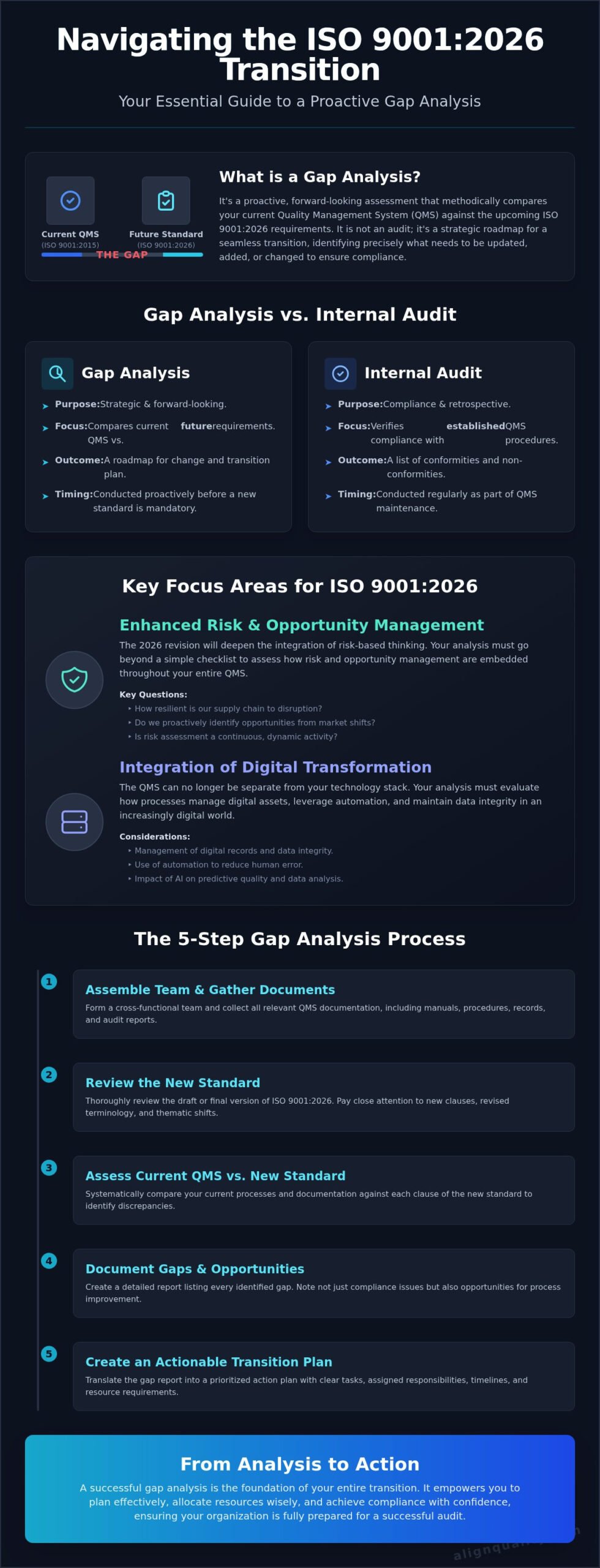
While both are evaluation tools, a gap analysis and an internal audit serve fundamentally different purposes. An internal audit is retrospective, verifying that your organization is complying with its currently established QMS procedures. In contrast, a gap analysis is forward-looking. It strategically compares your current system against a future set of requirements to create a roadmap for change, not a list of non-conformities.
The Strategic Benefits of an Early Gap Analysis
Performing an early iso 9001 2026 gap analysis delivers tangible strategic advantages that streamline the entire transition process. It empowers your organization to:
- Plan and Budget Effectively: Implement necessary changes in a phased, manageable manner without straining resources.
- Facilitate Smoother Adoption: Allocate sufficient time for team training, process updates, and cultural integration of new requirements.
- Identify Improvement Opportunities: Go beyond simple compliance to discover ways to enhance efficiency and add real value to your QMS.
- Reduce Transition Stress: Avoid the pressure and potential errors of a last-minute rush to meet certification deadlines.
Key Focus Areas: What to Look for in Your ISO 9001:2026 Gap Analysis
While the final text of ISO 9001:2026 is still under development by the technical committee, the direction of change is becoming clear. A successful iso 9001 2026 gap analysis moves beyond minor clause adjustments and focuses on the strategic, philosophical shifts shaping the future of quality management. As noted by ASQ, a leading authority on quality standards, the standard has always evolved to meet contemporary business challenges. This section highlights the key themes your organization should assess to prepare your Quality Management System (QMS) for a seamless and confident transition.
Enhanced Focus on Risk and Opportunity Management
The 2015 revision introduced risk-based thinking; the 2026 update is expected to deepen and broaden its integration. Your analysis should scrutinize how effectively risk and opportunity are embedded throughout your entire QMS, not just treated as a separate exercise. Look for gaps in how your organization addresses modern operational vulnerabilities and strategic advantages. Key questions to ask include:
- How resilient is our supply chain to geopolitical, environmental, or economic disruption?
- Do our processes proactively identify and act on opportunities from market shifts or technological advances?
- Is risk assessment a continuous, dynamic activity that informs strategic decision-making?
Integration of Digital Transformation and New Technologies
The rapid pace of digital transformation is a central theme for the upcoming revision. Your QMS can no longer exist in a vacuum separate from your technology stack. Your gap analysis must evaluate how your current processes manage digital assets and leverage new tools. Assess the integrity of your data, the use of automation to reduce errors, and your readiness for future technologies. Consider the impact of artificial intelligence on predictive quality control and data analysis. To explore this topic further, you can learn more about how AI will impact ISO 9001.
Sustainability and ESG Considerations
ISO 9001 is increasingly expected to align with broader business imperatives, including Environmental, Social, and Governance (ESG) criteria. A forward-thinking iso 9001 2026 gap analysis must evaluate how your quality objectives support your organization’s sustainability commitments. This moves quality beyond product conformity to encompass responsible operations. Review how social and governance factors are considered within your QMS, particularly in areas like ethical sourcing, waste reduction, and energy efficiency within your processes.
A Step-by-Step Guide to Conducting Your Gap Analysis
A successful transition to a new standard relies on a methodical process, not guesswork. This structured, three-phase framework ensures your findings are accurate, comprehensive, and actionable. It provides a clear roadmap for any organization, regardless of size or industry, to confidently navigate the changes in ISO 9001:2026. The ultimate goal is to produce a detailed report that precisely guides your implementation efforts.
Phase 1: Preparation and Planning
Success begins with meticulous preparation. This foundational phase sets the stage for an effective analysis by ensuring you have the right people, information, and tools. Before assessing your Quality Management System (QMS), focus on these critical steps:
- Assemble Your Team: Form a cross-functional team with deep knowledge of your organization’s processes. Include representatives from different departments to gain a holistic view.
- Gather Documentation: Collect all relevant QMS documents, including your quality manual, procedures, work instructions, and records of audits and reviews.
- Secure the Standard: Obtain a copy of the ISO 9001:2026 Draft International Standard (DIS) as soon as it becomes available to use as your definitive benchmark.
- Develop a Plan: Create a detailed project plan or use a comprehensive gap analysis checklist to guide your activities and ensure no requirement is overlooked.
Phase 2: Assessment and Evidence Gathering
This is the investigative phase of your iso 9001 2026 gap analysis. The objective is to systematically compare your current QMS against the new requirements. This involves more than just a paper exercise; it requires a deep dive into your operations to gather objective evidence of both conformity and non-conformity.
- Review Documents: Meticulously review your QMS documentation clause-by-clause against the new standard.
- Conduct Interviews: Speak with process owners and key personnel to understand how procedures are implemented in practice.
- Observe Processes: Watch processes in action to verify that they align with documented procedures and meet the standard’s intent.
Phase 3: Analysis and Reporting
The final phase translates your findings into a clear, actionable strategy. The analysis and report are the most critical outputs, providing the roadmap for your transition project. This report should be a practical tool for management and the implementation team.
- Identify Gaps: Systematically analyze the collected evidence to pinpoint specific discrepancies between your current QMS and the ISO 9001:2026 requirements.
- Prioritize Findings: Score each identified gap based on its potential risk to the business and the level of effort required to close it. This helps focus resources effectively.
- Create the Report: Compile a formal gap analysis report that summarizes all findings, highlights non-conformities, and clearly outlines what is missing or needs updating to achieve compliance.
Common Pitfalls in a Gap Analysis (And How to Avoid Them)
An effective gap analysis is more than a procedural step; it is a strategic tool for business improvement. However, several common pitfalls can diminish its value, turning it into a mere administrative task. By understanding and avoiding these mistakes, you can ensure your analysis provides a clear, actionable roadmap for your ISO 9001:2026 journey.
Treating It as a Paper-Only Exercise
A frequent error is limiting the analysis to a review of the quality manual and documented procedures. While documentation is a critical starting point, it rarely reflects the complete reality of day-to-day operations. To gain an accurate picture, you must go beyond the documents and verify processes in action. A robust analysis includes:
- Direct Observation: Watch how work is actually performed to identify deviations from written procedures.
- Staff Interviews: Speak with employees who execute tasks to understand practical challenges and informal workarounds.
- Record Reviews: Trace records and outputs to confirm that procedures are being followed consistently and effectively.
Lack of Leadership Involvement
When the quality manager performs the analysis in isolation, it often lacks the authority needed for meaningful change. Top management involvement is not optional; it is essential for success. By engaging leadership from the planning stage, you secure the necessary buy-in and commitment. This ensures that when gaps are identified, the resources required to address them-whether time, budget, or personnel-are made available without delay.
Focusing Only on Compliance, Not Improvement
The ultimate goal of an iso 9001 2026 gap analysis should be to build a better, more efficient business, not just to tick boxes for an audit. Avoid the trap of seeking only the minimum required for compliance. Instead, view the analysis as an opportunity to identify process optimizations and enhance operational performance. Remember, findings are not failures; they are a guide to fixing potential nonconformances before they impact your business or your customers.
By avoiding these common errors, your iso 9001 2026 gap analysis transforms from a simple compliance check into a powerful catalyst for organizational improvement. It provides the clarity and direction needed to prepare for certification with confidence and build a more resilient quality management system.
From Analysis to Action: Creating Your ISO 9001:2026 Transition Plan
A comprehensive iso 9001 2026 gap analysis is a critical diagnostic tool, but its findings are only valuable when translated into a decisive action plan. This final step is where your organization bridges the gap between identifying non-conformities and achieving certification readiness. A structured transition plan transforms a list of findings into a clear, manageable path toward compliance. Align Quality’s proven process turns your analysis into certification success, ensuring no detail is overlooked on your journey.
Prioritizing and Assigning Actions
The first step is to organize your findings methodically. Not all gaps carry the same weight. By categorizing each item based on its potential impact on your Quality Management System (QMS) and compliance, you can focus your resources where they are needed most.
- High-Risk: Major non-conformities that would likely result in audit failure. Address these immediately.
- Medium-Risk: Areas that require significant improvement to meet the standard’s intent.
- Low-Risk: Minor deviations or opportunities for improvement that can be addressed systematically.
Once categorized, create a detailed project plan that assigns specific, measurable actions to responsible team members with realistic deadlines.
Implementing and Verifying Changes
With a clear plan, your team can begin implementation. This involves updating QMS documentation, such as procedures and work instructions, and communicating these changes effectively across all relevant departments. To ensure new processes are adopted correctly, provide targeted training to staff. The final, crucial step is to conduct a follow-up internal audit to verify that the implemented changes are effective and have successfully closed the identified gaps.
Preparing for Your Transition Audit
Your completed action plan serves as powerful evidence of your commitment to continual improvement and readiness for the transition audit. Ensure all records demonstrating conformity with new or revised clauses are organized and readily accessible for your external auditor. Following a structured path, like the one outlined in our step-by-step certification guide, helps guarantee that every requirement is met with confidence. A well-executed plan based on a thorough gap analysis is your key to a seamless transition.
Ready to turn your gap analysis into a successful certification? Book a free consultation with an Align Quality expert today to build your transition plan with confidence.
Your Path to a Confident ISO 9001:2026 Transition
The upcoming transition to ISO 9001:2026 is an opportunity for organizational improvement, not a hurdle to overcome. As this guide has detailed, a meticulously conducted iso 9001 2026 gap analysis is the strategic foundation for a seamless and successful update. By identifying discrepancies early and creating a clear action plan, you transform a complex requirement into a manageable project that enhances your Quality Management System.
While this guide provides the framework, expert partnership ensures precision and efficiency. At Align Quality, our Certified ISO 9001 Lead Auditors leverage multi-industry experience and a proven 5-Stage Certification Process to streamline your journey. We provide the clarity needed to navigate the changes effectively, ensuring your organization is prepared, compliant, and positioned for continual improvement.
Ready to move from analysis to action? Book Your Free Consultation to Ensure a Confident ISO 9001:2026 Transition and let our expertise guide your certification journey.
Frequently Asked Questions
When is the best time to start our ISO 9001:2026 gap analysis?
The ideal time to begin your ISO 9001:2026 gap analysis is as soon as the Draft International Standard (DIS) is published. Starting early provides your organization with ample time to understand the new requirements, plan resources, and implement necessary changes methodically. Waiting for the final publication can create unnecessary pressure and rush the transition process. Proactive preparation is key to a smooth and confident certification journey.
Can we use a generic online checklist for our gap analysis?
While a generic checklist can provide a basic overview, it is not recommended for a thorough analysis. These templates lack the specific context of your industry and the unique processes within your Quality Management System. A tailored approach is essential to accurately identify all potential non-conformities and ensure your QMS is robust. An effective analysis requires a deep understanding of both the standard’s clauses and your operational realities.
What is the difference between a gap analysis and a regular internal audit?
A gap analysis and an internal audit serve distinct purposes. A gap analysis is a high-level assessment comparing your current QMS against the requirements of a new standard, like ISO 9001:2026, to identify major gaps before transition. In contrast, an internal audit is a detailed, systematic process to verify that your established QMS conforms to the requirements of the current standard to which you are certified.
How long does a comprehensive ISO 9001:2026 gap analysis typically take?
The duration of a comprehensive analysis depends on several factors, including the size of your organization, the complexity of your existing QMS, and the number of operational sites. For a small to medium-sized enterprise, the process typically takes between three to seven business days. Larger or more complex organizations may require a more extended period to ensure a meticulous and complete evaluation of all processes and documentation.
Do we need an external consultant to perform our gap analysis?
While not mandatory, engaging an external consultant is highly recommended. An experienced consultant provides an unbiased, expert perspective, ensuring no detail is overlooked. They bring deep knowledge of the upcoming ISO 9001:2026 changes and best practices from other successful transitions. This external expertise helps streamline the process, saves internal resource time, and provides confidence that your analysis is both accurate and comprehensive.
What happens if we find significant gaps in our Quality Management System?
Discovering gaps is a positive and expected outcome-it is the primary purpose of the exercise. If significant gaps are identified, the next step is to develop a structured action plan. This plan should detail the required changes, assign responsibilities, and set realistic timelines for implementation. This methodical approach transforms potential issues into a clear roadmap for achieving compliance and improving your overall Quality Management System with confidence.