Embarking on the ISO 9001 certification journey can feel like navigating a complex map without a compass. You understand the destination—a robust Quality Management System—but the starting point is often unclear, leaving you worried about missing a critical requirement. The most effective way to establish your position and plot a direct course is with a thorough gap analysis. This guide provides the definitive iso 9001 gap analysis checklist to ensure your preparation is meticulous and complete.
At Align Quality, we have developed a comprehensive, clause-by-clause breakdown of the ISO 9001 standard to help you systematically assess your current processes. By using this checklist, you will move from uncertainty to clarity, identifying every non-conformity and deviation from the standard’s requirements. The result is not just a list of gaps, but a structured, actionable plan that provides a confident and streamlined path toward successful certification.
Key Takeaways
- An ISO 9001 gap analysis is your critical first step, providing a clear comparison of your current QMS against the standard’s requirements to map your certification journey.
- Successful analysis depends on thorough preparation. Learn the key steps to take before starting your review to ensure accurate and actionable results.
- This guide provides a detailed, clause-by-clause iso 9001 gap analysis checklist to ensure no requirement is overlooked during your assessment.
- Discover how to translate your completed checklist into a prioritized action plan, creating a clear and strategic roadmap toward successful ISO 9001 certification.
What Is an ISO 9001 Gap Analysis (And Why a Checklist Is Essential)?
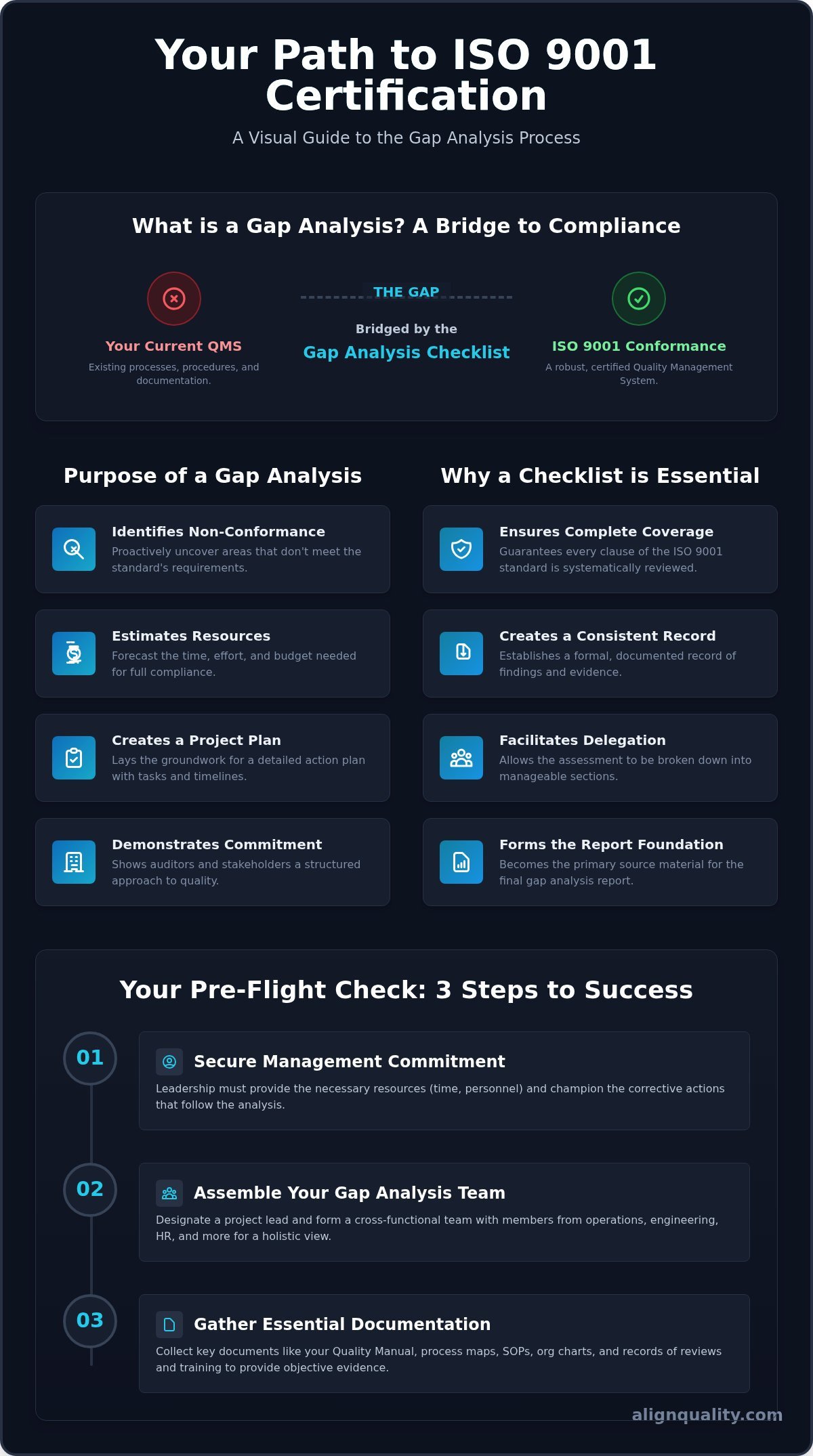
Embarking on the journey to ISO 9001 certification begins with a critical first step: a gap analysis. This methodical assessment is a comprehensive review that compares your current Quality Management System (QMS) against the stringent requirements of the standard. Think of it as creating a detailed roadmap for compliance. It precisely identifies your starting point (your existing processes) and your destination (full ISO 9001 conformance), clearly highlighting every gap that must be addressed to achieve certification with confidence.
The primary tool for conducting this evaluation is a comprehensive iso 9001 gap analysis checklist. This structured document ensures that no requirement is overlooked, providing the framework needed to systematically navigate the clauses within the ISO 9000 family of standards. It transforms a potentially overwhelming task into a manageable, data-driven process.
The Purpose of a Gap Analysis
A gap analysis provides the strategic insight necessary to plan your implementation project effectively. It serves several key functions:
- Identifies Non-Conformance: Proactively uncover areas where your QMS does not meet the standard’s requirements, long before the formal certification audit.
- Estimates Resources: Provides a clear baseline to accurately forecast the time, effort, and resources needed to achieve full compliance.
- Creates a Project Plan: Lays the groundwork for a detailed action plan, outlining specific tasks, responsibilities, and timelines for implementation.
- Demonstrates Commitment: Shows auditors, stakeholders, and management a serious commitment to quality and a structured approach to due diligence.
Why You Can’t Succeed Without a Checklist
While the analysis sets the strategy, the checklist provides the tactical precision required for execution. A robust iso 9001 gap analysis checklist is indispensable for several reasons:
- Ensures Complete Coverage: Guarantees that every clause and sub-clause of the ISO 9001 standard is systematically reviewed without omission.
- Creates a Consistent Record: Establishes a formal, documented record of findings, evidence, and observations for future reference and audit preparation.
- Facilitates Delegation: Allows you to break down the assessment into manageable sections that can be delegated to relevant team members or department heads.
- Forms the Report Foundation: The completed checklist becomes the primary source material for creating the final gap analysis report and your subsequent action plan.
Preparing for a Successful Gap Analysis: Your Pre-Flight Check
A successful ISO 9001 gap analysis does not begin with the first question on a checklist; it starts with meticulous preparation. This proactive approach, mirroring the methodology of certified auditors, is the foundation for an accurate and valuable assessment. By completing this pre-flight check, you minimize surprises, streamline the audit process, and ensure your team is positioned to achieve compliance with confidence.
Step 1: Secure Management Commitment
Before any analysis begins, securing commitment from top management is non-negotiable. Leadership must provide the necessary resources-primarily the time and availability of key personnel-to support the process. More importantly, their buy-in guarantees that the findings from the gap analysis will be taken seriously and that the required corrective actions will be championed and implemented across the organization.
Step 2: Assemble Your Gap Analysis Team
Designate a project lead, typically a Quality Manager or a similar role, to steer the initiative. The most effective teams are cross-functional, including members from operations, engineering, sales, and HR who can provide a holistic view of your processes. It is vital that this team has a foundational understanding of the requirements outlined in the ISO 9001 standard to interpret checklist questions correctly.
Step 3: Gather Essential Documentation
To effectively use the iso 9001 gap analysis checklist, your team needs ready access to all relevant documentation. Having these materials on hand prevents delays and provides the objective evidence needed to validate your current state. Key documents to collect include:
- Your existing Quality Manual, quality policy, and objectives.
- Process maps, flowcharts, standard operating procedures (SOPs), and work instructions.
- Organizational charts and relevant job descriptions.
- Records of management reviews, internal audits, and employee training.
- Documentation of customer feedback, complaints, and supplier evaluations.
The ISO 9001 Gap Analysis Checklist: A Clause-by-Clause Breakdown
A successful gap analysis systematically evaluates your current Quality Management System (QMS) against the requirements of the ISO 9001:2015 standard. This section provides a foundational, clause-by-clause framework for your iso 9001 gap analysis checklist. Use these key questions as a starting point to identify where your processes align with the standard and where gaps may exist, paving the way for a streamlined certification journey.
Clause 4: Context of the Organization
This clause requires you to define your organization’s purpose and strategic direction, considering internal and external factors that can impact your QMS.
- Have we identified all internal and external issues relevant to our QMS?
- Have we determined all interested parties and their requirements?
- Is the scope of our QMS clearly defined and documented?
Clause 5: Leadership
Effective leadership is critical for a successful QMS. This clause focuses on top management’s commitment, the establishment of a quality policy, and the clear definition of roles.
- Does top management demonstrate leadership and commitment to the QMS?
- Is there a documented Quality Policy that is communicated and understood?
- Are roles, responsibilities, and authorities defined and communicated?
Clause 6: Planning
Here, the standard addresses how you proactively plan for risks, opportunities, quality objectives, and changes within the QMS to achieve intended outcomes.
- Have we identified risks and opportunities and planned actions to address them?
- Are there measurable quality objectives established at relevant functions?
- Is there a process for planning and implementing changes to the QMS?
Clause 7 & 8: Support & Operation
These clauses cover the essential resources needed for the QMS and the core operational processes required for delivering products and services that meet customer requirements.
- Are sufficient resources (people, infrastructure, environment) provided?
- Is there a process for ensuring personnel are competent and aware?
- How is documented information controlled (created, updated, distributed)?
- Are processes in place for production, design, and service delivery?
Clause 9 & 10: Performance Evaluation & Improvement
The final clauses focus on monitoring QMS performance and driving continual improvement. This is achieved through structured measurement, internal audits, management reviews, and corrective actions.
- How do we monitor, measure, analyze, and evaluate our QMS performance?
- Is a formal internal audit program established and implemented?
- Are management reviews conducted at planned intervals?
- Is there a process for managing nonconformities and corrective actions?
This overview forms the basis of a comprehensive assessment. To streamline your compliance journey and ensure no requirement is overlooked, we have developed a detailed, editable template.
Download the complete ISO 9001 Gap Analysis Checklist template here.
From Checklist to Action: How to Interpret and Use Your Findings
Completing your iso 9001 gap analysis checklist is a critical data-gathering exercise, but its true value is unlocked in the next phase. This is where you shift from collecting information to making sense of it, transforming your raw findings into a strategic roadmap for compliance. This crucial step bridges the gap between analysis and effective implementation, and it is where expert interpretation adds significant, lasting value to your certification journey.
Scoring and Documenting Evidence
A systematic approach ensures clarity and objectivity. Use a simple scoring system for each clause, such as Compliant, Partially Compliant, or Not Compliant. Most importantly, every finding must be supported by objective evidence, not opinion. For each requirement reviewed, meticulously document:
- The specific ISO 9001 clause number
- The requirement being assessed
- Your detailed finding (the “gap”)
- The concrete evidence observed (e.g., document name, record, or process witnessed)
Creating the Gap Analysis Report
Your documented findings should be compiled into a formal Gap Analysis Report. This professional document provides a clear, comprehensive overview for all stakeholders. A well-structured report includes an executive summary for management, highlighting key risks and overall compliance levels. It should also feature a detailed breakdown of findings for each ISO 9001 clause, often visualized with charts to quickly communicate areas of strength and weakness, and conclude with high-level recommendations for next steps.
Prioritizing Actions and Creating a Project Plan
With a clear report, you can build an actionable project plan. Not all gaps carry the same weight; they must be prioritized based on their potential risk and impact on the business, quality, and customer satisfaction. This prioritization forms the basis of your project plan, which should assign specific tasks, designate responsible owners, and set realistic deadlines. This plan becomes the definitive roadmap that guides your organization toward closing all identified gaps and achieving ISO 9001 certification with confidence. Need help turning your findings from the iso 9001 gap analysis checklist into a workable plan? Talk to our experts.
From Checklist to Compliance: Your Next Steps
Completing a thorough gap analysis is the foundational first step on your path to ISO 9001 certification. As we’ve detailed, this process is far more than a simple check-the-box exercise; it’s a strategic assessment that provides the essential roadmap for your quality management system. Using a comprehensive iso 9001 gap analysis checklist ensures no requirement is overlooked, and translating those findings into a clear action plan is where true progress begins.
Interpreting these results and building a robust implementation strategy can be complex, but you do not have to navigate this journey alone. Our team of certified ISO 9001 lead auditors leverages multi-industry experience and a proven 5-stage process to guarantee certification success. We develop tailored quality solutions that transform your gap analysis findings into a streamlined path to compliance.
Take the next step with confidence. Book a free consultation to discuss your gap analysis results with an ISO 9001 expert. Your goal of certification is within reach.
Frequently Asked Questions About ISO 9001 Gap Analysis
How long does an ISO 9001 gap analysis typically take?
The duration of a gap analysis depends on your company’s size, complexity, and the current state of your Quality Management System (QMS). For a small to medium-sized business, the process can often be completed within one to five days. Larger organizations with multiple sites or more intricate processes may require one to two weeks. The timeline is primarily influenced by the number of processes to review and the availability of key personnel and documentation.
Can our company perform a gap analysis ourselves, or do we need a consultant?
While an internal analysis is possible, engaging an experienced ISO 9001 consultant provides an objective, unbiased perspective that internal teams may lack. A specialist can more effectively identify non-conformities and interpret the standard’s requirements, ensuring a thorough review. This expert guidance streamlines your certification journey, builds a more robust QMS, and helps you move forward with confidence, saving significant time and resources in the long run. For educational institutions, you can discover Keelson Consulting to learn how they apply specialized diagnostics to the hidden systems that drive school performance.
What is the difference between an ISO 9001 gap analysis and an internal audit?
A gap analysis is a preliminary, high-level review performed before a QMS is fully implemented. Its goal is to identify what is missing to meet the standard. In contrast, an internal audit is a systematic, ongoing process conducted after the QMS is operational. It verifies that the system is functioning as intended and remains compliant. The gap analysis is the starting point for building your system; internal audits are for maintaining it.
What are the most common gaps or non-conformities found during an analysis?
Common gaps often involve inadequate documentation, a lack of clearly defined quality objectives, and insufficient management review records. Other frequent findings include a poorly defined scope for the QMS and an inconsistent application of risk-based thinking. Using a detailed ISO 9001 gap analysis checklist ensures these common problem areas are systematically identified and addressed before you proceed toward implementation and the formal certification audit.
Our business is small. Do we still need to check every clause in the standard?
Yes, all applicable clauses of the ISO 9001 standard must be addressed, regardless of company size. However, the standard is scalable. This means the implementation of each clause can be tailored to fit your business. For a small company, this might involve simpler documentation and less complex processes compared to a large corporation. The goal is to demonstrate that your QMS meets the intent of every relevant clause in a way that is appropriate for your specific operations.
What happens after we complete the gap analysis and create an action plan?
Your action plan is the roadmap for implementing your QMS. The next phase involves systematically closing each identified gap. This includes developing required documentation, refining processes, training employees, and implementing any new procedures. Once these actions are complete and the QMS is operational, you will conduct internal audits and a management review. This methodical approach ensures your organization is fully prepared to confidently proceed with the formal certification audit.