With the 2026 revision of ISO 9001 on the horizon, a pivotal question resonates with quality managers worldwide: How will AI impact ISO 9001:2026? For many organizations, the integration of artificial intelligence brings understandable concerns—from the potential obsolescence of existing QMS frameworks to the complexities of auditing AI-driven processes. The perceived complexity and cost of this transition, coupled with the imperative to adapt, can make the path forward seem daunting.
To support this crucial upskilling, organizations can turn to specialized training providers. For example, the Grow Skills Store offers a range of professional courses on ISO standards to help teams prepare for these new technological shifts.
This Align Quality guide is designed to navigate that complexity with confidence. We will provide a clear, strategic overview of the expected changes, demystifying how AI will fundamentally reshape the standard. You will discover practical applications for enhancing your quality management system, understand the evolving landscape of risk management, and gain an actionable plan to prepare your organization for a seamless transition. Consider this your essential roadmap to the future of quality management.
Key Takeaways
- The upcoming ISO 9001:2026 revision moves beyond static checklists, embracing AI to create proactive and predictive Quality Management Systems.
- Learn how AI can automate core QMS processes like corrective actions, document control, and risk assessment to improve efficiency and accuracy.
- Understand how AI impacts ISO 9001:2026 by transforming the audit process from periodic snapshots into a system of continuous monitoring and assurance.
- Discover a strategic roadmap to prepare for the 2026 revision, positioning your business to leverage AI for a competitive advantage, not just compliance.
The Driving Forces: Why ISO 9001:2026 is Embracing AI and Digitalization
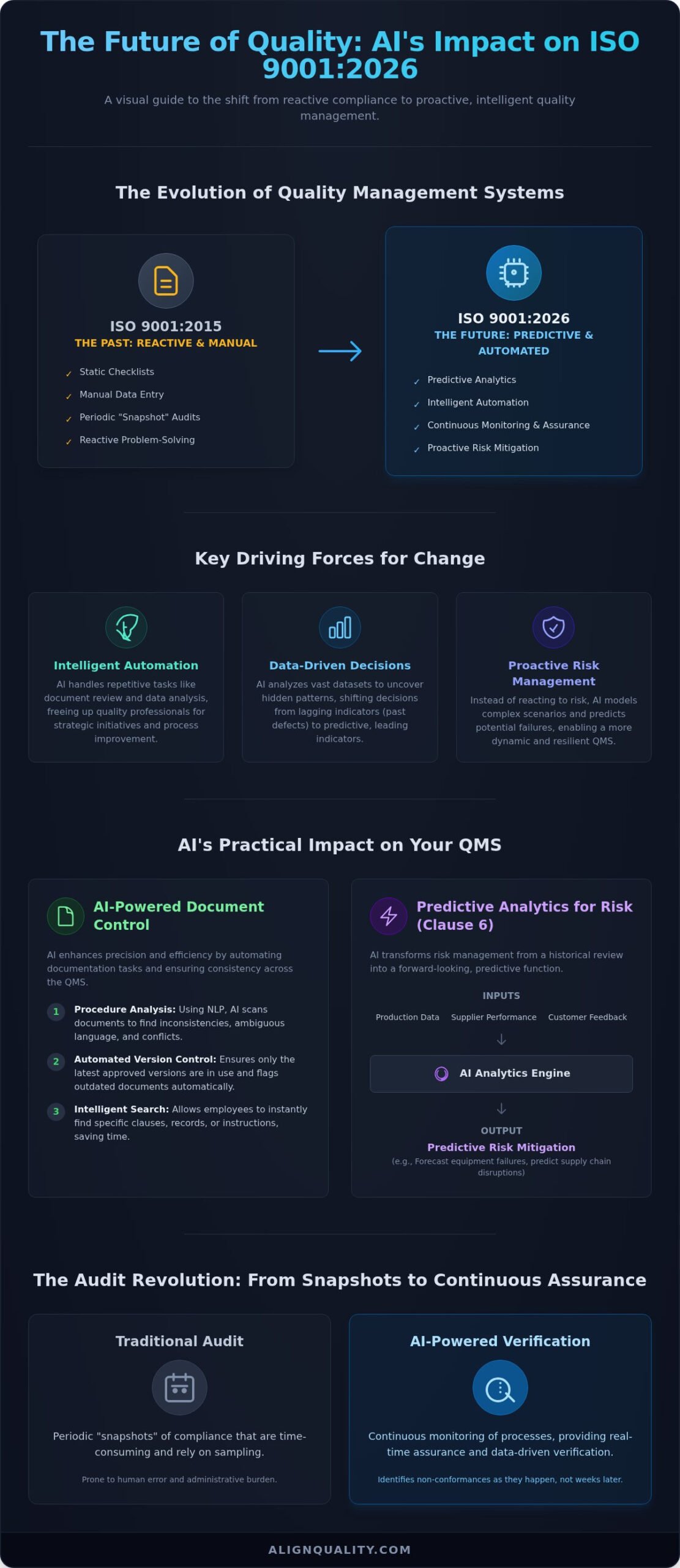
The last major revision of ISO 9001 occurred in 2015, a time when artificial intelligence was more of a future concept than a daily business tool. Today, the technological landscape is fundamentally different. The upcoming 2026 revision is set to be a significant evolution, driven by the necessity to integrate AI and digitalization into the core of quality management. This change reflects a critical shift from reactive, checklist-based compliance to proactive, intelligent quality systems. Organizations now operate in an environment saturated with data, where AI is no longer an option but a reality for maintaining a competitive edge. Understanding how AI impacts ISO 9001:2026 is essential for preparing your organization for the future of quality and compliance.
From Manual Processes to Intelligent Automation
Traditional approaches to a Quality Management System (QMS) often relied on manual data entry, paper-based documentation, and time-consuming internal audits. These methods are prone to human error and create administrative burdens. AI-powered tools introduce intelligent automation, capable of handling repetitive tasks like document review, non-conformance logging, and data analysis with superior speed and accuracy. This transition frees your quality professionals from routine work, allowing them to focus on strategic initiatives such as process improvement, risk analysis, and enhancing customer satisfaction.
The Mandate for Data-Driven Decision-Making
ISO 9001 has always emphasized the importance of evidence-based decisions. However, the sheer volume and velocity of data generated by modern businesses can overwhelm traditional analytical methods. AI provides the capability to process and analyze vast datasets, uncovering patterns, correlations, and insights that would otherwise remain hidden. This empowers organizations to move beyond lagging indicators (like defect rates from last quarter) to predictive, leading indicators (such as identifying production variables likely to cause future defects). This deeper analytical power makes decision-making more precise, timely, and impactful.
Managing Modern Complexity with Proactive Risk Management
Global supply chains, interconnected digital systems, and evolving customer expectations introduce new and complex risks. The principle of risk-based thinking, central to ISO 9001:2015, is amplified by AI’s ability to model complex scenarios and predict potential failures. Instead of simply reacting to risks as they arise, AI enables a more dynamic and proactive approach. The 2026 standard will almost certainly expect organizations to leverage digital tools for more sophisticated risk assessments, reflecting the need for enhanced digital governance and operational resilience in a complex world. This governance extends to all digital assets, including ensuring website accessibility with support from experts like Helplee.
AI’s Practical Impact Across Your Quality Management System (QMS)
Understanding how AI impacts ISO 9001:2026 requires moving beyond theoretical discussions to see its tangible applications. Artificial Intelligence will not replace the core principles of quality management; instead, it will serve as a powerful tool to enhance precision, efficiency, and foresight across every clause of the standard. Below, we explore practical ways AI can be integrated into your existing QMS processes to drive compliance and performance.
AI-Powered Document Control and Information Management
A well-maintained QMS relies on accurate and accessible documentation. AI streamlines this critical function by automating complex tasks and ensuring consistency. Key applications include:
- Procedure Analysis: Using Natural Language Processing (NLP), AI can scan quality manuals and procedures to identify inconsistencies, ambiguous language, or conflicts between documents.
- Automated Version Control: AI tools can manage document revisions, ensuring that only the latest approved versions are in use and automatically flagging documents that no longer align with updated ISO 9001 requirements.
- Intelligent Search: Employees can use smart search functions to instantly find specific clauses, records, or work instructions, dramatically reducing time spent searching for information during operations or audits.
Predictive Analytics for Risk-Based Thinking (Clause 6)
Clause 6 of ISO 9001 emphasizes a proactive approach to risk, a principle where AI offers transformative capabilities. Instead of relying solely on historical analysis, AI algorithms can process vast datasets from production lines, supplier performance, and customer feedback to identify subtle patterns that signal potential risks. This allows organizations to move from reactive problem-solving to predictive risk mitigation. For instance, AI can forecast equipment failure before it leads to a non-conformity or analyze supplier data to predict potential disruptions. Implementing such powerful tools requires a structured approach, as outlined in frameworks like the NIST AI Risk Management Framework, to ensure responsible and effective deployment.
Enhancing Corrective Actions and Continuous Improvement (Clause 10)
Continuous improvement is the cornerstone of ISO 9001, and AI accelerates this cycle significantly. When a non-conformance occurs, AI tools can perform a rapid and deep root cause analysis, sifting through complex operational data to pinpoint the origin of the issue far more quickly than manual methods. Furthermore, by analyzing historical data on past corrective actions, AI can suggest the most effective solutions based on their previous success rates, ensuring that your improvement efforts are both targeted and impactful. For a deeper dive, read our guide on handling ISO 9001 nonconformance.
Revolutionizing the Audit: AI’s Role in Verification and Compliance
The internal and external audit process, a cornerstone of ISO 9001, is one of the areas most ripe for AI-driven transformation. Traditional audits provide a point-in-time snapshot of compliance, often relying on manual sampling and review. As we look ahead, understanding how AI impacts ISO 9001:2026 means recognizing a fundamental shift from periodic checks to continuous assurance, enhancing both the efficiency and effectiveness of verification.
Continuous Auditing: The End of the Annual Scramble
Instead of a frantic preparation for an annual audit, imagine a system that offers constant vigilance. AI-powered tools can be integrated directly into your Quality Management System (QMS) to monitor processes in real-time. These systems can automatically flag deviations from standard operating procedures the moment they occur, turning the audit from a periodic event into an ongoing, manageable process of verification. This proactive approach allows for immediate corrective action, fostering a culture of sustained compliance.
Automated Evidence Gathering and Analysis
A key limitation of manual audits is the reliance on sampling. An auditor can only review a small subset of records or transactions. AI eliminates this constraint by enabling the analysis of 100% of the relevant data. By processing vast datasets, AI algorithms can identify subtle patterns, trends, and anomalies that a human auditor might easily miss. This leads to more thorough, objective, and data-driven audit findings, significantly increasing confidence in the QMS’s integrity.
The Evolving Role of the Human Auditor
AI does not make the human auditor obsolete; it makes them more strategic. Freed from the repetitive task of manual data checking, auditors can dedicate their expertise to higher-value activities. Their focus will shift to interpreting complex findings, assessing risks, and evaluating the effectiveness of the AI models themselves. This is a core aspect of how AI impacts ISO 9001:2026. Ensuring proper governance and safeguards for these systems, a point emphasized in a recent U.S. Government Accountability Office report on AI, will become a critical audit function. The auditor’s judgment and experience become more valuable than ever. Master the fundamentals with our complete guide to the ISO audit.
Preparing for ISO 9001:2026: A Strategic Roadmap for Leaders
The upcoming revision of ISO 9001 is not a compliance burden but a strategic opportunity. Understanding how AI impacts ISO 9001:2026 is the key to building a more resilient and efficient quality management system (QMS). By embracing this technology, you can transform quality into a competitive advantage. This methodical, four-step roadmap will help you prepare your organization with confidence.
Step 1: Conduct a Digital Maturity and Gap Analysis
Before integrating new technology, you must understand your starting point. Assess your current digital infrastructure, data management practices, and overall system maturity. The goal is to identify the specific gaps between your current state and an AI-ready QMS. A structured assessment is critical; our ultimate ISO 9001 gap analysis checklist provides a proven framework for this essential first step.
Step 2: Upskill Your Team and Foster a Data-First Culture
Technology is only as effective as the people who use it. Your team is your most important asset in this transition. Invest in training on data literacy, basic analytics, and AI fundamentals to empower your employees. This fosters a data-first culture where decisions are based on objective evidence, not intuition-a core principle of quality management that AI will significantly enhance.
Step 3: Develop AI Governance and Ethical Guidelines
Implementing AI without clear rules creates significant risk. Establish robust governance policies that define the ethical use of AI within your QMS. Address critical areas such as:
- Data privacy and security
- Algorithm transparency and bias
- Accountability for AI-driven decisions
Documenting these controls is not just good practice; it will be essential for demonstrating effective risk management to an ISO 9001 auditor.
Step 4: Start Small with Pilot Projects
Avoid the risk of a large-scale, system-wide implementation. Instead, select a single, well-defined process for an AI pilot project. For example, you could use a machine learning model to predict non-conformances or automate the root cause analysis of corrective actions. This allows you to learn, refine your approach, and demonstrate value before scaling AI integration across your entire QMS.
This proactive approach ensures your organization is not just compliant, but positioned to lead. To discuss how to tailor this roadmap to your specific needs, contact our certified experts today.
Embracing the AI-Powered Future of ISO 9001
The upcoming ISO 9001:2026 revision represents a pivotal evolution in quality management, driven by the transformative power of artificial intelligence. As we’ve explored, AI is set to redefine everything from predictive risk assessment and process optimization to the very nature of compliance audits. Understanding how AI impacts ISO 9001:2026 is no longer optional-it is a strategic imperative for forward-thinking organizations. The key is to move from awareness to action with a clear and methodical plan.
Navigating this complex transition demands an expert partner. At Align Quality, our Certified ISO 9001 Lead Auditors utilize a proven 5-stage process and multi-industry expertise to streamline your journey to compliance. We provide the strategic clarity needed to integrate these changes effectively and confidently. Book a free consultation to discuss your ISO 9001:2026 transition strategy and let our team build your roadmap to success.
Embrace this technological shift and position your Quality Management System to lead in the next era of innovation.
Frequently Asked Questions
Will the ISO 9001:2026 standard explicitly require the use of AI?
It is highly unlikely that the 2026 revision will mandate the use of any specific technology, including AI. ISO 9001 is a principles-based standard focused on the ‘what’-effective quality management-not the ‘how’. Instead, the standard will expect organizations to manage risks and opportunities associated with new technologies. Understanding how AI impacts ISO 9001:2026 is about seeing it as a powerful tool to meet requirements more efficiently, not as a new requirement itself.
Will AI make the role of the quality manager obsolete?
No, the role of the quality manager will evolve, not disappear. AI will automate routine tasks like data analysis and monitoring, freeing professionals to focus on higher-value strategic activities. The quality manager’s role will shift towards interpreting AI-driven insights, managing complex system risks, and providing critical human oversight. Judgment, leadership, and strategic thinking will become more important than ever in this new landscape, ensuring the QMS remains effective and aligned with business goals.
Is implementing AI for ISO 9001 compliance only feasible for large corporations?
This is a common misconception. While large enterprises may develop bespoke AI systems, a growing number of scalable and affordable AI-powered tools are available for small and medium-sized businesses (SMEs). Cloud-based QMS platforms, for example, now integrate AI for tasks like root cause analysis and audit preparation. The key is not the size of your company, but the strategic selection of tools that fit your specific operational needs and budget, making AI accessible to all.
How can we audit an AI system, especially if it’s a ‘black box’?
Auditing a ‘black box’ AI system focuses on the governance framework surrounding it. The audit process must verify the quality and integrity of the input data, as this directly affects the output. It must also validate the system’s outputs against known benchmarks or manual checks to ensure accuracy and reliability. Furthermore, auditors will examine the documented procedures for managing the AI, including change control, access rights, and the protocol for handling and correcting algorithmic errors.
What are the biggest risks of integrating AI into a QMS?
The primary risks include data security vulnerabilities, algorithmic bias that can lead to skewed or non-compliant decisions, and over-reliance on the system without adequate human oversight. Another critical risk is a lack of in-house expertise to properly manage, validate, and maintain the AI, which could lead to systemic failures. A thorough risk assessment, as required by ISO 9001, is an essential first step before any AI integration into your Quality Management System.
What is the very first step our company should take to prepare?
The most crucial first step is to conduct an internal assessment. Begin by clearly identifying specific quality processes where AI could provide the most significant value, such as in analyzing non-conformance data or predicting equipment maintenance needs. Simultaneously, evaluate your team’s current digital literacy and technical capabilities. This foundational analysis ensures that any future AI adoption is strategic, targeted, and directly supports your quality objectives, preparing you for the future of quality management.