The path to ISO certification presents a critical decision for every business leader. You understand the value of certification, but the process itself can seem overwhelmingly complex. Should you invest in an external expert, or can your existing team successfully navigate the demands of a formal audit? This question often brings valid concerns about costs, internal expertise, and the risk of a failed attempt. The choice between engaging an ISO consultancy and empowering an in-house team is a pivotal one, with distinct implications for your resources, timeline, and the long-term health of your quality management system.
This guide is designed to remove that uncertainty. We provide a clear, head-to-head comparison to help you confidently weigh the pros and cons of each approach. You will gain a realistic understanding of the budget, skill sets, and time commitments involved. Our goal is to equip you with the clarity needed to select the right path for your company’s unique situation, ensuring you can begin your certification journey feeling secure and prepared for a successful outcome.
Key Takeaways
- Accurately assess your team’s existing knowledge and resources to determine if an in-house certification project is a realistic path for your business.
- Understand how an iso consultancy acts as a strategic partner, providing the expert guidance needed to streamline the certification journey and mitigate risk.
- Compare the two paths directly on critical factors like total cost, implementation speed, and long-term resource commitment to see the true trade-offs.
- Identify the right approach for your specific goals by matching your company’s timeline, budget, and risk tolerance to clear decision-making criteria.
What is an ISO Consultancy? Defining the Expert’s Role
Pursuing ISO 9001 certification is a significant commitment that signals a dedication to quality and customer satisfaction. However, navigating the requirements set by the International Organization for Standardization (ISO) can be a complex and resource-intensive journey. This is where an ISO consultancy provides critical value. More than just a service provider, a consultant acts as a strategic partner, offering expert guidance to streamline your path to compliance.
Their primary goal is to ensure your organization achieves certification efficiently and effectively. By leveraging a proven framework, they save you from the time-consuming process of interpreting standards and developing systems from scratch. As an objective third party, an expert from an iso consultancy can identify gaps in your processes and documentation that internal teams, who are often too close to the daily operations, might overlook. This expert oversight is fundamental to building a robust and sustainable Quality Management System (QMS).
Core Services Provided by an ISO Consultant
An effective consultant provides a structured approach to certification, typically encompassing several key stages. These services are designed to build a compliant QMS and prepare your team for the final audit with confidence.
- Initial Gap Analysis: A thorough assessment of your current processes and systems against the specific requirements of the ISO 9001 standard to identify non-conformities.
- QMS Development: Expert assistance in designing, developing, and implementing a tailored Quality Management System that aligns with both ISO standards and your business objectives.
- Documentation Support: Guidance in creating the necessary documentation, including the quality manual, policies, procedures, and records required for compliance.
- Internal Audit Training & Execution: Preparing your team to conduct internal audits or performing them on your behalf to ensure the QMS is functioning correctly before the official audit.
The Consultant vs. The Certification Body
It is crucial to understand the distinction between your consultant and the certification body. An ISO consultant prepares and guides you; they do not issue the final certificate. Their role is to ensure you are 100% ready for the official audit.
The final audit is conducted by an accredited, independent certification body (also known as a registrar). This separation of duties is a core principle of the certification process, ensuring impartiality and maintaining the credibility of the ISO standard. A reputable consultant works to make the registrar’s audit a formality, confirming that all requirements have been met successfully.
The In-House Approach: Assessing Your Internal Capabilities
Managing your ISO 9001 certification journey internally means dedicating your own team’s time and resources to the entire process. On the surface, this approach can seem like a direct path to cost savings by avoiding the fees associated with an iso consultancy. However, it requires a significant commitment to project management and a deep, nuanced understanding of the ISO 9001 standard. The success of this method hinges entirely on the pre-existing expertise and availability of your staff, a factor that introduces considerable risk.
Potential Benefits of an In-House Process
For organizations with the right internal resources, a DIY approach can offer distinct advantages. The primary benefits include:
- Lower Upfront Costs: The most apparent advantage is avoiding direct consultancy fees, making it an attractive option for businesses with tight budgets.
- Deeper Internal Knowledge: Your team develops a comprehensive, hands-on understanding of the Quality Management System (QMS) as they build it, fostering long-term ownership and engagement.
- Complete Control: You retain full authority over the project’s timeline, implementation details, and overall direction, aligning it precisely with internal priorities and company culture.
Common Risks and Challenges of the DIY Method
While the benefits are appealing, the in-house path presents significant challenges that can undermine the entire certification effort. Without the guidance of a dedicated expert, companies often underestimate the meticulous detail required for compliance, leading to common pitfalls:
- Lack of Expertise: ISO 9001 clauses are precise and open to misinterpretation. Understanding the nuances detailed in authoritative resources like NIST’s guide to ISO and Quality Management is essential, and a lack of familiarity can lead directly to a failed audit.
- Resource Drain: The project demands substantial time from your most capable staff, pulling them away from their core responsibilities and potentially impacting daily operations and revenue-generating activities.
- Slower Timeline: The internal learning curve for mastering the standard, developing documentation, and preparing for an audit almost always extends the certification timeline compared to an expert-led process.
- Risk of Non-Conformities: An internal team may develop blind spots or overlook critical gaps in the system that an external auditor will quickly identify, resulting in costly delays and rework.
The ISO Consultancy Approach: Leveraging External Expertise
Opting for an ISO consultancy means engaging a specialist to lead your certification project. This approach is designed for organizations seeking to achieve compliance with speed, certainty, and minimal disruption to their core operations. Instead of tasking an internal team with navigating the complexities of the standard, you partner with an expert who brings a proven, structured methodology. This transforms a potentially overwhelming project into a manageable, step-by-step process.
The investment in an iso consultancy is not just for guidance; it is an investment in expertise, efficiency, and the peace of mind that comes from knowing your certification journey is in capable hands.
Key Advantages of Partnering with a Consultant
Engaging an external expert provides distinct benefits that directly impact the success and timeline of your ISO 9001 implementation. These advantages are centered on leveraging specialized knowledge and an established framework for success.
- Guaranteed Expertise: Consultants are certified professionals who live and breathe the ISO 9001 standard. They possess an in-depth understanding of its clauses, audit requirements, and common pitfalls, ensuring your Quality Management System is fully compliant.
- Accelerated Timeline: A seasoned consultant utilizes a proven process refined over numerous successful certifications. This structured approach eliminates guesswork, streamlines implementation, and dramatically shortens the timeline from project start to final audit.
- Objective Perspective: An external expert provides an unbiased assessment of your current processes. They can identify inefficiencies, gaps, and non-conformities that an internal team, accustomed to existing workflows, might overlook.
- Higher Success Rate: With a specialist guiding the process, the risk of a failed certification audit is drastically reduced. Their role is to prepare your organization meticulously, ensuring you pass the first time with confidence.
Potential Considerations and How to Mitigate Them
While the benefits are significant, it is important to consider the practical aspects of this approach. The primary consideration is the direct financial investment required for consulting services. However, this cost must be weighed against the internal resource hours, potential delays, and risks of a failed audit associated with a purely in-house effort.
The success of the engagement also depends heavily on selecting the right partner. It is crucial to vet any potential iso consultancy for their track record, industry experience, and cultural fit with your team. A clear understanding of the return on investment can clarify the decision. Book a free consultation to understand the ROI for your business.
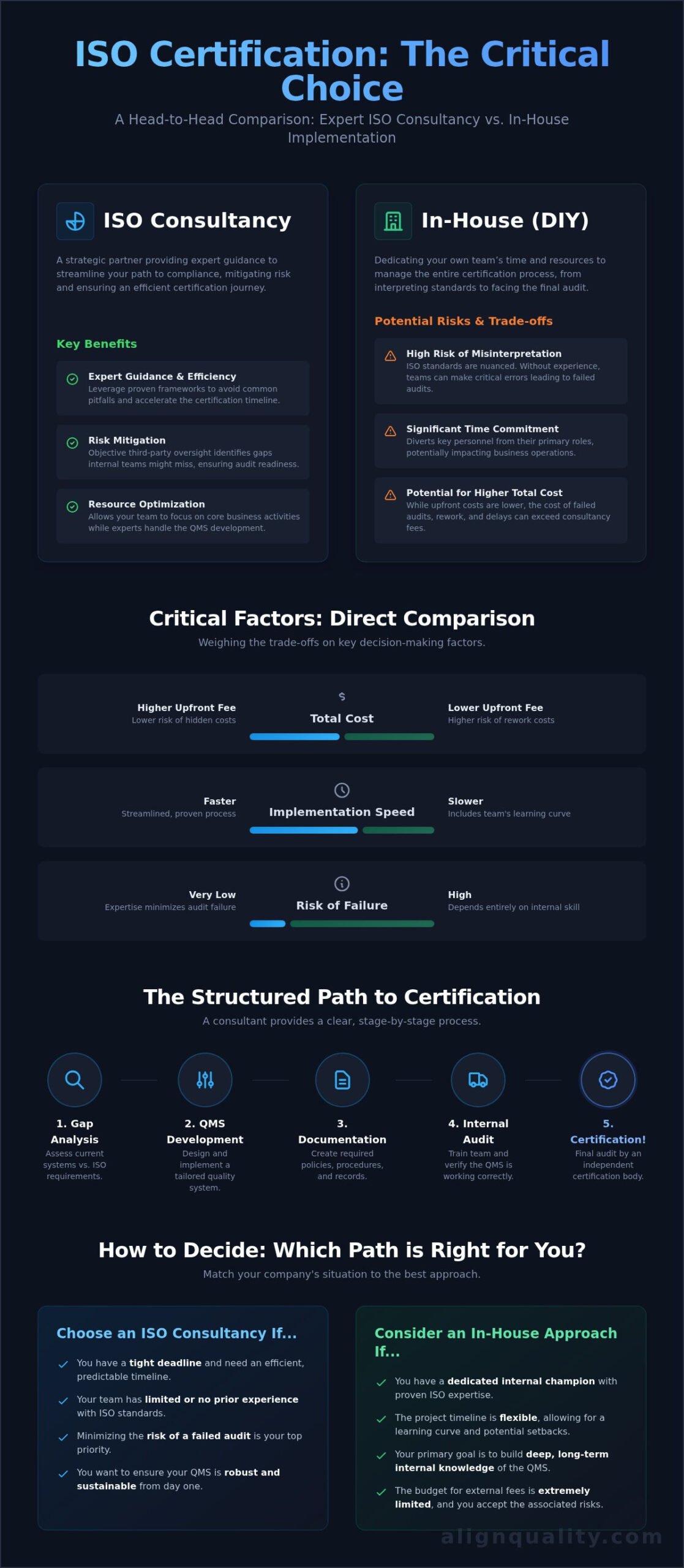
Head-to-Head Comparison: In-House vs. ISO Consultancy
Choosing the right path to ISO 9001 certification is a critical strategic decision. There is no single correct answer, only the one that best aligns with your company’s resources, timeline, and risk tolerance. Use the following head-to-head comparison as a checklist to evaluate your unique situation and make your decision with confidence.
Factor 1: Total Cost & ROI
An in-house approach appears less expensive initially, but hidden costs quickly accumulate. These include the salary of a dedicated Quality Manager, extensive training, and the significant opportunity cost of pulling key personnel away from their revenue-generating roles. A failed audit adds further expense and delay. In contrast, an iso consultancy involves a clear upfront investment that often delivers a faster ROI through a streamlined process, error avoidance, and quicker access to contracts requiring certification.
Factor 2: Time to Certification
Time is a resource you cannot recover. An internal team navigating the complexities of ISO 9001 for the first time typically requires 12 to 18 months to achieve certification due to learning curves and competing internal priorities. A consultant, leveraging a proven and structured methodology, can often streamline this journey to just 4 to 6 months. This accelerated timeline means you can begin leveraging your certification to win new business and improve operations much sooner.
Factor 3: Expertise & Risk of Failure
The greatest risk in an in-house project is a lack of specialized experience. Misinterpreting a clause or overlooking a documentation requirement can lead to a failed audit, wasting months of effort. Professional consultants have guided hundreds of companies through this process. They understand common pitfalls, know precisely what auditors look for, and can navigate complex requirements efficiently, often providing a certification guarantee that significantly de-risks the entire project.
Factor 4: Internal Resource Allocation
Implementing ISO 9001 in-house is a substantial commitment that demands significant time from your most valuable people. It requires a dedicated project manager and pulls team members away from their core responsibilities, which can disrupt operations. Engaging an expert iso consultancy minimizes this disruption. The consultant manages the project, provides clear guidance, and performs the heavy lifting, allowing your team to remain focused on driving your business forward.
By carefully weighing these factors, you can determine the most effective and efficient path for your organization. To see how a guided approach can streamline your certification journey, learn more about our proven process.
How to Decide: Which Path is Right for Your Business?
The final decision rests on a clear-eyed assessment of your company’s internal resources, strategic timeline, and tolerance for risk. To make a confident choice, you must be honest about your team’s capabilities and priorities. Remember, the goal is not merely to hang a certificate on the wall, but to implement a quality management system (QMS) that delivers tangible, lasting value to your operations.
These scenarios are designed to help you determine the most effective path forward for your organization.
An In-House Approach Might Work If…
Managing the certification journey internally can be a successful strategy under specific circumstances. This path is most viable if your organization can genuinely affirm the following:
- You have a team member with prior, successful ISO 9001 implementation experience.
- Your timeline for certification is flexible and not driven by an urgent client or contractual deadline.
- You have the internal capacity to dedicate a project manager to the implementation process full-time without disrupting core operations.
- The scope of your QMS is relatively small and straightforward, with few complex processes.
Hiring an ISO Consultancy is Recommended If…
For most businesses, partnering with a specialist provides the most direct and reliable path to certification. Engaging an expert iso consultancy is the clear choice when your situation involves:
- You need to achieve certification quickly to qualify for a tender or secure a critical contract.
- You want a guaranteed, successful outcome without the costly risks of trial and error.
- Your internal team is already at full capacity managing their primary duties and cannot take on a major project.
- You want to build a truly efficient QMS that streamlines operations, not just one that ticks a compliance box.
The Align Quality Advantage
At Align Quality, we provide the clarity and expertise needed to make your certification journey a success. Our approach is built on a foundation of proven methodology and tailored support, ensuring your QMS adds real value long after the audit is complete.
- Our 5-Stage Process removes guesswork and provides a clear, structured path from gap analysis to certification.
- We are Certified Lead Auditors who understand the standard inside and out, guiding you with confidence and precision.
- We tailor the solution to fit your unique business, ensuring your QMS becomes a tool for improvement, not a burden.
If you’re ready to achieve compliance efficiently and build a stronger business, we are here to guide you. Get your free, no-obligation quote today.
Chart Your Course to Certification with Confidence
The decision between developing an in-house team and engaging an external partner is a critical one on your path to ISO certification. While an internal team offers familiarity with your operations, it often requires significant investment in training and resources. For many organizations, partnering with a professional iso consultancy provides the structured guidance and expert resources necessary to navigate compliance efficiently. This approach leverages specialized knowledge to avoid common pitfalls and accelerate your timeline to success, ensuring a robust and sustainable Quality Management System.
Ultimately, a strong QMS supports the core pillars of business success: customer satisfaction and brand trust. For businesses looking to translate their new quality standards into a stronger market position, consulting firms like Human Instinct offer data-driven insights to refresh brand identity and improve customer engagement.
At Align Quality, our team of Certified ISO 9001 Lead Auditors utilizes a proven 5-Stage Certification Process to guide businesses with multi-industry experience. We provide the clarity and structure needed to achieve your goals without the strain on your internal teams. Ready to take the next step? Book Your Free Consultation to Plan Your Certification Journey and let our expertise simplify your path to compliance.
Frequently Asked Questions About ISO 9001 Consultation
What is the average cost of hiring an ISO 9001 consultancy?
The cost of an ISO 9001 consultant varies based on your company’s size, complexity, and the current state of your quality management system. For a small business, a project might typically range from a few thousand to several thousand, while larger organizations could see costs extending into the tens of thousands or more, depending on the scope. A professional consultancy will provide a detailed, fixed-price proposal after conducting an initial gap analysis to understand the specific scope of work required to achieve certification.
Can we use a hybrid approach, doing some work in-house and some with a consultant?
Absolutely. A hybrid model is a highly effective and common approach. In this partnership, your internal team can manage day-to-day implementation tasks while the consultant provides expert guidance, strategic oversight, and critical support for complex areas like risk assessment and internal audits. This collaborative method ensures knowledge is transferred to your team, building long-term capability while streamlining the certification journey and ensuring a successful outcome.
How much time will my team still need to commit, even with a consultant?
While a consultant significantly reduces the burden, your team’s involvement is crucial for success. Key personnel should expect to commit several hours per week for activities like process mapping workshops, documentation review, and implementing new procedures. Your designated quality manager or project lead will have a more substantial time commitment. This active participation ensures the resulting Quality Management System is practical and truly embedded within your organization’s operations.
Does a consultant guarantee we will pass the ISO 9001 audit?
No consultant can ethically guarantee certification, as the final decision is made by an independent certification body. However, a reputable firm guarantees that your Quality Management System will be fully compliant with the ISO 9001 standard and ready for the audit. Experienced consultants have a proven track record of success and will support you through the audit process, giving you the highest possible probability of passing on the first attempt.
What should I look for when choosing an ISO consultancy firm?
When selecting an ISO consultancy firm, look for evidence of proven success. Key criteria include experience in your specific industry, certified ISO 9001 Lead Auditors on their team, and transparent client testimonials. A professional firm will present a clear, structured methodology, such as a multi-stage implementation process. Ensure they provide a detailed proposal with clear deliverables and fixed costs, allowing you to partner with them with complete confidence.
Is ISO consultancy only for large corporations, or can small businesses benefit?
ISO 9001 certification offers significant benefits to businesses of all sizes. For small and medium-sized enterprises (SMEs), it enhances credibility, improves operational efficiency, and can open doors to new contracts that require certification. A consultant makes the process accessible and affordable by providing the dedicated expertise that a smaller business may not have in-house. This ensures a streamlined and cost-effective journey to compliance and continuous improvement.