The prospect of a certification audit can be a source of significant anxiety. For businesses pursuing an ISO 9001 or related compliance standard, the process can seem complex, the requirements exacting, and the fear of failure is very real. These concerns often stem from a single point of uncertainty: not knowing what the auditor is truly looking for. But at the heart of this process is a key professional whose role, when understood, can transform apprehension into preparedness: the ISO 9001 Lead Auditor.
This article provides the clarity you need to approach your audit with confidence. We will explain precisely what a Lead Auditor does, how their function differs from that of a consultant, and what they are trained to assess within your Quality Management System. By demystifying their role, you will gain a clear understanding of the audit from start to finish, allowing you to streamline your preparation and successfully complete your certification journey on the first attempt.
First, What Is ISO 9001? A Foundation for Understanding the Auditor’s Role
To understand the role of a lead auditor, we must first establish a clear definition of ISO 9001. At its core, ISO 9001 is the world’s most recognized international standard for a Quality Management System (QMS). It provides a structured framework that organizations use to ensure their products and services consistently meet customer and regulatory requirements, enhancing overall satisfaction.
As the flagship standard within the comprehensive ISO 9000 family of standards, it sets out the criteria for a systematic approach to managing quality. A critical point to understand is that the ISO 9001 standard is not a product certification; it is a process certification. It evaluates how your business operates, ensuring your processes are robust, repeatable, and geared towards continual improvement and customer focus.
The ‘Why’ Behind the Standard: Key Business Benefits
Implementing a QMS is not merely a compliance exercise; it is a strategic business decision that delivers tangible results. Achieving certification signals a commitment to excellence and unlocks significant operational advantages, including:
- Increased Operational Efficiency: Streamlines processes, identifies and eliminates waste, and reduces costly errors, leading to improved productivity.
- Enhanced Customer Satisfaction: Consistently meeting customer needs builds trust, fosters loyalty, and strengthens your brand reputation.
- Improved Market Access: ISO 9001 certification is often a prerequisite for tenders and contracts, opening doors to new domestic and international markets.
- Fosters a Culture of Continual Improvement: Embeds a proactive mindset where employees are engaged in systematically improving processes and outcomes.
ISO 9001’s 7 Quality Management Principles in Plain English
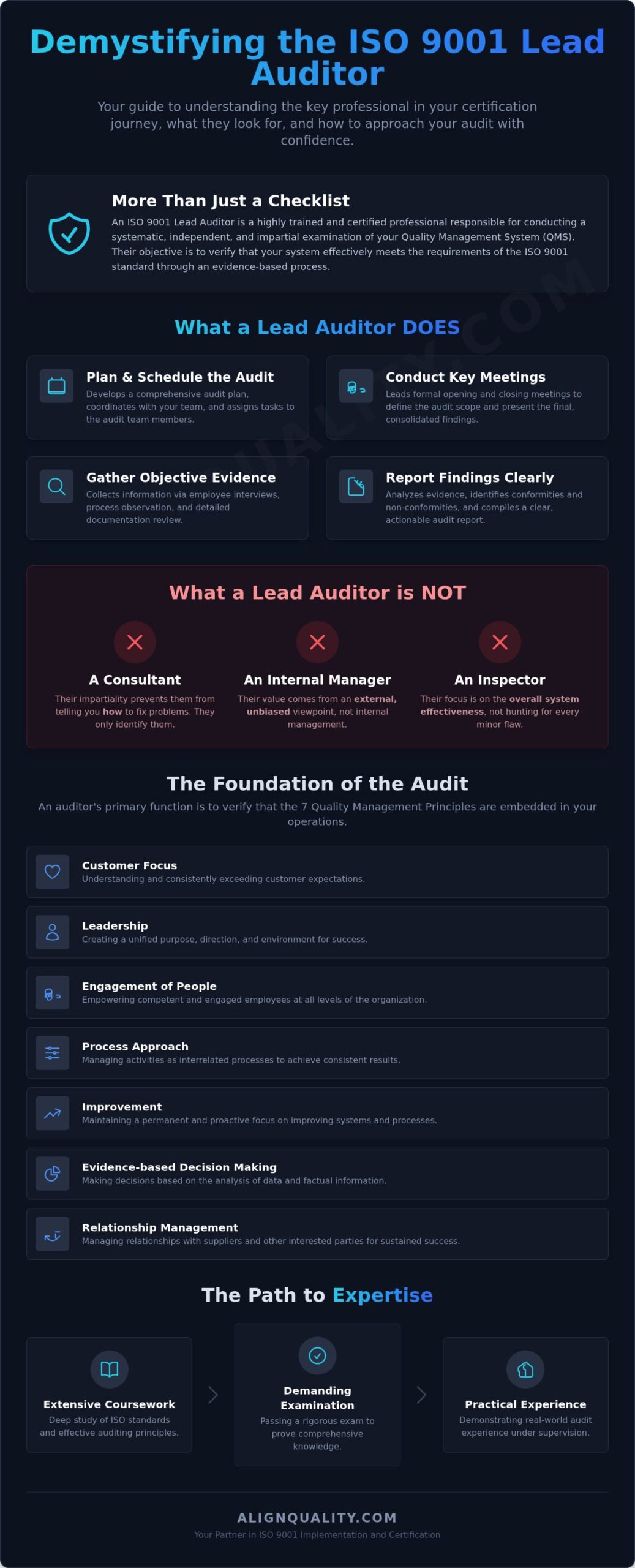
The standard is built upon seven fundamental quality management principles. These are not complex rules but the common-sense foundation for any well-run, customer-centric business. An ISO 9001 Lead Auditor’s primary function is to verify that these principles are embedded in your organization’s daily operations.
- Customer Focus: Understanding and consistently exceeding customer expectations.
- Leadership: Creating a unified purpose and direction for the organization.
- Process Approach: Managing activities as interrelated processes to achieve consistent results.
- Improvement: Maintaining a permanent focus on improving systems and processes.
- Evidence-based Decision Making: Making decisions based on the analysis of data and information.
- Relationship Management: Managing relationships with interested parties, such as suppliers, for sustained success.
For expert guidance on ISO 9001 implementation and certification, visit Align Quality.
Defining the ISO 9001 Lead Auditor: More Than Just a Checklist
An ISO 9001 Lead Auditor is far more than a compliance officer with a clipboard. They are a highly trained and certified professional responsible for conducting a systematic and independent examination of your Quality Management System (QMS). Their primary objective is not to find fault or ‘catch’ employees making mistakes, but to objectively verify that your system effectively meets the requirements of the ISO 9001 standard. This process is entirely impartial and evidence-based, culminating in a formal audit report that provides a clear picture of your system’s health.
Key Responsibilities of a Lead Auditor
The Lead Auditor manages the entire audit process from start to finish. Their role is structured and methodical, ensuring a thorough and fair assessment. Core duties include:
- Planning and Scheduling: Developing a comprehensive audit plan, coordinating with the client, and assigning tasks to the audit team.
- Conducting Meetings: Leading the formal opening and closing meetings with management to outline the audit scope and present the final findings.
- Gathering Objective Evidence: Systematically collecting information through employee interviews, direct observation of processes, and detailed review of documentation.
- Reporting Findings: Analyzing the evidence to identify areas of conformity and any non-conformities, then compiling these into a clear, actionable final audit report.
What They Are Not: Clearing Up Common Misconceptions
To fully appreciate their role, it is essential to understand what an ISO 9001 Lead Auditor is not. They are not consultants paid to provide solutions; their impartiality prevents them from telling you how to fix a problem. They are not your internal quality manager; their value comes from an external, unbiased viewpoint. Finally, they are not inspectors searching for every minor flaw; their focus is on the overall effectiveness and conformity of the management system as a whole, a core principle of 9001.
The Path to Becoming a Lead Auditor
The authority of a Lead Auditor is built on a foundation of rigorous training and proven experience. Becoming certified involves extensive coursework, passing a demanding examination, and demonstrating practical audit experience. This requires a deep understanding of complex ISO 9001 quality management systems and the principles of effective auditing that are central to 9001 certification. This commitment to expertise is why firms like Align Quality exclusively employ certified professionals, ensuring your audit journey is managed with the highest level of competence and confidence.
The Lead Auditor’s Role Throughout the Certification Journey
Achieving ISO 9001 certification is not a single event but a structured journey toward operational excellence. Throughout this official process, the Lead Auditor from your chosen certification body acts as an impartial and expert guide. Their role is to objectively assess your Quality Management System (QMS) against the standard’s rigorous requirements at several key stages. Before embarking, it’s vital to understand the standard’s core principles, as detailed by authoritative sources like the ASQ in their overview, What Is ISO 9001? This multi-stage audit process ensures that certification is both thorough and credible.
Stage 1 Audit: The Documentation Review
The first formal interaction with your Lead Auditor is the Stage 1 Audit. This is primarily a desktop review where the auditor meticulously examines your QMS documentation-such as your quality manual, procedures, and policies. The objective is to verify that your system is designed for compliance and is ready for a full assessment. The auditor will identify any major gaps or areas of concern that must be addressed before proceeding, ensuring your foundation for quality is sound before the on-site o 9001 audit.
Stage 2 Audit: The On-Site Assessment
During the Stage 2 Audit, the Lead Auditor moves from documentation to practical application. This on-site assessment is where the auditor verifies that your QMS is fully implemented and effective in day-to-day operations. The process involves:
- Interviewing staff at all levels to confirm their understanding of processes and quality objectives.
- Observing work activities to see procedures being followed in practice.
- Reviewing records, such as inspection reports and training logs, as evidence of compliance.
The outcome of this comprehensive evaluation determines whether the Lead Auditor will recommend your organization for ISO 9001 certification.
Surveillance and Recertification Audits: Maintaining Your Standard
Earning your ISO 9001 certificate is a significant achievement, but the journey continues. The Lead Auditor remains a key figure in ensuring your QMS is maintained and continually improved over a three-year cycle.
- Surveillance Audits: These are typically conducted annually to confirm ongoing compliance. The auditor samples different parts of your QMS to ensure it remains effective and that you are addressing any opportunities for improvement.
- Recertification Audits: Every three years, a full recertification audit is performed. This is a comprehensive reassessment of your entire QMS, similar to the initial Stage 2 audit, to renew your certification for another cycle.
How a Consultant with Lead Auditor Skills Prepares You for Success
Understanding an auditor’s responsibilities is the first step. The next is ensuring your organization is fully prepared to meet their scrutiny. This is where the strategic advantage of partnering with a consultant who is also a certified ISO 9001 Lead Auditor becomes clear. They bridge the critical gap between theory and practice.
While a certification auditor can only identify non-conformities, a consultant with an auditor’s background provides the “how-to” guidance needed to build, implement, and refine a compliant Quality Management System (QMS). They know precisely what evidence auditors look for because they have been on the other side of the table, offering an invaluable insider’s perspective on the certification journey.
Conducting a ‘Mock Audit’ or Gap Analysis
A consultant with lead auditor credentials performs a comprehensive gap analysis that functions as a ‘mock audit.’ This process simulates the formal certification audit in a low-pressure, collaborative environment. It is the most effective way to identify non-conformities, procedural weaknesses, and areas of risk before they become official findings. The outcome is not a pass/fail grade but a clear, prioritized action plan to close any gaps and strengthen your QMS with confidence.
Developing an Auditor’s Mindset Internally
True compliance goes beyond a single audit; it requires a sustainable culture of quality. An auditor-consultant trains your team to think in terms of processes, evidence, and continual improvement. By demystifying the audit process and teaching your staff how to demonstrate compliance effectively, they help build internal confidence. This proactive training reduces audit-related anxiety and embeds the principles of the ISo 9001 standard into your daily operations, making future audits a smooth formality.
Ensuring Your Documentation is Audit-Ready
Your documentation is the primary evidence of your QMS. A consultant with an auditor’s expertise will meticulously review your quality manual, policies, and procedures to ensure they are not only complete but also practical and reflective of your actual processes. They verify that every clause of the ISo 9001 standard is addressed, ensuring your documentation provides the objective evidence a certification auditor requires. This expert review prevents common pitfalls and positions you for a successful outcome. Let our certified Lead Auditors guide your certification journey.
Navigate Your ISO 9001 Audit with an Expert Guide
Ultimately, an ISO 9001 Lead Auditor is far more than an inspector; they are a strategic professional who manages the entire audit process to verify true compliance and effectiveness. Their expertise transforms the certification journey from a complex challenge into a valuable opportunity for improvement, ensuring your Quality Management System is not just compliant, but robust and optimized for performance.
Navigating this journey with confidence requires a partner with firsthand knowledge. At Align Quality, our team is composed of Certified ISO 9001 Lead Auditors with extensive experience across multiple industries. We apply this insider perspective to our proven 5-stage process, a methodical approach designed to guarantee your success on the path to o 9001 certification. Let us streamline your preparations and help you achieve your quality objectives with a clear, predictable plan.
Prepare for your audit with confidence. Book a free consultation with our experts.
Frequently Asked Questions About the ISO 9001 Lead Auditor Role
What’s the difference between an ISO 9001 consultant and a lead auditor from a certification body?
An ISO 9001 consultant is an advisor who helps your organization build and implement a Quality Management System (QMS) to meet the standard’s requirements. In contrast, a lead auditor from a certification body is an impartial assessor. Their sole function is to independently verify that your established QMS conforms to the standard. To ensure objectivity, the same individual or firm cannot act as both the consultant who prepared you and the auditor who certifies you.
Can our company’s quality manager act as the lead auditor for our certification?
No, this is not permitted. The lead auditor for a certification audit must be independent of the organization being assessed to ensure impartiality, a fundamental principle of accredited certification. Your quality manager is responsible for implementing and maintaining the system, creating a direct conflict of interest. The lead auditor must be provided by your chosen accredited certification body. Your quality manager will, however, be a key point of contact for the external auditor during the process.
What are the most common non-conformities that lead auditors find during an audit?
The most common non-conformities found during an ISO 9001 audit often relate to documentation and process evidence. These include inadequate document control, such as using outdated procedures, or insufficient records from management reviews. Auditors also frequently find a lack of evidence for completed corrective actions or poorly defined and unmeasured quality objectives. Ensuring these areas are robust is critical for a successful audit outcome and a strong quality management system.
How should our team interact with the lead auditor during the on-site visit?
Your team should be professional, open, and cooperative. Answer the questions asked directly and provide the requested evidence promptly. It is crucial not to hide information or become defensive. Treat the audit as a constructive process designed to verify your system’s effectiveness and identify opportunities for improvement, not as an interrogation. Appointing a single point of contact to accompany the auditor can help streamline communication and ensure the process runs smoothly.
Does the lead auditor have the final say on whether we get certified?
The lead auditor does not have the final say, but their recommendation is the primary factor. After the audit, the lead auditor submits a detailed report and a formal recommendation to the certification body. An independent and impartial review panel within that certification body then makes the final decision based on the audit evidence. This two-stage process ensures that the certification decision is fair, consistent, and adheres to strict accreditation requirements.
How long does a typical ISO 9001 Stage 2 audit take?
The duration of a typical ISO 9001 Stage 2 audit depends on several key factors, including your organization’s size, the number of employees, the complexity of your processes, and the number of physical sites. For a small, single-location business, the audit might last one to three days. For a larger, more complex organization with multiple locations, the audit could extend to a week or more. Your certification body will provide a detailed audit plan with the exact duration beforehand.