The journey towards ISO 9001 certification can often feel daunting. Faced with complex standards, technical jargon, and the looming pressure of an audit, many business leaders feel uncertain about where to begin. This uncertainty can stall progress and make achieving iso certification 9001 seem like an insurmountable goal, leaving you questioning the time, cost, and potential for success.
This guide is designed to eliminate that uncertainty. We are here to demystify the process and provide a clear, manageable roadmap to compliance. In the following sections, we will break down each critical stage, from initial gap analysis and documentation to the final audit. You will gain a precise understanding of the required resources, timelines, and costs involved, empowering you to approach your certification with a proven, strategic plan. Our goal is to equip you to not only achieve certification with confidence but also to leverage the standard to build a more resilient and successful business.
Understanding the ISO 9001 Certification Landscape
Many business leaders view ISO 9001 as a complex requirement, but at its core, it is a clear and logical framework for excellence. It is not a product you can buy, but rather the world’s most recognized standard for a Quality Management System (QMS). This standard provides a proven structure for consistently delivering products and services that meet customer and regulatory demands. As part of the wider ISO 9000 family of standards, it is built on principles of strong customer focus, process-based thinking, and continuous improvement. Achieving certification is the formal process where an independent body verifies that your organization’s QMS fully conforms to these rigorous requirements.
What Certification Means for Your Business
Earning an ISO 9001 certificate is far more than a plaque for the wall; it is an independent verification of your commitment to operational excellence and customer satisfaction. This credential acts as a powerful differentiator in the marketplace, often serving as a prerequisite for winning tenders and securing contracts with larger organizations. Ultimately, it translates to tangible business benefits: enhanced credibility, improved customer trust, and a clear competitive advantage.
Key Players: Consultant vs. Certification Body vs. Accreditation Body
Navigating the certification journey requires understanding the distinct roles of each key player. To simplify, consider an analogy of a student preparing for a major exam, the teacher who marks it, and the school board that accredits the school.
- Consultant (Your Expert Guide): An expert partner, like Align Quality, who prepares you for the final audit. We help implement the QMS, train your team, and ensure you are ready for a successful outcome.
- Certification Body (The Examiner): An independent organization, also known as a registrar, that conducts the formal audit to determine if your QMS meets the ISO 9001 standard. They are the ones who issue the certificate.
- Accreditation Body (The Oversight): A national authority that evaluates and accredits certification bodies, ensuring they are competent and impartial. They effectively “certify the certifiers.”
Is ISO 9001 Certification Right for You?
The ISO 9001 standard is designed to be universally applicable to any organization, regardless of its size, industry, or sector. For companies in highly regulated sectors like life sciences, resources such as apsinco.com provide essential guidance on aligning maintenance management with GxP compliance. The decision to pursue iso certification 9001 is a strategic one, driven by both external pressures and internal goals. Consider if your key customers require it or if your market demands it to remain competitive. Internally, if you are looking to streamline processes, reduce costly errors, and build a culture of continuous improvement, then certification is a direct investment in your business’s future success.
The 5-Stage Journey to ISO 9001 Certification
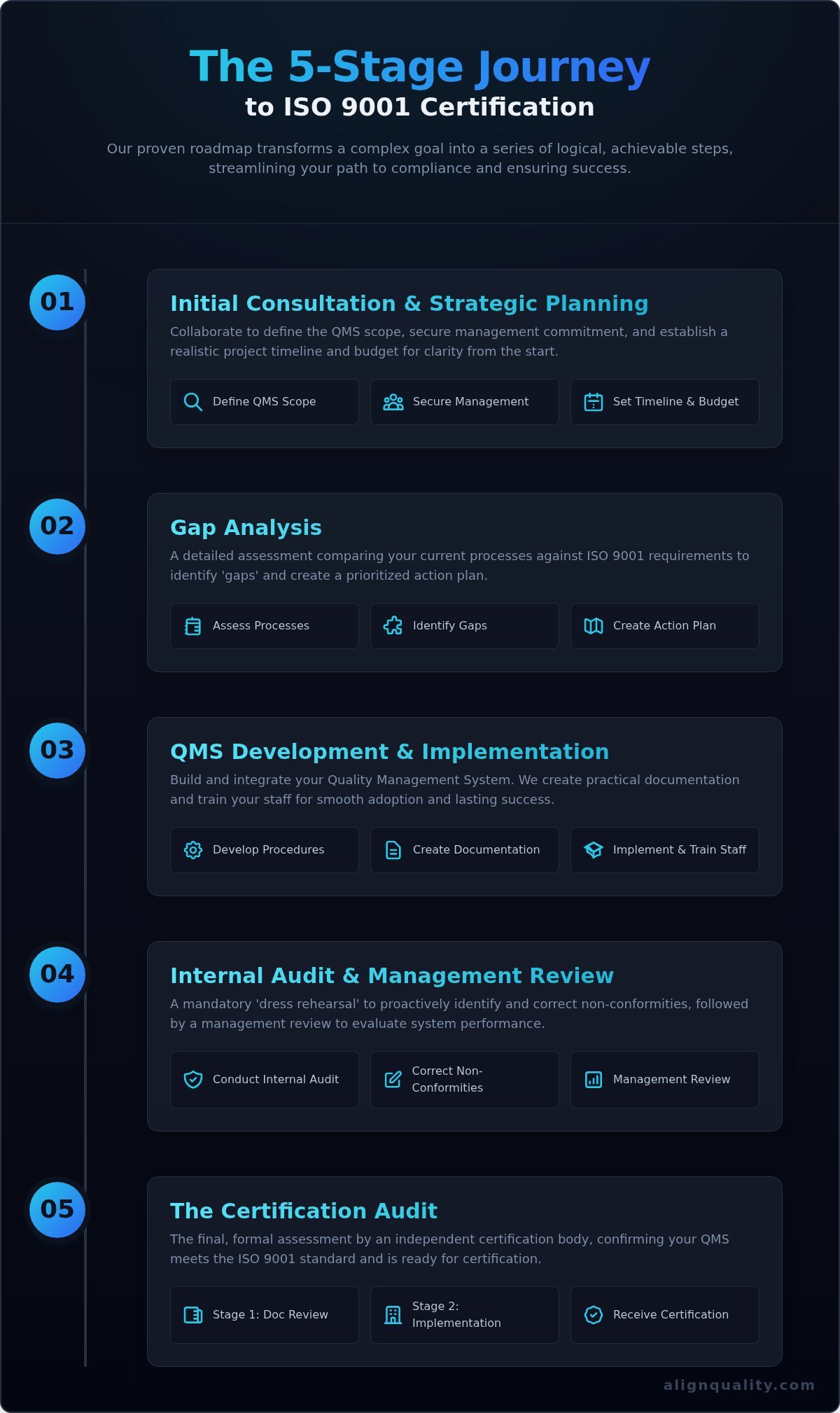
Achieving ISO 9001 certification can seem like a complex undertaking, but with a structured process, it becomes a manageable and highly valuable initiative. Our proven 5-stage journey provides a clear roadmap, transforming a potentially overwhelming goal into a series of logical, achievable steps. This methodical approach, refined through years of experience, streamlines your path to compliance, prevents wasted effort, and ensures you achieve your certification goals with confidence.
Here is the clear, five-stage process we use to guide businesses to successful iso certification 9001.
Stage 1: Initial Consultation & Strategic Planning
Every successful certification journey begins with a solid foundation. In this initial stage, we collaborate with your team to define the precise scope of your Quality Management System (QMS). We help secure commitment from senior management-a critical factor for success-and identify the key processes and stakeholders to be included. Together, we establish a realistic project timeline and budget, ensuring clarity and alignment from the very start.
Stage 2: Gap Analysis – Identifying Your Starting Point
To build your roadmap, we must first understand your current position. A Gap Analysis is a detailed assessment comparing your existing processes against the formal ISO 9001 requirements. The goal is to precisely identify the ‘gaps’ that need to be addressed to achieve compliance. This diagnostic stage results in a clear, prioritized action plan that becomes your to-do list for the project. See how our Gap Analysis service provides your definitive roadmap.
Stage 3: QMS Development & Implementation
This is the core phase where we build and integrate your QMS based on the findings from the Gap Analysis. Our experts guide you in creating the required documentation, including the quality manual, policies, and operational procedures. Crucially, we focus on implementing practical, efficient processes that add tangible value to your operations-not just creating documents. This stage includes training your staff on the new or formalized procedures to ensure smooth adoption and lasting success.
Navigating the Audit Process: Preparation and Execution
The audit process is the final, formal step in your certification journey. While it can seem daunting, it is a straightforward verification of your Quality Management System (QMS). With thorough preparation, the audit becomes an opportunity to demonstrate your commitment to quality, not a test to be feared. This phase involves two key types of audits-internal and external-which validate your system and pave the way for receiving your certificate.
Stage 4: Internal Audit & Management Review
An internal audit is a mandatory and invaluable ‘dress rehearsal’ for your external certification audit. Conducted by your own trained team or an expert consultant, its primary purpose is to proactively identify and correct any non-conformities within your QMS. Following the internal audit, the Management Review brings leadership into the loop, evaluating system performance and driving strategic improvements. This critical stage builds team confidence and ensures everyone is prepared to demonstrate compliance.
Stage 5: The Certification Audit (Stage 1 & Stage 2)
This is the formal assessment conducted by your chosen certification body, and it confirms your eligibility for iso certification 9001. The process is typically split into two parts:
- Stage 1 Audit: A high-level review of your QMS documentation to confirm it meets the standard’s requirements and that you are ready for the main audit. This is often conducted remotely.
- Stage 2 Audit: A detailed, on-site evaluation where the auditor verifies that your QMS is fully implemented. They will review records, interview staff, and observe processes to gather objective evidence of conformity.
During the audit, auditors look for consistency and proof. Your team should be prepared to answer questions honestly and provide the requested documentation with confidence.
Choosing the Right Certification Body
Selecting the right partner to award your certification is a critical decision. To ensure your certificate holds global recognition, it is vital to choose a body accredited by a recognized national authority (like UKAS in the UK or ANAB in the US). When evaluating options, consider their experience in your specific sector and request multiple quotes. Understanding the full scope of the ISO 9001 quality management standards will help you ask the right questions during this selection process. Navigating these final stages requires meticulous attention to detail, a core strength of the Align Quality team.
Life After Certification: Maintaining and Improving Your System
Achieving your ISO 9001 certificate is a significant milestone, but it marks the beginning-not the end-of your quality management journey. The true value of the standard is realized through ongoing commitment. The framework is built on the principle of continual improvement, transforming your Quality Management System (QMS) from a set of documents into a dynamic tool for strategic growth.
Maintaining compliance requires diligent effort, but a well-managed system delivers sustained returns in efficiency, customer satisfaction, and operational excellence. The certification cycle is designed to ensure your QMS remains effective and evolves with your business.
Understanding Surveillance Audits
Once certified, your organization will undergo periodic surveillance audits, typically conducted annually by your certification body. These audits are less intensive than your initial certification audit but are critical for maintaining your status. Their primary focus is to:
- Verify that your QMS continues to comply with ISO 9001 requirements.
- Review the performance of key processes and any changes made since the last audit.
- Confirm that internal audits and management reviews are being conducted effectively.
Failure to demonstrate continued compliance during a surveillance audit can result in the suspension of your certificate.
The 3-Year Recertification Cycle
Your ISO 9001 certificate is valid for a three-year period. Before it expires, your organization must undergo a comprehensive recertification audit. This audit is similar in scope to the initial Stage 2 audit, involving a complete review of your QMS to ensure it has not only been maintained but has also matured. This process confirms that your commitment to quality is embedded in your culture and that your system remains a powerful asset to the business.
Leveraging ISO 9001 for Continual Improvement
Your iso certification 9001 is more than a badge; it is a framework for operational excellence. Use the data and findings from internal and external audits to make informed strategic decisions, refine processes, and drive efficiency. A successful QMS fosters a culture of quality where every team member is engaged in improvement. As your business grows, your QMS should evolve with it, adapting to new challenges and opportunities.
Align Quality provides expert support beyond initial certification, helping you navigate surveillance audits and leverage your QMS for sustained success. Contact Align Quality to ensure your system continues to deliver maximum value.
Your Journey to ISO 9001 Certification Starts Here
Embarking on the path to ISO 9001 is a transformative step toward operational excellence. As we’ve outlined, the journey involves understanding the standard’s core principles, diligently following a structured implementation process, and preparing thoroughly for the audit. Achieving certification is not the final destination; it is the beginning of a commitment to continual improvement that builds customer trust and market credibility. Navigating the requirements of iso certification 9001, however, requires precision and expertise.
You do not have to manage this critical process alone. The team at Align Quality is here to guide your journey with confidence. Our Certified ISO 9001 Lead Auditors leverage a proven 5-Stage Certification Process-refined through extensive multi-industry experience-to streamline your path to success. We partner with you to build a robust Quality Management System tailored to your specific business goals.
Ready to transform your commitment to quality into a recognized standard of excellence? Book Your Free Consultation to Start Your ISO 9001 Journey and begin your path forward today.
Frequently Asked Questions About ISO 9001
How much does ISO 9001 certification cost?
The cost of ISO 9001 certification varies based on company size, complexity, and the number of locations. Costs typically include consulting fees, internal resource allocation, and the certification body’s audit fees. For a small to medium-sized business, the total investment can range from a few thousand to over ten thousand, with specific costs varying by region and local currency. Align Quality provides a tailored quote after an initial consultation to ensure a clear and accurate cost projection for your specific operational needs.
How long does it take to get ISO 9001 certified?
The timeline for achieving ISO 9001 certification typically ranges from 3 to 12 months. The exact duration depends on factors such as your organization’s size, the complexity of your processes, and the current state of your quality management system. Our structured, five-stage process is designed to streamline this journey, ensuring efficient implementation and readiness for your certification audit. A dedicated consultant helps maintain momentum and meet key milestones effectively.
What is the difference between ISO 9001 accredited vs. unaccredited certification?
Accredited certification is issued by a body that has been independently assessed by a national or international accreditation authority. This provides impartial validation that the certification body is competent and credible. Unaccredited certification lacks this third-party oversight, which can diminish its value and recognition in the marketplace. For maximum domestic and international acceptance, we always guide our clients toward achieving an accredited iso certification 9001 to ensure its full value is realised.
Can my small business get ISO 9001 certification?
Absolutely. ISO 9001 is designed to be scalable and is highly beneficial for businesses of all sizes, including small enterprises. The standard’s principles of quality management, customer focus, and continual improvement can provide a significant competitive advantage. We specialize in tailoring the implementation process to the specific needs and resources of small businesses, ensuring a practical and cost-effective path to certification without unnecessary bureaucracy or complexity.
What happens if we fail the certification audit?
Failing an audit is not a final outcome but an opportunity for improvement. The auditor will issue non-conformities, which are specific areas where your system does not meet the standard. You will be given a set period to implement corrective actions to address these findings. Our role as your consultant is to prepare you thoroughly to minimize this risk and to guide you through resolving any non-conformities swiftly and effectively to ensure successful certification.
Do I need a consultant to get ISO 9001 certified?
While it is possible to achieve certification independently, engaging an expert consultant significantly streamlines the journey and increases the likelihood of a first-time pass. A consultant provides deep knowledge of the standard, saving your team valuable time and preventing common implementation errors. At Align Quality, our certified auditors bring multi-industry experience to ensure your Quality Management System is not only compliant but also adds genuine value to your operations, guaranteeing a confident audit outcome.