For many business leaders, the term ISO 9001 conjures images of complex audits, dense jargon, and a significant investment of time and resources. It’s a standard synonymous with quality, yet the path to understanding its true value can often feel overwhelming. This definitive guide is designed to cut through that complexity. We will demystify the core principles of the iso9001 standard, translating its requirements into practical, actionable insights for the modern business.
Our goal is to provide clarity and confidence. You will discover the tangible benefits that extend far beyond a certificate on the wall-from enhanced efficiency and customer satisfaction to a stronger competitive edge. We will provide a high-level overview of the implementation journey, equipping you with the knowledge to confidently decide if pursuing certification is the right strategic move to secure your company’s future. Let’s begin the journey to quality management excellence.
Demystifying ISO 9001: More Than Just a Certificate
At its core, ISO 9001 is the world’s most recognized standard for creating, implementing, and maintaining a Quality Management System (QMS). It provides a proven framework that any organization can use to improve its operational processes, with two primary objectives: consistently meeting customer requirements and enhancing customer satisfaction. It is the flagship standard within the comprehensive ISO 9000 family of standards, which are dedicated to quality management. A common misconception is that this standard dictates the quality of a final product or service. Instead, it focuses on the processes that create them. Think of it as a recipe for operational excellence; it doesn’t guarantee a perfect meal, but it ensures you follow a proven method for a consistently high-quality result every time.
The Core Philosophy: Plan-Do-Check-Act (PDCA)
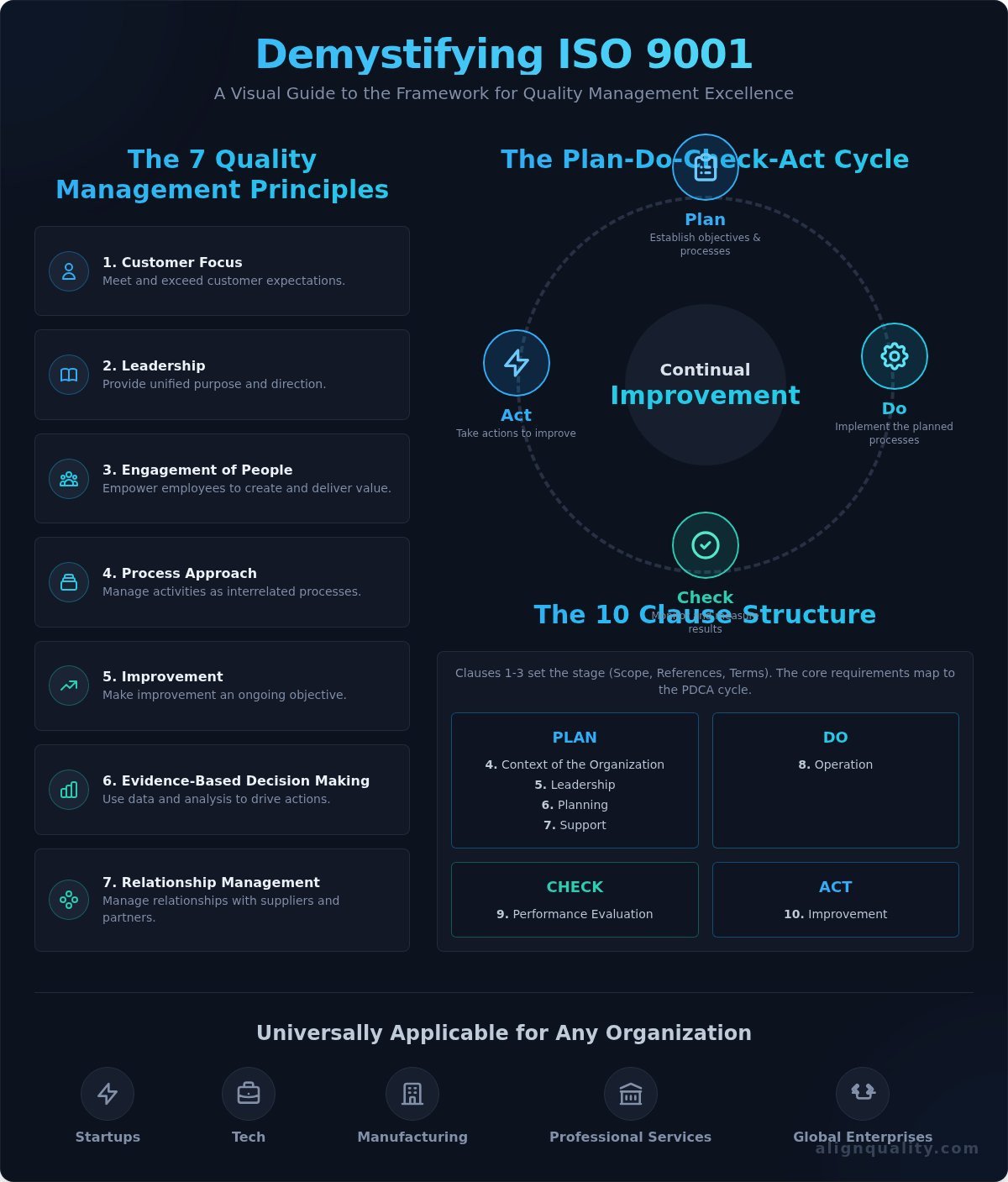
The practical engine driving the iso9001 standard is the Plan-Do-Check-Act (PDCA) cycle. This iterative four-stage approach ensures a commitment to continual improvement is embedded in your organization’s culture:
- Plan: Establish objectives and processes required to deliver results in accordance with customer requirements and organizational policies.
- Do: Implement the planned processes.
- Check: Monitor and measure processes and the resulting products against policies, objectives, and requirements.
- Act: Take actions to continually improve process performance.
Who is ISO 9001 For? From Startups to Global Enterprises
The Goal: What It Means to Be ‘ISO 9001 Certified’
Achieving ISO 9001 certification means an independent, accredited body has audited your QMS and verified that it conforms to the standard’s requirements. This certification is more than a plaque on the wall; it is a public declaration of your commitment to quality, consistency, and customer focus. For many organizations, it is a critical requirement for participating in tenders, securing contracts with larger corporations, and entering new markets. Ultimately, it builds profound trust with customers, partners, and stakeholders.
The 7 Quality Management Principles: The ‘Why’ Behind the Requirements
To successfully implement a Quality Management System (QMS), it is essential to understand the philosophy that underpins the standard. The requirements of iso9001 are not arbitrary rules; they are the practical application of seven core Quality Management Principles. As the American Society for Quality (ASQ) explains ISO 9001, the standard is designed to help organizations ensure they consistently meet customer needs. Viewing these principles as guiding values rather than a checklist is the key to building a sustainable culture of quality that drives tangible business outcomes, from enhanced efficiency to long-term growth.
Principle 1 & 2: Customer Focus and Leadership
At its core, quality management begins and ends with the customer. Customer Focus is the primary principle, dictating that an organization’s central goal is to meet and exceed customer requirements and expectations. This cannot be achieved without Leadership. Strong leadership provides a unified purpose and direction, creating an internal environment where every employee understands the quality objectives and is committed to achieving them. Together, these principles align the entire organization toward a single, critical goal: delivering exceptional value to the customer.
Principle 3, 4 & 5: Engagement of People, Process Approach, and Improvement
These three principles form the operational engine of your QMS. The Engagement of People at all levels is crucial; empowered and competent employees are essential for creating and delivering value. This value is delivered consistently through the Process Approach, which involves managing activities and resources as interrelated processes to achieve predictable results. Finally, Improvement is an ongoing objective, ensuring the organization is always seeking opportunities to enhance performance, adapt to changing conditions, and refine its processes.
Principle 6 & 7: Evidence-Based Decision Making and Relationship Management
Effective decisions are rarely based on intuition alone. The principle of Evidence-Based Decision Making emphasizes the use of data and analysis to drive actions, which significantly reduces risk and uncertainty. This data-driven mindset extends to Relationship Management with interested parties, such as suppliers and partners. By strategically managing these relationships, a business can foster mutual benefit, ensure a reliable supply chain, and optimize the performance of the entire value network for sustained success.
The Structure of ISO 9001: Understanding the 10 Clauses
At its core, the modern iso9001 standard is built upon a high-level framework known as Annex SL. This common structure is shared across many other ISO management system standards, such as ISO 14001 (Environmental) and ISO 45001 (Occupational Health & Safety). This alignment makes it significantly easier for businesses to implement and manage an integrated management system, reducing duplication and improving efficiency.
While you don’t need to be an expert on every detail, understanding the purpose of each clause provides a clear roadmap for your quality management journey. The 10 clauses can be logically grouped according to the Plan-Do-Check-Act (PDCA) cycle, a proven methodology for continuous improvement.
Clauses 1-3: Setting the Stage (Scope, References, Terms)
Think of these initial clauses as the introduction to the standard. They establish the foundational context, defining the scope of the standard, referencing other relevant documents, and clarifying key terms and definitions. While crucial for understanding, these sections are not audited for conformity in the same way as the subsequent clauses. They simply ensure everyone is working from a shared vocabulary and understanding.
Clauses 4-7: The ‘Plan’ Phase (Context, Leadership, Planning, Support)
This group of clauses forms the strategic foundation of your Quality Management System (QMS). It is where you define why your QMS exists and gather the resources needed for success. Key requirements include:
- Clause 4 (Context): Understanding your organization’s purpose, stakeholders, and the internal and external issues that affect your QMS.
- Clause 5 (Leadership): Defining top management’s commitment, establishing a quality policy, and assigning key roles and responsibilities.
- Clause 6 (Planning): Identifying risks and opportunities and setting clear, measurable quality objectives.
- Clause 7 (Support): Ensuring the availability of necessary resources, from infrastructure and competent personnel to communication and documented information.
Clause 8: The ‘Do’ Phase (Operation)
This is the engine room of your QMS, where your plans are put into action. Clause 8 covers the day-to-day processes required to create and deliver your products or services. It addresses everything from initial customer communication and design and development to production, service provision, and the control of nonconforming outputs. This clause ensures your operational activities are controlled and consistently meet customer requirements.
Clauses 9-10: The ‘Check & Act’ Phase (Performance Evaluation & Improvement)
To ensure the QMS is effective, you must measure its performance and drive improvement. These final clauses close the PDCA loop. Clause 9, Performance Evaluation, requires you to monitor, measure, and analyze your processes, conduct internal audits, and review performance at a management level. Based on these findings, Clause 10, Improvement, mandates that you address nonconformities, implement corrective actions, and foster a culture of continual improvement across the organization.
Looking Ahead: The Evolution from ISO 9001:2015 to the 2025 Revision
The International Organization for Standardization (ISO) reviews its standards every five years to ensure they remain relevant and effective in a dynamic global market. The current standard, ISO 9001:2015, provides a robust framework for quality management. However, as the business landscape evolves, so must the standards that guide it. The upcoming revision, anticipated for 2025, will adapt the world’s leading quality management standard to address the challenges and opportunities of the modern era, ensuring the iso9001 framework continues to deliver maximum value.
Why a Revision is Necessary: Responding to Modern Challenges
Today’s businesses operate in an environment defined by rapid change. The next version of ISO 9001 must address critical new drivers, including the need for greater supply chain resilience, the pervasive impact of digitalization, and the growing importance of Environmental, Social, and Governance (ESG) factors. Furthermore, emerging technologies like AI and automation are transforming how quality is managed, requiring an updated framework that incorporates these powerful tools effectively.
Anticipated Themes in the 2025 Update
While the final text is still under development, industry experts anticipate the revision will deepen several core concepts from the 2015 version. Key themes expected to feature prominently include:
- Enhanced Risk and Opportunity Management: A more dynamic approach to identifying and acting on risks and opportunities, especially in areas like cybersecurity and supply chain disruption.
- Integration of Sustainability: Clearer guidance on incorporating sustainability and ethical considerations into the Quality Management System (QMS).
- Digital Transformation and Data: Updated requirements related to the management of organizational knowledge, data integrity, and the use of digital tools in quality processes.
How to Prepare Your Business for the Future of Quality
The best way to prepare for the 2025 revision is to master the current one. A strong foundation in ISO 9001:2015 principles is the most effective preparation for any future changes. Focus on strengthening your existing QMS by fostering a deep culture of continual improvement and embedding risk-based thinking into every process. Emphasize robust data analysis to drive decisions, as this will be critical for adapting to new requirements with minimal disruption. Proactive preparation ensures a seamless transition journey.
Navigate the transition with confidence. See how our experts can help.
The Path to Certification: How an Expert Consultant Streamlines the Journey
Embarking on the ISO 9001 certification process can feel complex, but you don’t have to navigate it alone. Engaging an expert consultant transforms this journey from a daunting task into a strategic business improvement project. It’s vital to first understand the distinction between roles: a consultant is your preparatory guide, while a certification body (or registrar) is the independent auditor who ultimately grants the certificate. A consultant works for you to build and refine your system; the certification body works to verify its compliance.
By partnering with a specialist, you invest in a streamlined path to success. An experienced consultant helps you avoid common pitfalls, significantly reducing the risk of a failed audit. This expert guidance saves valuable time and resources, ensuring your Quality Management System (QMS) is not only compliant but also a practical asset that adds genuine value to your operations.
The Consultant’s Role: Your Strategic Partner
A skilled consultant does more than just check boxes. They act as a strategic partner, translating the dense language of the iso9001 standard into practical actions tailored to your unique business context. Their primary goal is to help you develop a lean, effective QMS that enhances your processes rather than creating unnecessary bureaucracy. This includes training your team to understand and own the system and conducting internal audits to ensure you are fully prepared for the final assessment.
Key Stages of a Guided Certification Process
A methodical consultant guides you through a proven, structured process. While every project is tailored, the core stages of the journey typically include:
- Gap Analysis: A thorough assessment of your current processes against the standard’s requirements to identify any shortfalls.
- QMS Development & Implementation: Creating clear documentation and providing hands-on support to integrate new quality procedures into your daily operations.
- Audit Readiness: Conducting a full internal audit and a formal management review to validate the system’s effectiveness and confirm your readiness for the external certification audit.
What to Look For in an ISO 9001 Consultant
Choosing the right partner is critical for a successful outcome. When evaluating a consultant, prioritize the following attributes to ensure you are working with a true expert:
- Certified Lead Auditor Credentials: This certification demonstrates a deep, professional understanding of the standard and the auditing process.
- Relevant Industry Experience: A consultant who understands the nuances of your sector can provide more practical and effective solutions.
- A Focus on Practicality: Seek a partner committed to building a system that works for your business, not one who simply delivers a generic set of documents.
Your journey to certification is a significant step. Ensure you have the right expert guidance to achieve it with confidence.
Navigating Your ISO 9001 Journey with Confidence
As we’ve explored, ISO 9001 is far more than a certificate; it is a strategic framework for embedding quality and continuous improvement into the core of your operations. By understanding its foundational principles and structured clauses, you gain a clear roadmap for achieving operational excellence. Ultimately, a successful iso9001 implementation drives customer satisfaction, enhances efficiency, and builds a resilient organization ready for the future.
The path to certification, while structured, requires expert navigation. At Align Quality, our Certified ISO 9001 Lead Auditors utilize a proven 5-Stage Certification Process to streamline this complex journey. Leveraging our multi-industry experience, we provide the methodical guidance your business needs to achieve compliance efficiently and effectively.
Take the definitive step towards quality excellence. Book your free consultation to start your certification journey with confidence.
Frequently Asked Questions About ISO 9001
What is the difference between being ISO 9001 ‘certified’ and ‘compliant’?
ISO 9001 compliance means your Quality Management System (QMS) is structured to meet the standard’s requirements. This is an internal achievement. Certification, however, is the formal verification by an accredited, independent certification body after a successful audit.
This external validation provides objective proof that your systems conform to the standard. While compliance is the foundation, certification is the recognized credential that builds trust with customers and stakeholders, demonstrating your commitment to quality.
How long does it typically take to achieve ISO 9001 certification?
The timeline for achieving ISO 9001 certification varies based on an organization’s size, complexity, and the current state of its quality processes. For most small to medium-sized businesses, the journey from initial gap analysis to final certification typically takes between three to six months.
A well-defined implementation plan and dedicated resources are critical to streamlining this process. Strong management commitment and employee engagement are key factors in meeting this timeline efficiently and with confidence.
What are the main costs associated with getting and maintaining ISO 9001?
The primary costs for ISO 9001 involve three key areas. First are the implementation costs, which may include consultant fees, employee training, and potential software updates. Second are the certification body’s fees for the mandatory Stage 1 and Stage 2 audits.
After certification, you must account for ongoing maintenance costs. These include annual surveillance audit fees and the internal resources needed to manage and continually improve your Quality Management System, ensuring its long-term effectiveness.
Is ISO 9001 certification a one-time event, or does it need to be renewed?
ISO 9001 certification is not a one-time achievement; it represents an ongoing commitment to quality. The certificate is valid for a three-year cycle. To maintain its validity, your organization must successfully complete annual surveillance audits conducted by your certification body.
These audits ensure your QMS continues to comply with the standard and is driving improvement. At the end of the three-year period, a more comprehensive recertification audit is required to renew your certificate for another cycle.
Can a very small business (under 10 employees) benefit from ISO 9001?
Absolutely. A small business can gain significant advantages from iso9001. The standard is scalable and focuses on process efficiency and customer satisfaction, which are vital for any size organization. Implementing a QMS helps small teams establish clear roles, reduce costly errors, and deliver consistent service.
Furthermore, certification can open doors to larger contracts and supply chains that mandate it as a prerequisite. It demonstrates a commitment to quality that builds immediate credibility and trust with new and existing customers.
Will implementing ISO 9001 create a lot of unnecessary bureaucracy and paperwork?
This is a common concern, but a well-implemented iso9001 system should reduce bureaucracy, not create it. The modern standard is flexible, emphasizing effective processes over prescriptive documentation. The goal is to document what is necessary for consistency and control, not to generate paperwork for its own sake.
When approached correctly, the framework streamlines operations, clarifies responsibilities, and provides valuable data for decision-making. The focus is on creating a lean, efficient system that adds tangible value to your business.