As the next evolution of the world’s leading quality management standard approaches, organizations currently certified to ISO 9001:2015 are facing a critical question: What changes are coming, and how do we prepare? The prospect of a new standard can create uncertainty, raising valid concerns about the impact on your current Quality Management System (QMS) and the potential for non-conformance during your next audit cycle.
Navigating this transition journey does not have to be complex or disruptive. With expert guidance, you can transform this requirement into an opportunity to strengthen your processes. This comprehensive guide is designed to provide that clarity and confidence. We will deliver a complete breakdown of the key differences between the two versions, providing an actionable roadmap for updating your QMS. You will gain the knowledge to lead the transition effectively, ensuring a smooth audit and demonstrating proactive compliance to management and auditors alike.
Recap: The Core Framework of ISO 9001:2015
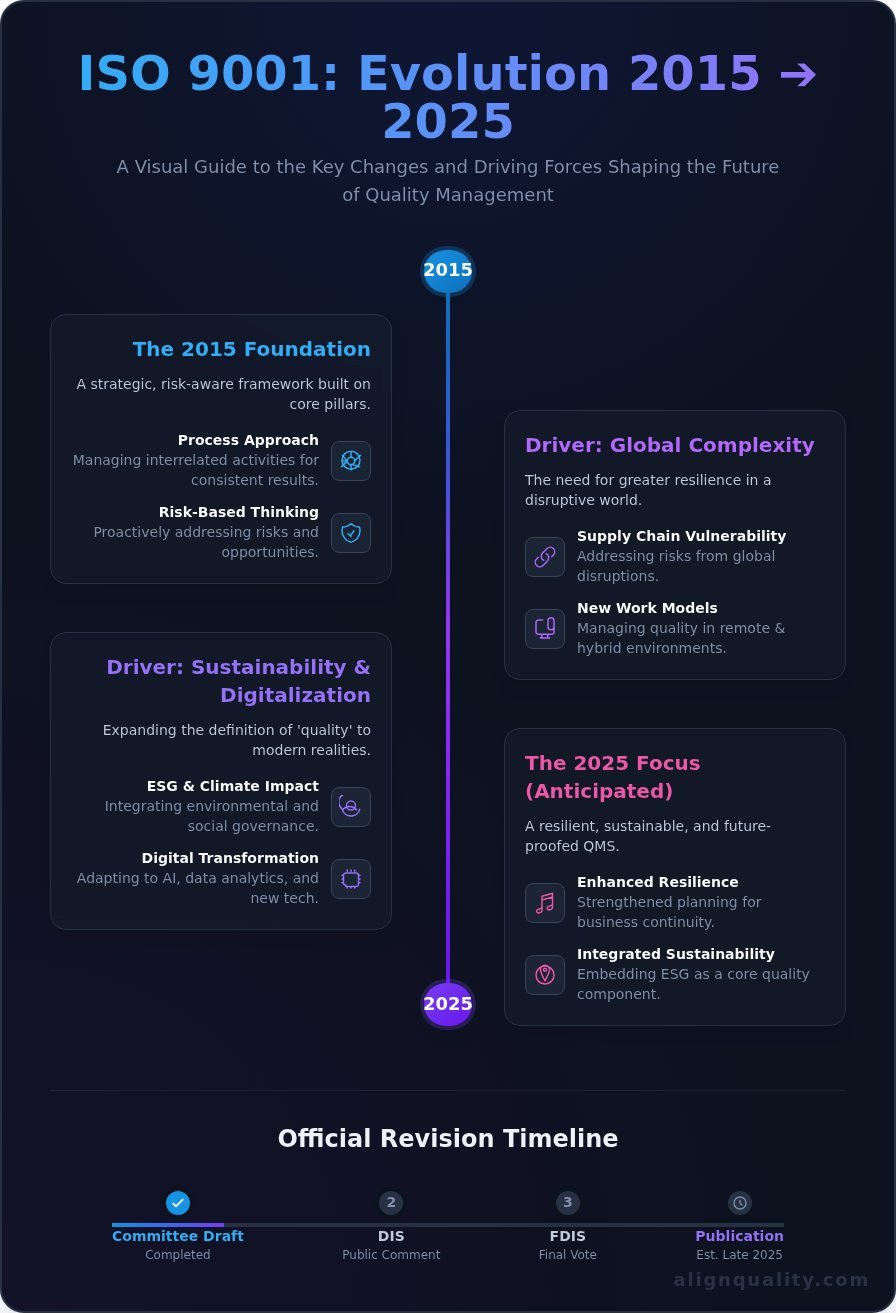
Before exploring the anticipated changes for 2026, it is essential to establish a firm understanding of the current standard. The iso 9001:2015 version marked a significant evolution, establishing a more strategic and risk-aware approach to quality management. Its most impactful change was the introduction of the High-Level Structure (HLS), also known as Annex SL, which provided a universal 10-clause structure for all ISO management system standards.
This revision cemented two foundational pillars: the Process Approach, which requires organizations to manage their activities as interrelated processes, and Risk-Based Thinking, a proactive mindset embedded throughout the entire ISO 9001 framework. These core elements are driven by the Plan-Do-Check-Act (PDCA) cycle, the operational engine for achieving continual improvement within your Quality Management System (QMS).
The 7 Quality Management Principles of the 2015 Standard
Underpinning the standard’s requirements are seven core principles. These are not auditable clauses but the philosophical foundation that gives the QMS its purpose. They represent the ‘why’ behind the ‘what’ and are expected to remain fundamental in future versions.
- Customer Focus: Meeting and exceeding customer expectations to drive loyalty.
- Leadership: Providing unity of purpose and direction from top management.
- Engagement of People: Empowering competent and engaged individuals at all levels.
- Process Approach: Managing activities as interrelated processes to achieve consistent results.
- Improvement: Maintaining an ongoing focus on enhancing performance and capabilities.
- Evidence-based Decision Making: Making decisions based on the analysis and evaluation of data.
- Relationship Management: Managing relationships with interested parties, such as suppliers, for sustained success.
Key Clauses That Defined the 2015 Version
The High-Level Structure organizes the requirements of iso 9001:2015 into ten clauses, with the key requirements detailed in Clauses 4 through 10. Two clauses, in particular, redefined the standard’s strategic value and moved it from a purely quality-focused tool to a core business integration framework:
- Clause 4: Context of the Organization: This requires a business to understand its internal and external issues and the needs of interested parties, ensuring the QMS is aligned with its strategic direction.
- Clause 6: Planning: This section formally introduced risk-based thinking by mandating the identification of risks and opportunities related to QMS performance and planning actions to address them.
Understanding this structure provides the essential baseline needed to accurately assess the impact of the upcoming amendments and streamline your transition journey with confidence.
Why a New Revision? The Driving Forces Behind ISO 9001:2025
International standards like ISO 9001 undergo a systematic review, typically every five to seven years, to ensure they remain relevant and effective. While the core framework of ISO 9001:2015 provides a robust foundation for quality management, the global business landscape has evolved dramatically since its publication. The upcoming revision is not an overhaul but a necessary alignment with modern operational realities, designed to enhance the standard’s value for organizations worldwide.
The key drivers for this update are rooted in significant global shifts, including technological advancements, new economic pressures, and a heightened focus on corporate responsibility. The goal is to ensure the next version of the standard equips businesses to build more resilient, sustainable, and future-proof quality management systems.
Adapting to a More Complex Global Marketplace
The years following the release of ISO 9001:2015 have been defined by unprecedented disruption. The COVID-19 pandemic, geopolitical instability, and supply chain vulnerabilities have underscored the critical need for organizational resilience. The revision will likely place a greater emphasis on risk management related to supply chain continuity, business disruption, and the operational shifts brought on by remote and hybrid work models. Furthermore, the rapid rise of digital transformation, including AI and data analytics, necessitates new considerations for quality and data security within a QMS.
Integrating Sustainability and Ethical Considerations
There is a growing global consensus on the importance of Environmental, Social, and Governance (ESG) factors. The new revision is expected to integrate these principles more directly into the quality management framework. This includes addressing the impact of climate change and promoting sustainable practices. The concept of “quality” is expanding beyond the product or service to encompass the ethical and environmental impact of an organization’s processes. This change also aims to improve alignment with other key ISO standards, such as ISO 14001 (Environmental Management) and ISO 45001 (Occupational Health and Safety).
The Official Revision Timeline and Key Dates
The journey to a new ISO standard follows a structured, multi-stage process to ensure global consensus. Understanding this timeline helps organizations prepare for the transition with confidence. The key stages include:
- Committee Draft (CD): An initial draft is circulated among the working group for comments and review. This stage has been completed.
- Draft International Standard (DIS): A more refined draft is made available to all ISO member bodies for voting and public comment.
- Final Draft (FDIS): The final version, incorporating feedback from the DIS stage, is submitted for a final vote.
- Publication: Once approved, the new standard is officially published. The current estimate for the final publication of the revised ISO 9001 is late 2025.
Clause-by-Clause Analysis: ISO 9001:2015 vs. 2025 (Anticipated Changes)
It is important to preface this analysis with a clarification: the next revision of ISO 9001 is still under development, and any details are based on draft information and committee discussions. The final standard is subject to change. However, the anticipated updates suggest a significant evolution, building upon the solid framework of iso 9001:2015 to address modern business challenges. The focus appears to be shifting from risk management to a more holistic approach encompassing resilience, change, and sustainability.
Potential Changes to Context, Leadership, and Planning (Clauses 4, 5, 6)
In the 2015 version, these clauses established the strategic foundation of the QMS. The next revision is expected to deepen this integration. Where Clause 4 previously focused on understanding the organization’s context, it will likely demand a more dynamic link between the QMS and strategic planning. Similarly, Clause 5’s emphasis on leadership commitment is expected to evolve, holding leadership more directly accountable for managing change. For Clause 6, risk-based thinking will likely expand to explicitly incorporate organizational resilience and continuity planning.
Updates in Support and Operation (Clauses 7 & 8)
These clauses govern the resources and processes needed to deliver products and services. Key anticipated changes include:
- Organizational Knowledge (Clause 7): The 2015 standard introduced the need to manage knowledge. The update will likely address modern realities, such as securing and sharing critical knowledge effectively in remote or hybrid work environments.
- Operational Control (Clause 8): Expect more robust requirements for managing the supply chain. The focus will shift towards ensuring supplier resilience and considering the entire product or service lifecycle, from initial design to end-of-life.
Refinements in Performance and Improvement (Clauses 9 & 10)
The core principles of evaluation and improvement remain, but their application is set to become more sophisticated. In the current iso 9001:2015 standard, internal audits (Clause 9) are a key tool; their scope is expected to broaden to cover emerging risks like cybersecurity and data integrity. Organizations may find that partnering with experts like Zero Assumption Security for independent penetration testing is a valuable way to address these specific risks. The role of data analytics in performance evaluation will also likely receive greater emphasis. Finally, Clause 10 (Improvement) will likely create a stronger, more explicit link between correcting a nonconformity and implementing proactive, preventative improvements across the entire system.
Your Action Plan: How to Prepare for the ISO 9001:2025 Transition
The upcoming revision to ISO 9001 presents a valuable opportunity to refine your Quality Management System (QMS). Approaching the transition with a structured plan not only ensures compliance but also drives genuine business improvement. Starting early is the key to a low-stress, successful journey from the current framework. A methodical approach allows your organization to adapt with confidence and leverage the changes for strategic advantage.
Follow these three essential steps to streamline your transition process.
Step 1: Conduct a Proactive Gap Analysis
The foundational step is to systematically compare your existing QMS, currently aligned with iso 9001:2015, against the new draft requirements. This proactive assessment will pinpoint the specific processes, documents, and policies that require modification. A thorough gap analysis provides a clear and actionable roadmap, preventing last-minute challenges and ensuring your system remains robust and effective. To ensure nothing is missed in this critical first stage, let our experts guide your transition with a Gap Analysis.
Step 2: Brief Leadership and Train Your Team
Step 3: Update QMS Documentation and Practices
With a clear plan and an engaged team, you can begin updating your QMS. This involves more than just revising your quality manual and procedures; it requires implementing practical changes in your daily operations. Integrate the new requirements into your internal audit program early. This allows you to verify that the changes are effectively implemented and delivering the intended results, turning your iso 9001:2015 certified system into one that is fully prepared for the future, long before your official transition audit.
Managing Certification: The Transition Period and Audit Process
Navigating the logistics of a new ISO standard can seem daunting, but the transition process is structured and manageable. A well-defined plan ensures your organization maintains its certified status without disruption. The key is to understand the official timeline and work proactively with your certification body. Your existing iso 9001:2015 certificate does not become invalid overnight; instead, there is a clear window for a smooth transition.
Understanding the Official Transition Window
Historically, the International Organization for Standardization (ISO) provides a three-year transition period following the publication of a revised standard. This means that once ISO 9001:2026 is officially released, all organizations will have until late 2029 to complete their transition audit. After this deadline, all iso 9001:2015 certificates will expire. Waiting until the final year is not recommended, as it can create unnecessary pressure and risk non-compliance if issues arise.
When to Schedule Your Transition Audit
You have flexibility in how you approach the transition audit. The most effective strategy depends on your organization’s readiness and existing audit schedule. The two primary options include:
- During a Scheduled Audit: The most common and cost-effective approach is to combine your transition audit with a planned surveillance or recertification audit. This integrates the assessment into your existing cycle.
- A Special Transition Audit: If your team is ready ahead of schedule or you prefer to separate the processes, you can arrange a standalone audit focused solely on transitioning to the new standard.
Discussing the best approach with your registrar and an experienced consultant is a critical first step. An expert partner can help you perform a gap analysis and ensure your Quality Management System is fully prepared, allowing you to approach the audit with confidence. To streamline your transition journey, explore how the certified lead auditors at Align Quality can support your team.
Your Strategic Path from ISO 9001:2015 to 2025
The upcoming revision of ISO 9001 marks a significant evolution in quality management. While the core principles of iso 9001:2015 provide a robust foundation, the anticipated 2025 update will integrate modern challenges like digital transformation and sustainability. Proactive preparation is not just recommended; it is essential for a seamless transition and for leveraging the new standard as a strategic advantage for your organization.
Navigating this journey requires expert guidance. At Align Quality, our Certified ISO 9001 Lead Auditors streamline your transition, utilizing our proven 5-Stage Certification Process. With our extensive multi-industry transition experience, we help you align your systems with the new requirements efficiently and effectively, ensuring you are prepared for your next audit.
Ensure a confident transition to ISO 9001:2025. Book your free consultation today. With a trusted partner, you can embrace the future of quality management not as a challenge, but as an opportunity for growth.
Frequently Asked Questions About the ISO 9001 Revision
When will ISO 9001:2025 be officially published?
The International Organization for Standardization (ISO) is currently reviewing the standard. While the initial target was late 2025, the final publication is now anticipated in 2026. This timeline allows the technical committee to thoroughly address global feedback and integrate new concepts. We recommend monitoring official ISO communications for the definitive publication date, which will formally begin the transition period for all certified organizations and provide a clear timeline for compliance.
How long do we have to transition from the 2015 to the 2025 version?
Historically, ISO provides a three-year transition period following the publication of a revised standard. Once the new version is officially released, your organization will have approximately 36 months to update its Quality Management System (QMS) and complete a successful transition audit. This provides ample time for a structured gap analysis, implementation of required changes, and verification of effectiveness. Proactive planning is the key to a seamless and confident transition journey.
Can we still get certified to ISO 9001:2015 now, or should we wait?
Yes, you should proceed with certification to ISO 9001:2015 without delay. Waiting means forfeiting the significant operational benefits that a certified QMS provides today, such as improved efficiency and customer trust. Achieving certification now establishes a robust framework that makes the future transition much simpler. Your certificate will remain valid throughout the official transition period, ensuring your business continues to meet international quality standards without interruption.
What is the single biggest change we should prepare for in the 2025 update?
The most significant changes are expected to focus on adapting the standard to emerging global challenges. This includes a greater emphasis on topics like sustainability, supply chain resilience, and the integration of new technologies within the QMS. The goal is to ensure the standard helps organizations build more robust and future-proof operations. The revision will likely broaden the scope from purely operational quality to a more holistic view of organizational resilience and responsibility.
Will we need to completely rewrite our Quality Manual for ISO 9001:2025?
It is highly unlikely that a complete rewrite will be necessary. The 2015 version already moved away from the mandatory quality manual, favoring more flexible “documented information.” The new revision will build upon this principle. Your focus should be on reviewing and updating your existing processes and documentation to align with any new or revised clauses, rather than starting from scratch. The process is an evolution, not a complete overhaul of your system.
How does the 2025 revision affect risk-based thinking?
The revision is expected to expand, not replace, the core concept of risk-based thinking. While the foundation established by iso 9001:2015 remains critical, the new standard will likely broaden the scope of risks and opportunities that organizations must consider. This may include external factors such as climate impact, geopolitical instability, and supply chain vulnerabilities. The principle remains the same, but its application will become more comprehensive and strategic.
Do we need an external consultant to help us transition to the new standard?
While not mandatory, engaging an experienced consultant is a strategic decision that streamlines your transition. A specialist provides expert interpretation of the new clauses, conducts an efficient gap analysis, and helps you avoid common implementation pitfalls. This ensures your transition is not only compliant but also adds tangible value to your business, allowing you to navigate the audit process with confidence and minimal disruption to your daily operations.