 [rank_math_related_posts]
Most businesses treat their quality manuals as a mountain of paperwork meant to satisfy an auditor, but in 2026, the sheer volume of your files is actually your biggest liability. You’ve likely felt the frustration of a bureaucratic system that creates more work than it saves. It’s understandable to feel confused by the shift toward documented information, especially with the mandatory climate change considerations now in effect. This guide will help you master the mandatory iso 9001 documentation requirements for the 2026 revision. We’ll show you how to build a lean, audit-ready system that focuses on information integrity rather than just filling binders.
Transitioning to the ISO 9001:2026 standard doesn’t require a total rebuild. However, it does demand a more methodical approach to how you capture and maintain data. You’ll learn exactly which documents are mandatory and which ones you can safely eliminate to reduce clutter. We’ll also explore how digital tools can simplify compliance and give you total confidence in your QMS structure. By the end of this guide, you’ll have a clear, actionable path to maintaining a compliant system that supports your business goals instead of hindering them.
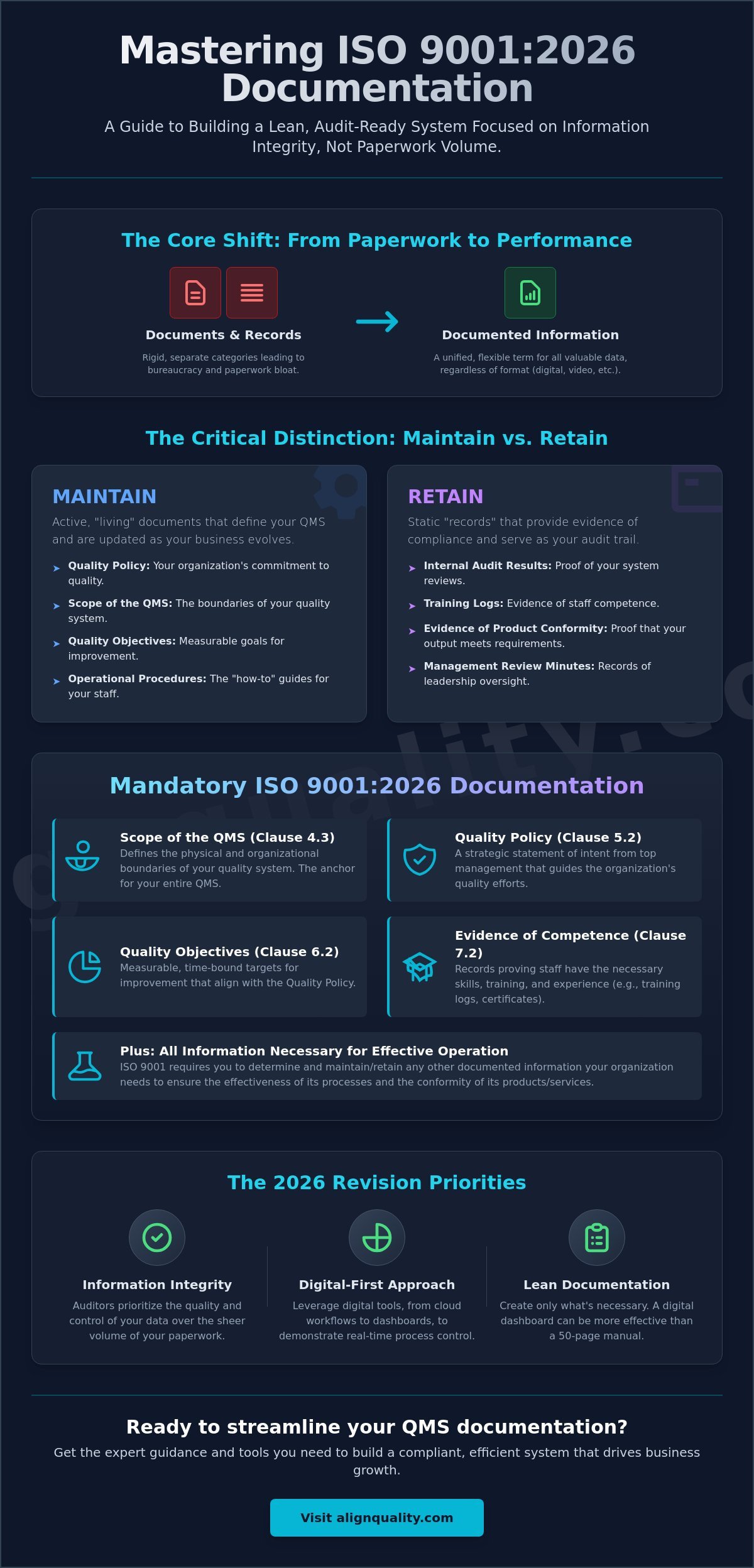
ISO 9001:2026 continues the evolution of the ISO 9000 family of standards by moving away from rigid, prescriptive paperwork. The standard uses “documented information” as a unified term. This replaces the older, separate categories of “documents” and “records.” This shift reflects a modern approach to business management. It recognizes that valuable information exists in many forms, from digital databases to cloud-based workflows. Your iso 9001 documentation requirements must now align with your organization’s specific context and strategic direction.
Your QMS should be a reflection of your unique business environment. It should account for your industry risks, your customer needs, and your internal culture. A small software firm will have vastly different documentation needs than a global manufacturing plant. The 2026 standard respects this diversity. It allows you to define what’s necessary for the effective operation of your processes without forcing unnecessary bureaucracy on your team.
ISO uses two specific instructions to guide your data management. Understanding these is the first step to a lean system. “Maintaining” documented information refers to the active, governing parts of your QMS. These are files you update as your business changes. They provide the “how-to” for your staff. For example, your Quality Policy is maintained to ensure it stays relevant to your current goals and market conditions.
“Retaining” documented information refers to records. These are snapshots in time that provide evidence of compliance. You don’t change these once they’re created. They serve as your audit trail. Distinguishing between these two prevents “paperwork bloat.” It ensures you only create what’s necessary to prove your system is effective. Consider these common examples:
The 2026 revision prioritizes system performance over the volume of paperwork. This update is noticeably technology-neutral. It doesn’t care if your procedures are in a PDF, a video, or a series of automated workflows. The goal is information integrity. Auditors now expect a digital-first approach. They look for real-time data that proves your processes are under control.
This shift allows for “lean” documentation. You don’t need a 50-page manual if a digital dashboard achieves the same result. A leaner system is easier to audit and simpler for your team to follow. It reduces the risk of missing a required update or failing to capture a critical record. By focusing on essential iso 9001 documentation requirements, you build a QMS that adds value. It becomes a tool for growth rather than a hurdle for compliance.
Navigating iso 9001 documentation requirements doesn’t have to be overwhelming. While the standard is less prescriptive than in the past, certain documents remain non-negotiable for certification. You must first define the Scope of the QMS. This document outlines the physical and organizational boundaries of your system. It’s often the first thing an auditor reviews to understand what your business actually does. Without a clearly defined scope, the rest of your quality system lacks a proper anchor.
Following the scope, you need a Quality Policy and Quality Objectives. These aren’t just wall decorations; they are strategic tools. The policy sets your organization’s intent, while objectives provide measurable targets for your team to hit. For a deeper look at ISO 9001:2015 requirements, industry leaders often point to the foundational principles of customer focus and leadership commitment. These documents must be communicated throughout your organization to ensure everyone is pulling in the same direction.
Evidence of competence is perhaps the most scrutinized area during an audit. You must prove that your staff has the necessary skills and training to perform their roles effectively. This means training records, certificates, and performance evaluations must be easily accessible and current. Finally, you must document your Internal Audit and Management Review processes. These records prove that leadership is actively engaged in the system’s health. They show that you are regularly checking your own performance and making strategic adjustments based on data.
Specific clauses mandate the retention of records to prove your system works as intended. Under Clause 7.1.5, you must maintain calibration records for any equipment used to measure product quality. Clause 8.2.3 requires records of customer requirement reviews before you commit to a sale. Finally, Clause 8.4.1 demands that you keep records of how you evaluate and monitor your external providers. If you aren’t sure where your current paperwork stands, our gap analysis checklist can help you identify any missing links before your next audit.
Your QMS must show it’s alive and evolving. Clause 9.1.1 requires you to document the results of monitoring and measurement activities. If things go wrong, Clause 10.2 mandates records of non-conformities and the actions taken to resolve them. Corrective action is the primary evidence of a maturing QMS. These records prove that you don’t just find mistakes, but you also take logical steps to prevent them from recurring. This demonstrates to auditors that your business is committed to continuous improvement rather than just basic compliance.
While the mandatory iso 9001 documentation requirements provide the skeleton of your system, non-mandatory documents add the muscle that makes your QMS actually work. Many organizations struggle with the transition because they assume “not mandatory” means “not necessary.” In reality, these optional items often prevent audit anxiety by providing the context that raw records lack. A Risk and Opportunity Register is a prime example. While the standard doesn’t explicitly demand a “register,” you must document how you address risks. A simple spreadsheet often serves as the most effective evidence of risk-based thinking during an audit.
Similarly, organizational charts are a powerful way to satisfy Clause 5.3. They visualize responsibility and authority far better than a wall of text. Understanding the Principles of ISO 9001, such as leadership and the engagement of people, becomes much easier when your team can see exactly where they fit in the corporate structure. These visual aids help auditors quickly verify that your management system is organized and that roles are clearly defined.
It’s a common misconception that you must have a Quality Manual. The ISO 9001:2015 and 2026 versions don’t require one. However, removing it entirely can leave auditors searching for a “map” of your system. Instead of a 100-page binder, consider a lean “Navigation Document.” This high-level summary points to your processes and shows how they interact. It helps clarify what it means to be ISO 9001 certified for your specific stakeholders without drowning them in unnecessary detail.
In 2026, text-heavy Standard Operating Procedures (SOPs) are becoming a relic. Video SOPs and flowcharts are often more effective for training and harder to misinterpret. Swimlane diagrams are particularly useful for complex workflows that cross multiple departments. They clearly show who is responsible for what at every stage of the process. This reduces the bureaucratic feel of your quality system and makes it more accessible to your staff.
If you choose visual documentation, you must still meet control requirements. This means your videos or diagrams need versioning and approval dates just like a traditional document. If you’re feeling overwhelmed by the volume of your current files, our gap analysis checklist can help you decide which documents to keep and which to cut to achieve a leaner system.
[rank_math_related_posts]Clause 7.5.3 outlines the core of information control within your QMS. It requires you to manage distribution, access, retrieval, and use of all documented information. In a digital environment, this means more than just a locked filing cabinet; it involves sophisticated permissions and secure cloud storage. Effective iso 9001 documentation requirements now demand that information is available where and when it’s needed while remaining protected from unauthorized changes. This ensures that your system remains a reliable source of truth for every employee in the organization.
The 2026 revision encourages a shift toward dynamic documentation. Instead of static PDFs that sit on a server, organizations increasingly use real-time data from ERP and CRM systems as audit records. This live data provides a more accurate picture of process health than a monthly report ever could. It satisfies the auditor’s need for evidence while reducing the manual effort of record-keeping. This transition allows your team to focus on quality outcomes rather than the administrative burden of manual data entry.
Managing AI-generated quality records involves more than just clicking save. The AI in the 2026 revision allows for predictive quality analytics, but you must validate these tools as part of your documented information control. Algorithmic transparency is a new requirement for digital QMS audits, necessitating that you can demonstrate the logic behind machine-led quality decisions. This validation proves to auditors that your automated records are as trustworthy and accurate as your manual ones.
Moving beyond V1 and V2 naming conventions is essential for modern compliance. Automated metadata now handles versioning, ensuring the latest version is the only one accessible to the shop floor or operational teams. This reduces the risk of non-conformities caused by staff using obsolete instructions. You must also address the retention of legacy digital records. Even when a process changes, you’re required to keep historical data for a set period to satisfy regulatory requirements and maintain a complete audit trail.
Cybersecurity is no longer just an IT concern; it’s a critical component of quality management. Ensuring data integrity in a cloud-based QMS is vital for protecting your intellectual property and your compliance status. If you’re unsure if your digital systems meet current iso 9001 documentation requirements, our gap analysis checklist offers a clear path to evaluating your information controls and identifying potential vulnerabilities.
Generic templates are a significant liability for modern businesses. They often include hundreds of pages of irrelevant procedures that don’t reflect how your team actually works. This mismatch creates “documentation debt,” where your staff ignores the formal QMS because it’s too bureaucratic or confusing. When your paperwork doesn’t match your reality, you’re at a high risk for audit non-conformities. At Align Quality, we replace this bloat with a methodical 5-stage process for custom documentation development. This approach ensures that your iso 9001 documentation requirements are met with precision while keeping your system as lean as possible.
Our 5-stage process begins with contextual discovery to understand your specific strategic direction. We then move through process mapping and drafting, ensuring that every workflow is validated before it’s integrated into your digital QMS. Finally, we perform a pre-audit validation to confirm that your system is robust enough to withstand external scrutiny. We focus on building a system that’s compliant, scalable, and actually useful for your daily operations. This structured path removes the guesswork and ensures that your quality framework supports your business goals instead of hindering them.
A successful transition to any new standard starts with knowing exactly where you stand. Our gap analysis checklist pinpoints the specific areas where your current system falls short of the 2026 standard. It identifies redundant procedures that you can safely delete to improve operational speed. We provide an “Audit-Ready” guarantee, ensuring every piece of information in your QMS serves a clear purpose. This methodical review removes the anxiety that often precedes a certification or surveillance audit. By identifying documentation debt early, you can streamline your workflows and reduce the time your team spends on manual record-keeping.
Engagement with our lead auditors provides a professional second opinion on your QMS structure. We help you prepare for the move from the 2015 version to the 2026 update with minimal disruption to your business. The 2026 revision is an evolution, not a total rebuild, and our expert guidance ensures you stay ahead of the three-year transition deadline. Start by evaluating your current files against the updated iso 9001 documentation requirements to see where you can simplify. Download the Ultimate ISO 9001 Gap Analysis Checklist to audit your current documentation today and begin your path toward a leaner, more effective quality management system.
Mastering the iso 9001 documentation requirements is no longer about the volume of your files; it’s about the accuracy and accessibility of your information. The 2026 revision emphasizes a technology-neutral approach that rewards lean, efficient systems over bureaucratic paperwork. By distinguishing between maintained and retained information and embracing digital workflows, you’ll create a QMS that drives real business value. This shift ensures your quality system remains a strategic asset rather than an administrative burden.
Align Quality is here to guide you through every stage of this evolution. Our team is led by certified ISO 9001 lead auditors who specialize in the 2026 revision and AI integration. We use a proven 5-stage certification process to ensure your documentation is both compliant and customized to your unique operational needs. Don’t let documentation debt or audit anxiety hold your business back from its full potential.
Take the first step toward a simplified, high-performing quality system today. Download the Ultimate ISO 9001 Gap Analysis Checklist to identify exactly what your system needs to succeed. With the right structure in place, you can face your next audit with total certainty and focus on growing your business with confidence.
ISO 9001:2026 doesn’t limit you to a specific count of documents, but it does mandate specific documented information. You must document the QMS scope, quality policy, and quality objectives. Additionally, you need records for competence, operational control, and management review results. These core elements are essential for meeting current iso 9001 documentation requirements and ensuring your system is ready for an external audit.
A formal Quality Manual is not mandatory in the ISO 9001:2026 revision. The standard transitioned away from this requirement in 2015 to allow for more flexible, technology-neutral systems. However, many organizations still use a lean navigation document or a high-level manual. This helps auditors and staff understand how the various parts of the QMS interact without creating unnecessary bureaucracy.
ISO 9001 doesn’t specify a universal retention period for records. You must determine the appropriate duration based on your industry regulations, legal requirements, and customer contracts. For example, aerospace or medical device firms often retain records for decades, while a service provider might choose three to five years. Your retention policy must be documented and consistently followed to satisfy audit criteria.
You can absolutely use digital signatures and cloud storage for your quality management system. The 2026 standard is technology-neutral and encourages digital-first documentation. You must ensure that your digital controls satisfy Clause 7.5.3 regarding protection from unauthorized changes, easy retrieval, and data integrity. Cloud-based systems often provide better version control and audit trails than traditional paper files or local servers.
Missing mandatory documentation typically results in a non-conformance finding during an audit. If the missing information is critical to the system’s operation, it’s often classified as a Major Non-conformance, which can delay your certification. Minor gaps usually require a corrective action plan to be submitted and verified. Regular internal audits are the best way to catch these gaps before an external auditor arrives.
ISO 9001 does not require a specific format for procedures or instructions. You’re free to use text-based SOPs, flowcharts, swimlane diagrams, or even video tutorials. The priority is that the information is clear, accessible, and controlled under your document management process. Choose the format that best suits your team’s learning style and the complexity of the task being documented.
You should review your documented information whenever significant changes occur in your processes, organization, or the standard itself. While the standard doesn’t set a hard deadline, many businesses perform an annual review to ensure everything remains accurate. This practice helps manage iso 9001 documentation requirements effectively by preventing the system from becoming obsolete or disconnected from your daily operations.
An organization chart is not a mandatory requirement for ISO 9001 certification. However, Clause 5.3 requires you to ensure that responsibilities and authorities for relevant roles are assigned, communicated, and understood. A chart is often the most efficient way to demonstrate this to an auditor. It provides a clear visual map of your structure that text descriptions often fail to capture effectively.