
What if your next surveillance audit was less about passing a test and more about future-proofing your entire quality management system? It’s a common feeling to view the annual audit as a stressful, compliance-driven hurdle. Many quality managers feel the pressure to simply maintain the status quo and avoid non-conformances, especially with the anticipated ISO 9001:2026 revision creating new uncertainties.
This guide changes that perspective. We provide a structured roadmap for preparing for your ISO 9001 surveillance audit with complete confidence. You will get a definitive checklist of ‘must-haves’ for your auditor, a clear strategy to demonstrate that your QMS is actively improving, and a practical plan to align with the 2026 requirements well ahead of schedule. Consider this your definitive plan for transforming the audit from a mandatory obligation into a powerful tool for strategic growth.
Key Takeaways
- A key part of preparing for an ISO 9001 surveillance audit is understanding its role as a mandatory annual review within the three-year certification cycle, not just a routine check-up.
- Understand the auditor’s “sampling” strategy for selecting departments; this is vital knowledge when preparing for an ISO 9001 surveillance audit, as core QMS processes are always inspected.
- A forward-thinking approach to preparing for an ISO 9001 surveillance audit involves using it as a gap analysis for the major themes of the upcoming 2026 revision.
- Implement a structured readiness roadmap that prioritizes closing previous audit findings and conducting targeted internal audits on processes not recently reviewed.
Understanding the ISO 9001 Surveillance Audit: More Than a Routine Check
After achieving your ISO 9001 certification, the journey doesn’t end. Your certification body will conduct mandatory annual reviews to ensure your Quality Management System (QMS) remains effective and compliant. These are known as surveillance audits. Viewing them as mere check-ins is a mistake; they are critical health checks for your QMS and a core part of preparing for your ISO 9001 surveillance audit with confidence.
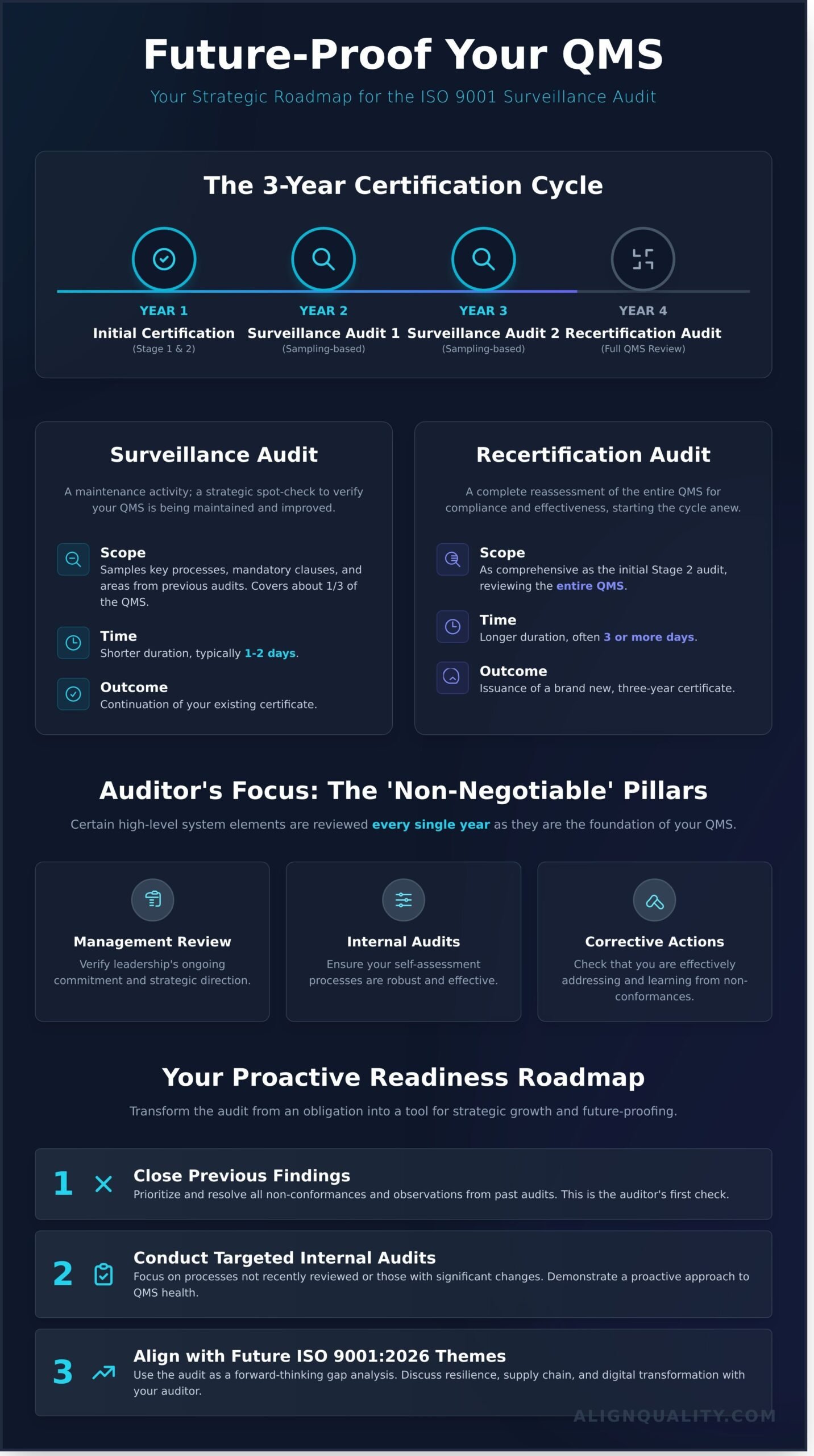
Your certification operates on a three-year cycle that looks like this:
- Year 1: Initial Certification Audit (Stage 1 and Stage 2)
- Year 2: Surveillance Audit 1
- Year 3: Surveillance Audit 2
- Year 4: Recertification Audit (begins the cycle anew)
Unlike the initial Stage 2 audit, which is a comprehensive, deep dive into every aspect of your QMS, a surveillance audit is sampling-based. An auditor won’t review every single process. Instead, they will select specific areas to verify that your system is being maintained and improved. Think of it as a trusted advisor performing a strategic spot-check. This process is designed to catch minor issues before they become systemic failures, saving you from costly rework and protecting the integrity of your certification.
The Purpose of Surveillance: Maintaining Your Quality Journey
The primary goal of a surveillance audit is to provide independent verification that your QMS continues to deliver on its promises. The auditor is there to confirm three key points:
- Continued Compliance: Your QMS must still meet all the requirements of the ISO 9001 standard. The auditor will check that your documented processes are being followed in practice.
- Effective Change Management: The audit verifies that you have effectively managed any changes since your last review. This includes changes to processes, personnel, or how you’re preparing for the upcoming ISO 9001:2026 revision.
- Achieving Objectives: Your QMS isn’t just for show. The auditor will look for evidence that it is achieving its intended results, such as improved customer satisfaction, reduced defects, and progress toward your quality objectives.
Surveillance vs. Recertification: Knowing the Difference
While both are audits, their scope and outcomes are distinct. Properly preparing for an ISO 9001 surveillance audit requires understanding these differences. A surveillance audit is a maintenance activity, while a recertification audit is a complete reassessment.
Key distinctions include:
- Scope: A surveillance audit samples key processes, mandatory clauses (like internal audits and management review), and areas from previous audits. A recertification audit is as comprehensive as your initial Stage 2 audit, reviewing the entire QMS for compliance and effectiveness. A great way to prepare for either is by using our Ultimate ISO 9001 Gap Analysis Checklist for a self-assessment.
- Time: Surveillance audits are shorter, typically lasting 1-2 days, as they cover about one-third of the QMS scope. Recertification audits are longer, often requiring 3 or more days to complete the full system review.
- Outcome: A successful surveillance audit results in the continuation of your existing certificate. A successful recertification audit results in the issuance of a brand new, three-year certificate.
The Scope of Surveillance: What Auditors Focus on in 2026
A surveillance audit isn’t a repeat of your initial certification. It’s a targeted verification, designed to confirm that your Quality Management System (QMS) is not just a certificate on the wall but a living, breathing part of your daily operations. Auditors operate on a sampling basis; they won’t review every single process each year. Instead, they select a representative sample of your QMS to assess its ongoing health and effectiveness.
Understanding this scope is the foundation of successfully preparing for your ISO 9001 surveillance audit. Over the three-year certification cycle, the auditor’s goal is to cover all key processes, ensuring the system maintains its integrity. In this sense, what it means to be ISO 9001 certified evolves. The first year is about building. The surveillance years are about proving your commitment to maintenance and continual improvement.
Mandatory Audit Areas: The ‘Non-Negotiables’
While auditors use a sampling strategy for operational processes, certain high-level system elements are reviewed every single year. These are the pillars of your QMS, and any weakness here suggests a systemic problem. Expect intense focus on the following:
- Management Review Minutes: Auditors need to see evidence that your leadership team is actively steering the QMS. They will verify that your reviews occur at planned intervals (at least annually), cover all required inputs like customer feedback and process performance, and produce clear, actionable outputs.
- Internal Audit Results: A healthy QMS finds its own problems. Auditors want to see a robust internal audit program that uncovers non-conformities. Having findings isn’t a failure; it’s proof your system works. Failing to find anything for 12 months can be a red flag.
- Corrective Actions: This demonstrates your ‘closed-loop’ process for problem-solving. Auditors will trace a non-conformity from its identification, through root cause analysis, to the implementation and verification of a corrective action. An open or overdue corrective action log is one of the fastest ways to receive a major non-conformity.
System Drift: Detecting and Correcting QMS Decay
System drift is the gradual, often unnoticed, gap that forms between your documented procedures and your actual practices. It happens when “how we do it” no longer matches “how the manual says we do it.” This is a primary concern for auditors because it undermines the reliability of the entire QMS. It erodes the very Benefits of ISO 9001 certification you worked to achieve.
Drift commonly appears in areas with high activity or turnover. For example, a new machine operator hired in Q1 2026 might be shown a shortcut by a coworker, bypassing a critical quality check defined in the work instruction. Or, a pressure gauge due for calibration on March 1st remains in service through May. These small deviations multiply over time, creating significant risk.
The most effective defense against system drift is proactive internal assessment. By regularly using tools like our ultimate ISO 9001 gap analysis checklist, you can spot these deviations before they become ingrained habits and long before an external auditor arrives. This disciplined approach is a core part of a mature QMS and a key element in preparing for an ISO 9001 surveillance audit with confidence.
Preparing for the ISO 9001:2026 Transition During Your Surveillance Audit
Your annual surveillance audit is more than a simple compliance check; it’s a strategic opportunity to look ahead. The upcoming ISO 9001:2026 revision represents the most significant update to the quality management standard in over a decade, with a planned focus on resilience, technology, and supply chain management. Proactive organizations are already using their current audits to gauge readiness, turning a routine requirement into a competitive advantage.
This forward-thinking approach is critical. As we move through 2025 and into 2026, auditors will begin to shift their focus from only checking past performance to probing your plans for the future. You can use this audit to perform an informal gap check against the emerging themes of the 2026 revision. While the final text is not yet published, confirmed topics include digital transformation and the impact of new technologies. For example, an auditor might ask how your QMS addresses data integrity from an AI-powered analytics tool. Answering this confidently demonstrates foresight. For leaders aiming to get ahead, our guide on AI’s impact on ISO 9001 provides a detailed roadmap. Don’t be surprised if your auditor begins asking “soft questions” about your transition plan during your next audit cycle.
Risk-Based Thinking in the 2026 Context
The 2026 revision is set to expand the definition of risk far beyond operational errors. Your risk-based thinking must evolve to account for emerging technological threats, such as cybersecurity vulnerabilities, and complex global supply chain disruptions. Your risk register can no longer be a static document reviewed once a year; it must be a living part of your operational management. Prepare your team to discuss these risks in plain English. Instead of just pointing to a document, they should be able to explain, “We identified a single-source supplier as a high risk due to geopolitical instability, so we’ve qualified a secondary supplier as a contingency.” This demonstrates a true risk management culture. For a foundational overview, the Ultimate Guide to ISO Audit Preparation offers excellent insights on communicating these complex topics effectively with an auditor.
Aligning with the ISO 9001:2026 News and Updates
Staying informed is the first step in a smooth and confident transition. It’s essential to regularly review authoritative sources for the latest developments. We consolidate all confirmed changes and expert analysis in our dedicated ISO 9001:2026 update news hub. Using your Year 2 surveillance audit to conduct a ‘pre-transition’ gap analysis is a highly effective strategy. This proactive step helps you identify potential non-conformities with the new standard well ahead of schedule, allowing for methodical implementation instead of a last-minute rush. The process of preparing for an ISO 9001 surveillance audit now includes looking at the road ahead, not just the rearview mirror. This new standard will continue to emphasize operational agility, and auditors will look for evidence that your QMS enables you to adapt quickly rather than being constrained by rigid documentation.
A Step-by-Step Roadmap for Surveillance Audit Readiness
A successful surveillance audit isn’t the result of a last-minute scramble. It’s the outcome of a structured, methodical process that begins weeks, or even months, in advance. This roadmap provides a clear, actionable framework for navigating the journey with confidence. Following these steps is the most effective way of preparing for your ISO 9001 surveillance audit and demonstrating your ongoing commitment to quality.
Your first action item is to review the report from your previous external audit. Auditors will almost certainly begin by verifying that all prior findings have been addressed. Pay close attention to any “Opportunities for Improvement” (OFIs). While not mandatory, addressing them shows a proactive commitment to your Quality Management System (QMS). An OFI from your 2023 audit that has been ignored can easily be escalated to a minor non-conformance this year.
Next, conduct a targeted internal audit. Don’t simply re-audit the same high-level processes. Instead, focus on the areas the external auditor didn’t sample last time. For example, if their last visit focused heavily on production and design, your internal audit should prioritize processes like purchasing, training, or management review. This strategic approach ensures comprehensive coverage and prepares your team for any direction the auditor might take.
Finally, organize your evidence and brief your team. An auditor’s time is valuable; making them wait 10 minutes while you search for a calibration record creates friction and projects an image of disorganization. Ensure all digital records are indexed and easily searchable, and physical documents are clearly labeled. Before the audit, hold a 30-minute briefing to remind staff that the audit is an evaluation of the process, not their personal performance. This simple meeting can significantly reduce team anxiety and lead to clearer, more confident interactions with the auditor.
Stage 1: The Pre-Audit Document Scrub
Your documented information is the backbone of your QMS. Before the audit, perform a thorough review to ensure everything is current and controlled. Key verification steps include:
- Quality Policy: Confirm it is still relevant to your organization’s strategic direction and has been effectively communicated. The auditor may ask any employee to explain it in their own words.
- External Documents: Check that you are using the current versions of all external standards, customer specifications, and statutory regulations. Using an outdated standard like ISO 9001:2008 instead of the 2015 version would be an immediate finding.
According to the latest 2026 guidance, ‘document control’ is the systematic management of documented information to ensure its availability, suitability, and protection from unintended alteration throughout its lifecycle.
Stage 2: Managing Findings and Non-Conformities
Understanding the types of audit findings is crucial. A Minor Non-Conformance is typically a single, isolated lapse in following a procedure, like one missing training record. A Major Non-Conformance represents a systemic failure, such as the complete absence of a required process, that jeopardizes the integrity of the QMS. For a deeper dive into corrective actions, consult our comprehensive guide to findings, fixes, and prevention.
If you uncover a gap during your preparation, don’t hide it. Immediately open a corrective action request (CAR), document your containment plan, and begin root cause analysis. Presenting this proactive improvement plan to the auditor demonstrates ownership and the effectiveness of your QMS. It turns a potential negative into a powerful positive. To ensure you haven’t missed a single detail in your preparation, download our Ultimate ISO 9001 Gap Analysis Checklist and identify potential issues before your auditor does.
Maintain Your Certification with Confidence: The Align Quality Approach
The annual surveillance audit doesn’t have to be a source of stress. We see it as an opportunity to validate and strengthen your Quality Management System (QMS). Align Quality transforms the entire cycle, turning compliance from a yearly scramble into a continuous, manageable process. Our approach is designed to remove uncertainty from the journey of preparing for iso 9001 surveillance audit, ensuring you’re always ready and always improving.
Maintaining momentum between audits is the key to success. Our comprehensive ISO 9001 definitive guide serves as a year-round reference for your team, keeping best practices top of mind. But a guide alone isn’t enough. Your internal team is often too close to the daily processes to spot slow, incremental “process drift.” Our Certified Lead Auditors provide the essential ‘outside eyes’, identifying minor deviations before they escalate into non-conformities during an official audit.
This expert oversight is built into our proven 5-Stage Process. It acts as the ultimate safety net for your certification. It’s a methodical framework that ensures nothing is missed, from initial review to continuous improvement, giving you a clear and predictable path to audit success, year after year.
Why a Professional Gap Analysis is Your Best Defense
Self-assessments are valuable, but they have inherent limitations. It’s human nature to overlook our own systematic errors or inconsistencies. A professional gap analysis provides an objective, impartial evaluation of your QMS against the ISO 9001 standard. This external validation not only speeds up the registrar’s audit by presenting a well-prepared system, but it also builds immense confidence. For example, a UK-based manufacturing client recently turned a potential Major Non-conformity in their document control process into a success story. Our analysis identified the risk, and by implementing our recommendations, they not only cleared the audit but also reduced document retrieval times by 40%.
Your Next Step: The Ultimate ISO 9001 Gap Analysis Checklist
A reactive approach to audits leads to stress and risk. Being proactive is the only way to maintain control and drive real value from your QMS. Take the first step today. Download our Ultimate ISO 9001 Gap Analysis Checklist to get a clear, actionable framework for your internal review. This tool is essential not just for your next audit, but for securing a smooth transition to the upcoming 2026 revision.
Let us provide the expert guidance and proven structure you need. Achieve and maintain your ISO 9001 certification with confidence.
Maintain Your Certification with Confidence
Your surveillance audit isn’t just a formality; it’s a critical opportunity to prove your ongoing commitment to quality and continuous improvement. The key to success lies in understanding that auditors in 2026 will scrutinize your progress toward the new standard and your system’s overall effectiveness. A structured, proactive approach is the most effective strategy when preparing for your ISO 9001 surveillance audit.
This journey to compliance doesn’t have to be complex. At Align Quality, you’re supported by Certified ISO 9001 Lead Auditors who are specialists in the 2026 transition requirements. Our proven 5-stage success process removes uncertainty and streamlines your preparation, ensuring you’re not just ready, but ahead of the curve.
To take the first decisive step, identify exactly where your QMS stands today. Our comprehensive guide is the perfect tool for this. Download the Ultimate ISO 9001 Gap Analysis Checklist to begin your gap analysis and walk into your next audit fully prepared. You have the framework for success; now you can move forward with clarity.
Frequently Asked Questions About ISO 9001 Surveillance Audits
What happens if we fail an ISO 9001 surveillance audit?
Failing an ISO 9001 surveillance audit does not result in the immediate loss of your certification. Instead, the auditor will issue non-conformities and provide a set timeframe, typically between 30 and 90 days, for you to submit a corrective action plan. Your certification is usually suspended, not revoked, while you provide evidence that you have effectively addressed the root cause of the findings. The key is to respond promptly and thoroughly to the auditor’s report.
Can a surveillance audit result in the loss of our ISO certification?
Yes, a surveillance audit can result in the loss of certification, but only under specific circumstances. This typically occurs if a major non-conformity is not resolved within the mandated 90-day period or if the audit reveals a complete breakdown of the quality management system. Before revoking a certificate, the certification body will almost always issue a suspension. This serves as a final warning and provides one last opportunity to implement the necessary corrective actions to save your certification.
How much time should we spend preparing for a surveillance audit?
Effective preparation should be a year-round activity, but focused efforts should begin 4 to 6 weeks before the audit. This timeframe allows your quality team to conduct a final internal audit, hold a management review meeting, and ensure all previous corrective actions have been closed. This structured approach is a critical component when preparing for an ISO 9001 surveillance audit and helps ensure your team is organized and confident on the day of the assessment.
Is an internal audit required before every surveillance audit?
Yes, conducting internal audits at planned intervals is a mandatory requirement of the ISO 9001:2015 standard. To maintain compliance, you must complete a full internal audit of your Quality Management System (QMS) at least once within your 12-month surveillance cycle. This practice is essential for continuous improvement. It allows you to identify and fix potential issues before your external auditor finds them, demonstrating the maturity and effectiveness of your QMS.
How do the ISO 9001:2026 changes affect my current surveillance cycle?
The upcoming ISO 9001:2026 revision will not impact your current surveillance audits until after its official publication. Once released, the International Accreditation Forum (IAF) will define a formal transition period, which is typically three years. During that time, your audits will assess your plan to adopt the new requirements. For now, your QMS should continue to be audited against the current ISO 9001:2015 version. Stay informed about the transition to ensure a smooth journey.
Can we change our certification body during the surveillance period?
Yes, you are permitted to transfer your ISO 9001 certification to a different certification body (CB) during your three-year cycle. The process involves an application with the new CB, who will review your current certificate’s validity and any outstanding audit findings. A transfer audit may be required to confirm your system’s compliance before they officially take over the certification. It’s important to coordinate carefully to prevent any lapse in your certified status.
What is the difference between a minor and major non-conformity in a surveillance audit?
A major non-conformity represents a significant failure in your QMS, such as the complete absence of a required process like management reviews. A minor non-conformity is an isolated lapse, like a single training record that is out of date. While you must address both with corrective action, a major non-conformity must be resolved and verified before your certification can be maintained. Multiple minor findings related to the same clause can be elevated to a major one.